 GlassBottleSupplies












Sales manager will contact you within 24 hours
Why Top Labs Standardize on 100ml Wide Mouth Amber Reagent Bottles
In the precise world of chemical storage, the vessel is as critical as the solvent. When sourcing a reagent bottle laboratory setup, procurement officers often default to standard specifications without questioning the underlying material science.
But before we list the benefits of a reagent glass bottle 100ml, we must apply a critical filter: Is a “lab-grade” bottle actually suitable for aggressive reagents just because it is made of glass?
The answer is often no. Not all glass is created equal, and not all “amber” offers protection. This guide dissects the technical reality of selecting the correct glass bottle reagent packaging, specifically focusing on the industry workhorse: the 100ml wide mouth amber variant.
The Material Hierarchy: “Glass” is Not a Specification
Many suppliers label their products simply as “glass.” In the glass bottle supplies industry, this is insufficient. A standard soda-lime glass bottle may suffice for simple powders, but it will fail catastrophically under thermal shock or acidic attack.
Borosilicate 3.3 vs. Soda-Lime
For a professional reagent glass bottle 100ml, the industry gold standard is Borosilicate 3.3 glass (often referred to by trade names like Pyrex or Duran, though the material itself is the key).
- Thermal Expansion: Borosilicate 3.3 has a very low coefficient of thermal expansion ($\alpha \approx 3.3 \times 10^{-6} K^{-1}$). This means it can survive the autoclave cycles (121°C / 15 psi) required for sterile lab environments without cracking.
- Chemical Resistance: It falls under Hydrolytic Class 1. Unlike cheaper soda-lime glass, it does not leach alkali ions (sodium/calcium) into the stored reagent, which is vital for maintaining the purity of high-grade analytical standards.
Check this before buying: Ask your supplier for the hydrolytic resistance certificate. If they cannot provide it, the bottle is likely standard flint glass, unsuitable for long-term reagent storage.
The Amber Myth: Solid vs. Sprayed
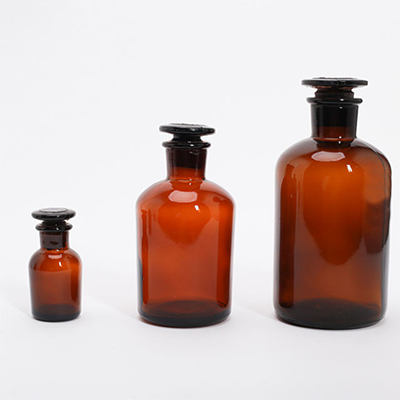
When sourcing an amber reagent bottle, a critical question arises: Is the glass inherently amber, or is it clear glass that has been surface-treated?
- True Amber Glass: The coloration is achieved by adding iron, sulfur, and carbon to the molten glass batch. This filters out ultraviolet (UV) light, typically up to 500nm. This is permanent and chemical resistant.
- Sprayed/Coated Amber: Some manufacturers cut costs by spraying a coating onto clear bottles. While this blocks light initially, solvents (like Acetone or Dichloromethane) can strip this coating, or it can scratch off during handling, compromising photosensitive chemicals like Silver Nitrate.
Verdict: For professional laboratory use, you must specify “Solid Amber Glass” (Type III or Borosilicate colored).
The Ergonomics of the Wide Mouth Reagent Bottle
Why is the wide mouth reagent bottle specifically trending in 100ml formats?
The “100ml” volume is a “Goldilocks” size—large enough for stock solutions but small enough for benchtop use. However, the neck finish dictates utility.
- Viscous Fluids & Powders: A GL45 (45mm thread) or wide-mouth ground neck allows for the easy insertion of spatulas and pipettes. Standard narrow necks (GL25 or GL32) create airlocks when pouring viscous liquids (like Glycerol), leading to dangerous glugging and splashing.
- Cleaning Validation: In GMP environments, bottles must be cleaned. A wide mouth ensures that spray balls or brushes can reach the shoulder of the bottle, ensuring no residue remains.
Cap Technology: The Weakest Link
A glass bottle reagent container is only as good as its seal. The bottle body may last decades, but the cap determines the shelf life of the content.
- Polypropylene (PP): Standard blue caps. Autoclavable up to 140°C. Good for most aqueous solutions.
- PBT (Red Caps): Polybutylene terephthalate. Withstands higher temperatures (up to 180°C) and offers superior resistance to aggressive chemicals compared to PP.
- PTFE Liners: For highly volatile organic solvents, a simple plastic cap is insufficient. You require a cap with a PTFE (Teflon) disc liner to ensure an inert seal that prevents solvent evaporation.
Real Product Case Study: The Silver Nitrate Failure
To illustrate the importance of these specifications, let’s look at a real-world scenario from our client archives (anonymized).
The Client: A mid-sized chemical reagent manufacturer supplying educational labs.
The Problem: The client was selling 50g of Silver Nitrate (AgNO3) crystals in 100ml amber glass bottles. After 3 months, customers complained that the crystals were turning grey/black (evidence of photoreduction) and the plastic caps were becoming brittle and cracking.
The Investigation (First ask Is it true?):
- Was the glass amber? Yes, but upon scratch testing, it was revealed to be sprayed amber coating on soda-lime glass. The coating was thin and had micro-scratches from the filling line, allowing UV light to degrade the silver nitrate.
- Why were caps cracking? Silver nitrate is an oxidizer. The client was using standard LDPE liners which were reacting slowly with the chemical dust.
The Solution:
We transitioned the client to a True Amber Borosilicate 3.3 Wide Mouth Reagent Bottle.
- Material: Solid amber glass blocked UV light effectively, stopping the degradation.
- Format: The wide mouth allowed for automated filling of the crystal powder without spillage (reducing waste).
- Closure: We implemented a PBT cap with a PTFE-faced silicone liner. The PTFE provided an inert barrier against the oxidizer.
The Result: Product returns dropped to near zero. The shelf-life guarantee on their datasheet was extended from 12 months to 24 months, allowing them to command a higher market price.
Procurement Checklist: Reagent Bottle Laboratory
If you are sourcing a reagent glass bottle 100ml, use this checklist to ensure you are getting professional grade ware:
- Wall Thickness Uniformity: Cheap bottles have thin corners (bottom radius) which break easily. High-quality reagent bottles have a controlled wall thickness (usually >1.5mm for 100ml size).
- Graduation Accuracy: While not volumetric instruments, the white enamel graduations should be resistant to acid and accurate to within ±5%.
- Pouring Ring: Does the bottle come with a drip-free pouring ring? This plastic insert on the neck prevents hazardous drops from running down the outside of the glass.
- Flatness of Base: The bottle must sit flat on a scale without wobbling. Rocking bottles leads to weighing errors.
Conclusion
The humble reagent bottle laboratory container is a sophisticated piece of engineering. Whether you require a wide mouth reagent bottle for powders or an amber reagent bottle for light-sensitive liquids, the decision must be based on material science, not just aesthetics.
At Glass Bottle Supplies, we understand that for our clients in the chemical and cosmetic sectors, the packaging is part of the product quality.