 GlassBottleSupplies












Sales manager will contact you within 24 hours
Top Chemical Reagent Bottles: What You Must Know About Storage Safety
In the glass manufacturing industry, the distinction between a standard container and a chemical reagent bottle is not just about shape; it is about the molecular integrity of the glass and the precision of the closure. Whether used in a high-stakes university laboratory or for storing concentrated active ingredients in the cosmetic supply chain, the vessel you choose dictates the shelf life and purity of the liquid inside.
This guide delves into the manufacturing standards, material science, and functional design of the modern chemistry reagent bottle, helping B2B buyers distinguish between generic glassware and industrial-grade storage solutions.
The Material Core: Borosilicate 3.3 vs. Soda-Lime
When sourcing a reagent bottle chemistry professional will tell you that the substrate is the first line of defense. Not all clear glass is created equal.
Borosilicate 3.3 Glass (The Gold Standard)
For the highest tier of chemical reagent bottles, Borosilicate 3.3 is the mandatory specification. Unlike standard glass, this material is engineered with a low coefficient of thermal expansion ($3.3 \times 10^{-6} K^{-1}$).
- Thermal Shock Resistance: It can withstand drastic temperature changes, allowing the bottle to be moved from a cold storage environment (like a refrigerator for unstable cosmetic peptides) directly to room temperature without cracking.
- Chemical Inertness: It possesses a high hydrolytic class (Class 1). This means the glass does not leach alkali ions into the reagent. For analytical chemistry or high-purity cosmetic serums, this is non-negotiable to prevent pH shifts in the stored liquid.
Soda-Lime Glass
Standard soda-lime glass is often used for powders or less aggressive chemicals. While more affordable, it has a higher expansion coefficient. We generally recommend soda-lime only for dry chemistry reagent bottle applications where heat sterilization (autoclaving) is not frequently required.
The Anatomy of a Reagent Bottle with Screw Cap
The traditional ground-glass stopper has largely been replaced in modern logistics by the reagent bottle with screw cap. This shift is driven by the need for transport safety and airtight seals.
The GL Thread Standard
The industry standard for these bottles is the GL thread system, with GL45 being the most prevalent for bottles ranging from 100ml to 10L.
- Why GL45? The “45” refers to the outer diameter of the thread (45mm). This wide mouth design allows for easy filling of viscous liquids (like glycerin or cosmetic bases) and easy cleaning.
- Torque Retention: A properly manufactured glass thread must be molded with precision to ensure that when the cap is torqued, it does not “jump” the thread or loosen during vibration in transit.
Polypropylene (PP) vs. PBT Caps
Not all plastic caps can survive the autoclave.
- Blue PP Caps: Standard for chemical reagent bottles. They are autoclavable up to $140^\circ C$.
- Red PBT Caps: Used for dry heat sterilization up to $180^\circ C$.
- The Liner: A reagent bottle with screw cap is only as good as its liner. High-end applications utilize a PTFE (Teflon) faced silicone liner. This ensures that aggressive solvents never touch the plastic cap, only the inert PTFE.
Amber vs. Clear: Photochemical Considerations
In the reagent bottle chemistry sector, light is an enemy to stability.
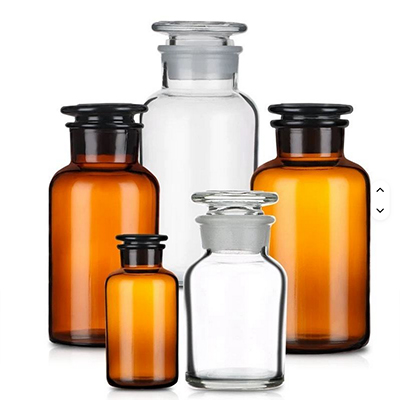
- Clear (Flint) Glass: Used when visibility of the contents is paramount and the chemical is stable under UV light. It facilitates easy visual inspection of turbidity or color changes.
- Amber Glass: This is not a surface coating; the color is achieved by adding iron, sulfur, and carbon to the glass melt. True amber glass blocks UV radiation up to approximately 500nm. This is critical for light-sensitive chemicals (like Silver Nitrate) or photosensitive cosmetic ingredients (like Vitamin C esters or Retinol).
Manufacturing Precision: Wall Thickness and Uniformity
A cheap bottle fails under pressure. During the manufacturing process of a chemistry reagent bottle, the distribution of glass (gob) during the blow-molding phase is critical.
If the wall thickness is uneven, the bottle creates stress points. When such a bottle is pressurized or heated, it will shatter at the thinnest point. High-quality reagent bottles undergo “annealing,” a process of slowly cooling the glass to relieve internal stresses formed during molding. As a manufacturer, we adhere to strict ISO 4796-1 standards to ensure uniform wall thickness, particularly at the “heel” (the bottom corner) of the bottle, which bears the most mechanical load.
Case Study: The “Leaking Solvent” Solution
Client: A mid-sized distributor of botanical extracts and essential oils (serving both lab and cosmetic sectors).
The Problem: The client was importing “standard” pharmaceutical syrup bottles to store high-concentration d-Limonene (a powerful solvent found in citrus oils) and specific chemical reagents. They faced two major issues:
- Cap degradation: The aggressive oils were eating through the standard EPE liners of the generic caps.
- Leakage during shipping: The standard bottle threads were not deep enough, causing caps to back off during air freight due to pressure changes.
The Solution:
We transitioned the client to a reagent bottle with screw cap (GL45 specification) made of Borosilicate 3.3 glass.
- Chemical Resistance: We implemented a Pouring Ring design integrated into the neck. This prevents drops of liquid from running down the outside of the bottle, protecting the label and safety information.
- The Seal: We utilized a one-piece Polypropylene cap with a chemically bonded PTFE face. The d-Limonene could no longer interact with the liner or the plastic.
- Pressure Equalization: The GL45 thread depth provided a secure locking mechanism that withstood the pressure differential of air cargo.
The Result: Leakage rates dropped to near zero ($<0.01\%$). The client marketed the new packaging as a “Premium Lab-Grade Protection” feature, allowing them to increase the unit price of their raw materials by 15% due to the perceived (and actual) increase in storage quality.
Technical Specifications for B2B Buyers
When ordering chemical reagent bottles, you should request the following data sheet parameters to ensure you are getting industrial quality:
| Parameter | Specification | Why it matters |
| Material | Borosilicate Glass 3.3 | Thermal shock resistance and hydrolytic stability. |
| Thread Type | GL45 / GL80 | Standardized compatibility with HPLC machines and auto-titrators. |
| Cap Material | PP (Polypropylene) | Autoclavable at $121^\circ C$ or $140^\circ C$. |
| Gasket/Seal | PTFE (Teflon) | Maximum chemical inertness. |
| Graduations | Fired-on Enamel | Paint that does not wash off with Acetone or Ethanol. |
| ISO Standard | ISO 4796-1 | Guarantees dimensional accuracy. |
Why the “Graduation” Matters in Reagent Bottle Chemistry
You will notice that a professional chemistry reagent bottle has white marking scales. These are not just printed ink; they are ceramic enamel paints fired onto the glass surface during the annealing process.
Whether in a lab mixing a solution or a cosmetic factory compounding a trial batch, the user relies on these markings for approximate volume estimation. Cheap bottles use low-temperature ink that dissolves when wiped with ethanol. Our bottles utilize high-temperature cured enamel that resists acid, alkali, and organic solvent cleaning cycles.
FAQ: Common Questions on Reagent Glassware
Q: Can I freeze liquids in a reagent bottle with screw cap?
A: Yes, provided the glass is Borosilicate 3.3. However, you must freeze the bottle at a 45-degree angle (slanted) with the cap loose. Water expands when freezing; if the bottle is upright and full, the expansion will shatter even the strongest glass.
Q: What is the difference between a Media Bottle and a Reagent Bottle?
A: In the industry, they are often used interchangeably. However, “Media Bottles” almost always refer to the GL45 screw cap style designed for autoclaving culture media. “Reagent Bottles” can sometimes refer to the older narrow-mouth ground-glass stopper style, though the trend is shifting heavily toward the reagent bottle with screw cap for versatility.
Q: Why do some reagent bottles have a plastic ring on the neck?
A: That is a “drip-free pouring ring.” It snaps onto the lip of the bottle. When you pour hazardous acids or expensive oils, the ring catches the last drop that would otherwise run down the side of the bottle, preventing damage to the workbench or the label.
Conclusion
Selecting the right chemical reagent bottles is a balance of chemical compatibility, thermal endurance, and seal integrity. For businesses dealing with high-value liquids—whether they are laboratory reagents or concentrated cosmetic formulations—the vessel is an insurance policy for the product inside.
At GlassBottleSupplies.com, we understand that a bottle is not just a container; it is a precision engineering component. By utilizing Borosilicate 3.3 glass and advanced reagent bottle with screw cap designs, we ensure that your product remains as pure as the day it was manufactured.
If you are unsure which glass type or cap liner suits your specific chemical solvent or essential oil, contact our technical team for a compatibility assessment.