 GlassBottleSupplies









Sales manager will contact you within 24 hours
Why Precision-Engineered Square Nail Polish Bottles Define Modern Manicure Brands
In the competitive landscape of the beauty industry, the tactile experience of a product often precedes the quality of the formula itself. For brand owners and manufacturers, the selection of an empty nail polish bottle is not merely a logistical choice; it is a structural commitment to brand identity and chemical stability. As professional salons shift toward light-sensitive formulations, the demand for high-performance gel bottle nail polish solutions has surged, forcing a re-evaluation of how glass density and geometry affect shelf life.
1. The Geometry of Luxury: The Rise of Nail Polish in Square Bottle Design
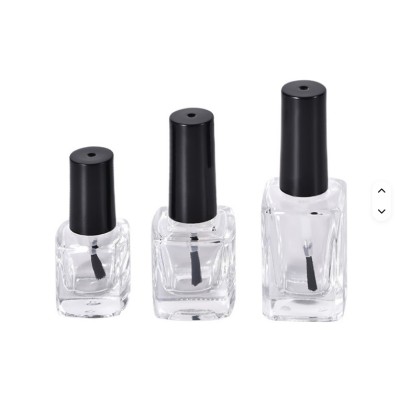
While round bottles are traditional, the nail polish in square bottle format has become the industry standard for “prestige” lines. But beyond the visual appeal, why do leading brands prefer this shape?
Space Efficiency and Logistics
From a wholesale perspective, square nail polish bottles offer superior volumetric efficiency. In a shipping carton, square geometries eliminate the “dead space” inherent between cylindrical vessels. This 15-20% increase in packing density directly reduces the carbon footprint and shipping cost per unit—a critical factor for global distribution.
Stability and User Experience
The center of gravity in a square bottle is typically lower and more distributed. For nail technicians, this means a lower risk of tipping the bottle during a busy service. Furthermore, the flat surfaces of a square nail polish bottle provide a superior canvas for high-definition silk-screening and hot stamping, ensuring that branding remains legible even on a 10ml or 15ml vessel.
2. Technical Material Science: Beyond the Empty Nail Polish Bottle
To understand why one empty nail polish bottle costs $0.10 and another costs $0.40, we must look at the glass chemistry.
UV Shielding in Gel Bottle Nail Polish
Gel bottle nail polish requires absolute opacity. Since gel formulas are cured by UV light, even 1% light leakage can cause premature polymerization (clumping) inside the bottle. High-end manufacturers utilize two primary methods for protection:
- Internal Pigmentation: Integrating black or deep amber colorants directly into the molten glass batch.
- Triple-Coat Lacquering: Applying a base coat, a UV-blocking mid-coat, and a decorative top-coat to a clear glass base.
At glassbottlesupplies.com, we prioritize the “Double-Dip” coating process for our gel bottle nail polish range to ensure that zero UV radiation reaches the photo-initiators in the formula.
The Annealing Cycle and Stress Points
Square corners are natural stress points in glass manufacturing. A poorly annealed nail polish in square bottle will have “thin shoulders”—areas where the glass is significantly thinner than the base. We utilize polariscopes to inspect the “birefringence” of our bottles, ensuring that the internal stress is neutralized, making the bottle resistant to the high-pressure capping machines used in automated filling lines.
3. The Anatomy of the Brush and Cap Assembly
An empty nail polish bottle is a system, not just a jar. The interaction between the neck finish and the brush determines the product’s success.
- DuPont Nylon Filaments: We source filaments that maintain their “memory,” ensuring the brush doesn’t splay after the first use.
- Stem Length Precision: In a square nail polish bottle, the brush must reach the bottom corner. We customize stem lengths to within +/- 0.2mm to minimize product waste (the “dead volume” at the bottom).
- Wiper Fit: The neck of the bottle must have a perfectly calibrated inner diameter to “wipe” excess polish from the stem without causing air bubbles in the formula.
4. Product Case Study: The “Obsidian” Series for Luxe-Gel Korea
The Client: A leading professional gel manufacturer in Seoul, South Korea. The Requirement: A 15ml gel bottle nail polish that felt significantly heavier than market standards, with a unique square profile that wouldn’t roll off salon trolleys.
Our Engineering Process:
- Glass Weight Distribution: We increased the base thickness to 5mm. This added 12g of weight to each empty nail polish bottle, instantly elevating the “hand-feel” to a luxury tier.
- The “Click-Lock” Cap: We engineered a custom inner-cap thread that provides a tactile “click” when sealed, preventing the common issue of solvent evaporation in square nail polish bottles.
- Light-Proof Testing: The bottles were subjected to 48 hours of intense UV exposure. The viscosity of the internal gel remained unchanged, proving 100% UV filtration.
The Result: The client reported a 22% increase in repeat orders from salon professionals, who cited the “premium weight” and “leak-proof design” as their primary reasons for switching brands.
5. Manufacturing Standards: ISO and Beyond
When sourcing nail polish in square bottle wholesale, you must ask your supplier for their quality control protocols. Our facility adheres to:
- Vertical Load Testing: Ensuring the bottle can withstand the pressure of industrial capping.
- Thermal Shock Resistance: Critical for brands that ship to climates with extreme temperature fluctuations.
- Lead-Free Certification: Ensuring the glass and the exterior coatings are 100% safe for consumer contact.
6. Sourcing Wholesale: The Strategic Advantage
Buying wholesale nail polish bottles is a balance of MOQ (Minimum Order Quantity) and customization. While a standard empty nail polish bottle is readily available, the market is moving toward “custom-stock.” This means using a standard mold but applying unique secondary finishes like:
- Soft-Touch Matte: A rubberized coating that provides grip.
- Electroplating: A metallic mirror finish in gold, rose gold, or chrome.
- Acid Frosting: Creating a translucent, “ice-like” appearance for spring collections.
7. Deep Dive: Why “Cheap” Glass Costs More
Is there a difference in square nail polish bottles from different suppliers? Absolutely. “Economy” glass often uses a higher percentage of “cullet” (recycled glass) without proper purification. This results in “seeds” (tiny air bubbles) and “stones” (unmelted raw material). In a gel bottle nail polish, a “stone” in the glass creates a weak point that can shatter under the heat of a shrink-wrap tunnel. Investing in virgin-grade soda-lime glass ensures your production line runs at 100% efficiency without costly downtime due to breakage.
8. Summary for Brand Founders
If you are launching a nail line in 2025, your checklist for an empty nail polish bottle should be:
- Shape: Does the nail polish in square bottle align with my brand’s shelf presence?
- UV Protection: If it’s a gel, is the coating thick enough to pass a 72-hour light test?
- Sustainability: Is the glass recyclable? Are the inks eco-friendly?
- Tolerance: Does the cap fit perfectly every time to prevent solvent loss?
Conclusion
The evolution of the empty nail polish bottle reflects the sophistication of the modern beauty consumer. By choosing high-quality square nail polish bottles, brands protect their chemical integrity while providing a superior aesthetic experience. Whether you are seeking gel bottle nail polish vessels or traditional lacquer containers, the engineering behind the glass is what will ultimately sustain your brand’s reputation.