 GlassBottleSupplies












Sales manager will contact you within 24 hours
The Technical Engineering and Sealing Physics of High-Performance Glass Roller Bottles
In the high-stakes world of cosmetic packaging, the glass roller bottles format is often unfairly labeled as “prone to leakage.” However, a professional analysis of the packaging assembly reveals that failure is rarely a result of the format itself, but rather a failure of engineering tolerances. For a brand, selecting the right roll on bottles is not an aesthetic choice—it is a decision that dictates product shelf-life, consumer safety, and brand reputation. When a customer uses a roller ball bottles system, they expect a consistent, controlled release of liquid, free from “glitches” or messy overflows.
First Question: Are Roller Bottles Inherently Flawed?
Before we ask why some roller bottles fail, we must first follow the principle of: “Is it true that the roller system is naturally prone to leaking?”
The answer is no. In the pharmaceutical and laboratory sectors, the roller system (or “ball-and-socket” delivery) is considered one of the most efficient ways to apply concentrated liquids. The “leaking” reputation associated with glass roller bottles in the consumer market is almost exclusively due to “Neck Ovality”—a manufacturing defect where the bottle neck is not a perfect circle. If the neck is even slightly elliptical, the plastic fitment cannot create a 360-degree airtight seal. Therefore, the “Why” of a leaking bottle is usually found in the “How” of the glass molding process.
The Physics of the Fluid Seal in Roll On Bottles
To engineer a superior roll on bottles experience, one must understand three physical forces: Capillary Action, Surface Tension, and Atmospheric Pressure.
1. The Capillary Gap
The space between the ball and the housing in roller ball bottles is called the “capillary gap.” If this gap is too wide, the liquid will flow out via gravity. If it is too narrow, the ball will seize. Professional-grade glass roller bottles use a “floating ball” design where the liquid itself acts as a lubricant, allowing the ball to glide over the housing surface without friction.
2. The Vacuum Effect
When you seal a roller ball bottles unit, a small amount of air is trapped inside. If the bottle is high-quality, it creates a slight vacuum when the liquid is dispensed. This vacuum helps pull the ball back into the “seat” of the fitment when not in use, providing a secondary seal. Cheaply made roller bottles lack the precision to maintain this internal pressure, leading to “dripping” during use.
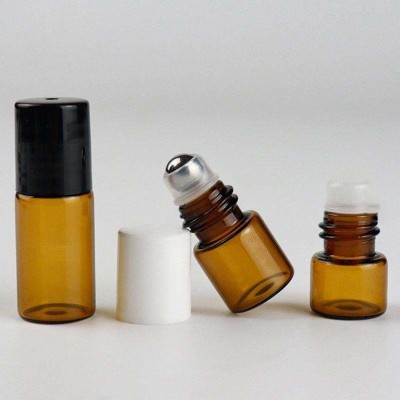
Material Engineering: Beyond the Glass Surface
While the glass is the star of the show, the success of glass roller bottles depends on the interplay between three distinct materials:
| Component | Common Material | Technical Requirement |
| Vial Body | Type III Soda-Lime Glass | Must have a high “Vertical Crush Strength” to withstand fitment insertion. |
| The Ball | Grade 100 Stainless Steel | Must be perfectly spherical to ±0.001mm to prevent “stuttering.” |
| The Fitment | LDPE (Low-Density Polyethylene) | Must have specific “Elastic Memory” to return to its shape after being compressed into the neck. |
Why Glass Chemistry Matters
For many essential oil brands, the “Hydrolytic Resistance” of the glass roller bottles is paramount. Essential oils can be chemically aggressive. If the glass has too much “free alkali” on the surface, the oils can react with the glass over time, creating a cloudy residue or even altering the scent profile of a perfume. We ensure our roll on bottles undergo an optimized annealing process to minimize surface alkalinity.
Case Study: The “Luxe-Scent” Integrity Project
Client: Luxe-Scent, a premium botanical perfume house.The Challenge: Luxe-Scent was launching a $120 “Pocket Parfum” line. They initially used 10ml glass roller bottles from a generic wholesaler. During their 40°C stability testing, they found that the perfume was evaporating through the fitment at a rate of 3% per month. For a high-value product, this was unacceptable.
The Diagnostic:
Our lab team performed a “Vacuum Leak Test” (ASTM D4991). We discovered that the generic roller ball bottles were using a polypropylene (PP) fitment. While PP is strong, it is rigid. When the temperature fluctuated, the glass expanded and contracted at a different rate than the PP, creating “micro-channels” for the alcohol-based perfume to evaporate.
The Solution:
- Material Swap: We transitioned them to a custom-tooled LDPE fitment. LDPE has a lower modulus of elasticity, meaning it “moves” with the glass during temperature swings, maintaining the seal.
- Neck Precision: We switched the production to a “Blow-and-Blow” molding process, which produces a thicker, more consistent neck finish than standard tubing glass.
- The Ball: We upgraded them to a 10mm oversized stainless steel ball to provide a more luxurious “weight” and smoother flow rate.
The Result:
Luxe-Scent’s evaporation rate dropped to 0.05% per month (well within industry standards). The “feel” of the roller bottles was noted by influencers as “exceptionally smooth,” contributing to a 100% sell-through of their first production run.
Managing Thermal Expansion in Glass Roller Bottles
One “Why” question we often address is: “Why do my bottles leak more in the summer?”
This is due to the Coefficient of Thermal Expansion (COE). When the liquid inside a roll on bottles unit heats up, it expands. If the bottle is filled to the very top (zero headspace), the pressure has nowhere to go but out through the fitment.
- Pro Tip: When filling glass roller bottles, always leave at least 5-7% “Ullage” (air space). This allows the air to compress when the liquid expands, preventing the “pumping” effect that causes leaks.
The Aesthetic and Protective Role of Cobalt and Amber
In the SEO-driven world of WordPress e-commerce, customers often search for “Amber roller ball bottles” or “Cobalt roller bottles.” But there is a technical reason for these colors:
- Amber: Utilizing iron and sulfur, amber glass provides the most comprehensive light barrier, specifically blocking the 200nm-400nm range. This is the “Why” behind its use in the pharmaceutical industry for light-sensitive tinctures.
- Cobalt Blue: The boston blue bottle style of glass provides excellent protection against the infrared spectrum, which carries heat. By keeping the product cooler, the boston blue bottle prevents the thermal expansion mentioned above.
Technical Quality Control: The “Torque-to-Seal” Ratio
For B2B buyers, the “Seal Integrity” of glass roller bottles is measured by the torque required to close the cap.
- Application Torque: The force used by the filling machine to screw the cap on.
- Removal Torque: The force the consumer needs to open it.
If the neck threads of the roll on bottles are poorly molded, the “removal torque” will be inconsistent. Some bottles will be impossible to open, while others will be so loose they leak in transit. Our glass roller bottles are tested to ensure a “Torque Retention” of at least 60% after 24 hours of cooling, ensuring the seal remains tight from the factory to the customer’s doorstep.
Final Summary: Choosing the Right Roller System
Whether you are looking for a 5ml sample size or a 30ml body roller ball bottles, the principle remains the same:
- Check the Neck: Is it molded glass or tubing glass? (Molded is better for durability).
- Check the Fitment: Is it LDPE or rigid plastic? (LDPE is better for sealing).
- Check the Ball: Is it Grade 100 or a lower grade? (Grade 100 is better for flow).
By understanding the “Why” behind the engineering, you can select glass roller bottles that don’t just hold your product, but enhance it.