 GlassBottleSupplies












Sales manager will contact you within 24 hours
Why Engineering Precision in Glass Roller Bottles Determines Your Brand’s Luxury Perception
When a consumer reaches for a topical essential oil or a high-end perfume, the first physical touchpoint isn’t the liquid inside—it is the hardware. While often dismissed as simple containers, glass roller bottles are complex mechanical assemblies where the tolerance of the glass neck must perfectly synchronize with the tension of the ball housing. In the competitive beauty and wellness market, the transition from a “generic” product to a “premium” brand often hinges on the tactile feedback and reliability of the roll on bottles used.
First, Ask the Question: Are All Roller Bottles Created Equal?
Before diving into the “why,” we must first ask: “Is there a measurable difference between a standard glass container and a professional-grade roller assembly?” The answer is a resounding yes. Many startups assume that any roller ball bottles will suffice as long as they don’t leak immediately. However, industry data shows that over 30% of consumer complaints in the aromatherapy sector relate to “inconsistent flow” or “leaking fitments.”
The reality is that roller bottles are precision instruments. If the interior neck diameter of the glass varies by even 0.1mm, the plastic fitment that holds the ball will either be too loose (causing leaks) or too tight (making it impossible to insert). Therefore, sourcing glass roller bottles requires a deep understanding of the manufacturing tolerances of both the glass and the injection-molded components.
The Anatomy of High-Performance Roller Ball Bottles
To understand why a 2 ounce boston round bottle (as discussed previously) differs so much from a 10ml roller, we must look at the “fitment.” A roller ball bottles system consists of three distinct parts: the glass vial, the ball (applicator), and the housing (fitment).
1. The Glass Vial: Soda-Lime vs. Borosilicate
Most glass roller bottles are made from Type III soda-lime glass, which is excellent for most essential oil applications. However, for products with high acidity or those requiring extreme temperature stability, some brands opt for borosilicate glass. The glass must undergo a specific annealing process to ensure the “rim” of the neck is perfectly flat. If the rim has “nicks” or is uneven, the cap will not sit flush, leading to the evaporation of volatile aromatic compounds.
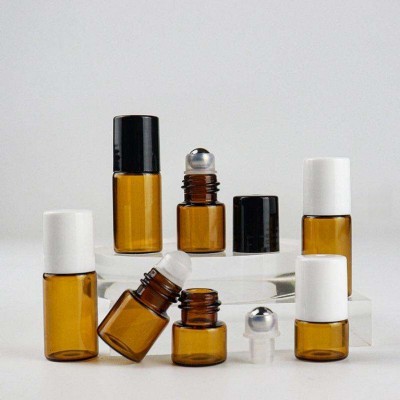
2. The Roller Ball: Material Science
- Stainless Steel: The industry standard for a “cooling” sensation. These are preferred for anti-headache or under-eye serums.
- Glass: Provides a neutral, non-reactive surface. Ideal for high-purity clinical applications.
- Plastic (Polypropylene): A cost-effective solution for high-viscosity liquids.
- Gemstones: Used primarily for “energetic” or luxury branding (Amethyst, Rose Quartz, etc.).
3. The Fitment: The “Engine” of the Bottle
The fitment is the plastic piece that snaps into the roll on bottles. It must be made from a material like LDPE (Low-Density Polyethylene) which has enough “give” to create a vacuum seal but enough “grip” to hold the ball in place under friction.
Technical Challenges: Solving the Leakage Problem
The most common “why” question we receive is: “Why do my roller bottles leak when I use MCT oil as a carrier?”
This isn’t necessarily a failure of the roller bottles themselves, but a mismatch in “Surface Tension.” Carrier oils like Fractionated Coconut Oil (MCT) have a very low surface tension, meaning they can “creep” through the tiniest microscopic gaps.
To solve this, professional glass roller bottles utilize a “dual-seal” system:
- The Ball-to-Housing Seal: The ball sits against a seat that blocks flow when not in use.
- The Cap-to-Ball Seal: The inside of the cap features a “conical” or “stipple” design that pushes the ball down into the housing when the cap is screwed on, effectively “locking” the liquid inside.
Case Study: The “ZenFlow” Aromatherapy Recall
Client: ZenFlow (A mid-sized wellness brand in California). The Issue: ZenFlow launched a “Sleep Support” line using 10ml glass roller bottles. Within two months, 15% of their Amazon inventory was flagged as “damaged” due to leakage. The oil had seeped out, ruining the labels and the outer packaging.
The Diagnosis: Our technical team analyzed the failed units. We found that the client had sourced “Standard 10ml” bottles from a vendor that used a generic fitment designed for high-viscosity perfumes. Because ZenFlow used a very thin, “water-like” essential oil blend, the fitment was not tight enough to hold the vacuum.
The Solution:
- Re-Engineering the Fitment: We provided roll on bottles with a “High-Tension” fitment specifically designed for low-viscosity oils.
- Neck Precision: We switched their production to a molded glass process rather than a tubing glass process, ensuring the inner neck diameter was consistent within ±0.05mm.
- Stress Testing: We subjected the new roller ball bottles to a “Vacuum Leak Test” (simulating the pressure changes in an airplane cargo hold).
The Result: ZenFlow re-launched the line with our custom roller bottles. Their return rate dropped to 0.1%, and their “5-star” reviews for “ease of application” increased by 40%. This proves that the “Why” of a product failure is almost always found in the “How” of its manufacturing.
The Role of Color: Amber, Cobalt, and Beyond
Just as with the boston blue bottle, color plays a functional role in glass roller bottles. Essential oils are highly sensitive to “Photo-oxidation.”
- Amber Glass: This is the “Gold Standard” for therapeutic products. It blocks wavelengths in the 200nm to 450nm range, protecting the delicate chemical bonds of oils like Lavender or Frankincense.
- Frosted Glass: Often used for roll on bottles to provide a “soft touch” feel. While beautiful, it offers less UV protection than Amber.
- Cobalt Blue: Provides excellent protection against visible light while giving the glass roller bottles a premium, “pharmacy-chic” look.
Manufacturing Trends: The Rise of the “Mega-Roller”
While the 10ml size is the global standard, we are seeing a surge in demand for larger roller ball bottles (30ml and 50ml). These are used for:
- Body Deodorants: Transitioning away from plastic tubes to sustainable glass roller bottles.
- Sports Recovery Rubs: Using large stainless steel balls for deep-tissue massage during application.
- CBD Topicals: Where the cooling sensation of the ball complements the anti-inflammatory properties of the formula.
How to Source Roller Bottles for WordPress E-commerce Stores
If you are running a WordPress/WooCommerce site selling these supplies, SEO is driven by technical specifications. Consumers aren’t just searching for “bottles”; they are searching for:
- “Leak-proof roller bottles for essential oils”
- “Wholesale glass roller bottles with metal balls”
- “Travel-size roll on bottles for perfume”
By providing the technical data (GPI finish, ball material, glass type) in your product descriptions, you build trust with professional formulators.
Quality Control: The “Three-Point” Inspection
When we manufacture roller bottles, we follow a strict three-point protocol:
- Dimensional Verification: Using digital calipers to check neck ID (Internal Diameter) and OD (Outer Diameter).
- Fitment Friction Test: Measuring the “Pull-out Force” required to remove the fitment. If it’s too easy, it will leak; if it’s too hard, the consumer can’t refill it.
- Ball Rotation Smoothness: Ensuring the roller ball bottles glide without “scratching” or “stuttering,” which can occur if the ball has microscopic burrs.
Conclusion: Investing in the “Touch” of Your Brand
In the world of cosmetic packaging, the glass roller bottles are your brand’s handshake. A smooth, cool, and leak-proof application tells the customer that your formula is high-quality. A scratchy, leaking, or stuck roller tells them the opposite.
By choosing roll on bottles that prioritize engineering over “the cheapest price,” you are investing in the long-term viability of your brand. Whether it is a 5ml sample size or a 50ml body roller, the physics remain the same: precision is the only path to performance.