 GlassBottleSupplies












Sales manager will contact you within 24 hours
Why fluid viscosity and ball-seat tolerances determine roller bottle reliability
The engineering of a roll on bottle is a study in precision-managed leakage. Unlike a standard bottle that remains sealed until the cap is removed, an essential oil roller bottle must maintain a partial seal even during use. The “roller” is essentially a valve that opens only when friction is applied. For manufacturers in the aromatherapy and topical pharmaceutical sectors, the challenge lies in balancing “leak-proof” storage with “effortless” application.
When a roller ball bottle fails, it is rarely due to a single component; rather, it is a failure of the “systemic tolerance” between the liquid’s viscosity and the ball’s seating depth.
The Fluid Dynamics of the Roller Interface
The primary mechanism of an essential oil bottle with roller is the “Surface Film Transfer.” As the ball rotates, it carries a microscopic layer of liquid from the internal reservoir to the external surface.
1. Viscosity-Specific Ball Clearance
The gap between the roller ball and its plastic housing (the cradle) is measured in microns.
- Low-Viscosity Liquids: For alcohol-based perfumes or thin floral waters, the clearance must be extremely tight. If the gap exceeds 0.05mm, gravity alone will cause the liquid to seep around the ball.
- High-Viscosity Liquids: For thick carrier oils like Castor or Avocado oil, a “tight” fitment will cause the ball to “dry out.” The liquid cannot flow into the gap fast enough to coat the ball, leading to a “scratchy” consumer experience.
2. The Vacuum Effect and Air Return
As liquid is dispensed from a roller ball bottle, a vacuum is created inside the glass. If the fitment does not allow for minute “air return,” the bottle will eventually stop dispensing, and the sides of the plastic fitment may collapse inward. Professional-grade essential oil roller bottles are designed with “venting grooves” in the cradle that allow air to bypass the ball as liquid leaves, maintaining equalized pressure.
The Superiority of Type III Glass in Volatile Storage
The choice of glass for an essential oil bottle with roller is dictated by the chemical aggressiveness of the oils. Many essential oils, such as Citrus (Limonene) or Cinnamon (Cinnamaldehyde), are natural solvents.
Why Glass Over Plastic?
Plastic rollers (specifically PET or HDPE) can undergo “Crazing” when exposed to high concentrations of essential oils. Crazing results in thousands of microscopic cracks that eventually lead to structural failure. Glass, being inorganic and non-porous, is immune to this solvent action. By using essential oil roller bottles, brands ensure that the “Organoleptic” properties (the pure scent and taste) of the oil remain unchanged from the day of bottling.
Amber Glass and the 450nm Cut-off
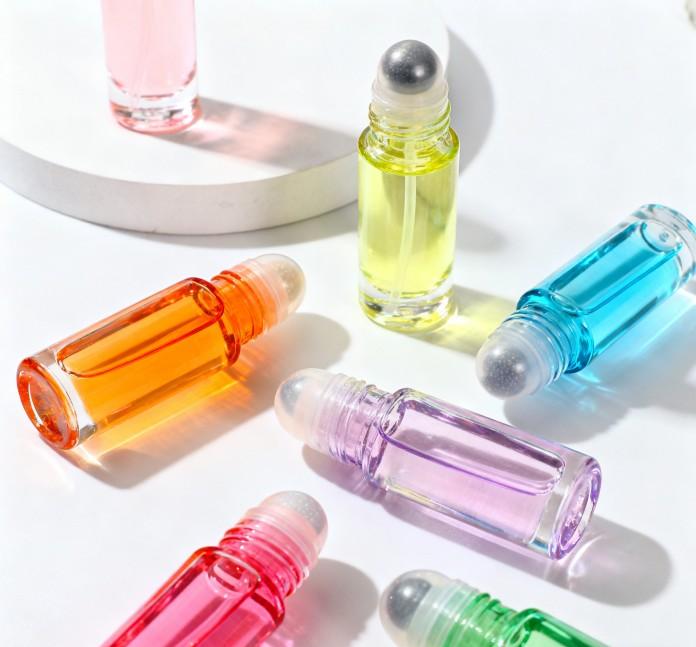
While cobalt blue and emerald green glass are popular, amber roll on bottles remain the gold standard for therapeutic applications. Amber glass is the only color that effectively blocks the “Blue Light” spectrum (400nm-450nm), which carries enough energy to break down the covalent bonds of the organic molecules in the oil.
Case Study: Mechanical Failure in “Gemstone” Roller Series
The Subject: A holistic skincare line launching a “Crystal Infused” essential oil roller bottle range using Amethyst and Rose Quartz balls. The Problem: The brand experienced a 20% “Seize Rate,” where the roller balls stopped spinning after three to four uses, or they would “pop out” of the fitment entirely.
Investigation (Is it? Why?):
- Is it the fitment? No. The LDPE fitment was standard.
- Is it the ball? Yes. Unlike stainless steel balls, which are perfectly spherical via industrial grinding, natural gemstones have slight “Ovoid” shapes and surface irregularities.
- Why is it failing? The natural stone was harder than the plastic cradle. Over several rotations, the irregular surface of the stone “bored out” the plastic cradle, enlarging the orifice until the ball fell out, or creating plastic “shavings” that jammed the rotation.
The Solution: We re-engineered the fitment to use a “Double-Lip” retaining ring made of a harder Polypropylene (PP) material. We also implemented a “Tumble-Polishing” requirement for the gemstone balls to ensure a spherical tolerance within ±0.01mm.
- The Result: The “Seize Rate” was eliminated.
- The Outcome: The brand maintained its luxury aesthetic without sacrificing the mechanical reliability required for mass-market distribution.
Industrial Assembly: The “Fit” of the Fitment
For a roll on bottle to be considered “Travel-Safe,” the fitment must be seated with a “Compression Fit.” This means the outer diameter of the plastic fitment is slightly larger than the inner diameter (I.D.) of the glass neck.
The Importance of the “Blow-and-Blow” Neck Finish
In glass manufacturing, the neck of the bottle is formed first. For roller ball bottles, the inner neck must be perfectly cylindrical (no “taper”) and free of “choke.” If the inner neck is tapered, the fitment will “jump” back up after being pressed in, a common defect known as “spring-back” that leads to leakage once the cap is applied.
Torque Retention and the “Plug” Seal
Most high-quality essential oil roller bottles utilize a cap with an internal “plug” or “land seal.” When the cap is screwed on, it applies downward pressure on the roller ball, forcing it firmly into the cradle to create a secondary seal. This is why “Torque Consistency” on the production line is vital—too little torque and the ball isn’t depressed enough to seal; too much, and the plastic threads may stretch.
Sustainability: The End-of-Life Reality
The roll on bottle is a prime candidate for “Closed-Loop” recycling. Because the components—Glass (Container), Steel (Ball), and PP/LDPE (Fitment/Cap)—are easily separable, they can be processed in standard recycling streams. However, the true sustainable value lies in their durability. A high-quality 10ml roller ball bottle can be reused for years, making it a favorite for the “DIY Wellness” community and reducing the carbon footprint associated with manufacturing new plastic applicators.
Quality Control Checklist for Roller Procurement
To ensure your essential oil bottles with roller perform under industrial conditions, verify these technical markers:
- Orifice Sizing: Does the I.D. of the glass neck match the fitment within a 0.1mm tolerance?
- Ball Sphericity: Is the ball perfectly round to prevent “skipping” during application?
- Chemical Compatibility: Has the fitment material been tested against your specific carrier oil to prevent swelling?
- Glass Annealing: Is the glass free of internal tension to withstand the “Press-Fit” force of assembly?
Summary The roll on bottle is a masterpiece of small-scale mechanical engineering. From the UV-blocking properties of the amber glass to the micron-level tolerances of the roller cradle, every component must work in unison to manage fluid flow. By understanding the interaction between viscosity, pressure, and material hardness, manufacturers can select essential oil roller bottles that protect their formulations while providing a flawless, leak-free user experience.