 GlassBottleSupplies












Sales manager will contact you within 24 hours
Why Precision Engineering of Roll-on Fitments is Critical for Volatile Botanical Essential Oils
The global shift toward “hands-free” topical application has placed roller bottles for essential oils at the center of the cosmetic and nutraceutical supply chain. While consumers value the convenience, industrial procurement managers must focus on the fluid dynamics of the roller essential oil bottles. A roll-on system is essentially a gravity-fed valve where the “ball” acts as the regulator. If the fitment—the interface between the glass neck and the ball—is not engineered to a micron-level tolerance, the result is either a seized applicator or a catastrophic leak of expensive essential oil blends.
1. The “Is It Leaking?” Question: Understanding Surface Tension
Before investigating why a bottle leaks, we must ask: Is the fluid compatible with the ball-fitment clearance? Essential oils possess extremely low surface tension compared to water-based serums. This allows the oil to “wick” through the microscopic space between the ball and its housing.
- The Capillary Seal: In high-quality empty roll on bottles, the seal is maintained by a “lip” inside the housing that the ball rests against.
- The S-Dimension: This is the distance the ball can move vertically. For high-viscosity oils (like Sandalwood), a larger S-dimension is required. For thin, alcohol-based perfumes in 1 oz roll on bottles, this dimension must be tightened to prevent “over-saturation.
2. 1 oz vs. 10ml: The Logic of Volume in Professional Treatment
While the 10ml “travel size” is ubiquitous, the 1 oz roll on bottles (30ml) are the preferred choice for professional massage therapy and sports medicine.
- Contact Surface Area: A 1 oz bottle typically utilizes a larger diameter roller ball (up to 12mm-14mm). This allows for a wider “swath” of oil to be applied to large muscle groups.
- Ergonomic Stability: The wider circumference of the 30ml glass body provides a better grip for clinical practitioners, reducing hand fatigue during repetitive applications.
- Thermal Inertia: Larger glass volumes take longer to heat up. This is vital for essential oils that are sensitive to the warmth of a user’s hand, which can cause the more volatile aromatic molecules to flash off.
3. Material Science of the Roller Ball: Steel, Glass, or Gemstone?
The choice of sphere material in roller bottles for essential oils significantly impacts the chemical stability of the formula.
- 316 Stainless Steel: Favored for its “cold-touch” effect. It is non-reactive with most oils but must be passivated to ensure no metallic ions leach into the solution.
- Borosilicate Glass Balls: These provide the highest level of chemical inertness. They are ideal for formulas with extreme pH levels that might cause minor pitting in steel.
- Fitment Housing (LDPE/PP): The housing is usually made of Low-Density Polyethylene (LDPE) because it has enough “give” to allow the ball to be snapped in while maintaining a tension-based seal against the glass neck.
4. The “Snap-Fit” Engineering: Glass Neck Internal Diameter (I.D.)
One of the most complex aspects of manufacturing empty roll on bottles is the internal neck finish. Unlike a screw-top bottle where the external thread is the focus, the roller bottle depends on the internal dimensions.
- The Interference Fit: The plastic fitment is slightly larger than the glass neck. When pressed in, it creates a “friction lock.”
- The Bore-Entry Profile: If the interior of the glass neck has a “taper,” the fitment may slowly migrate upward over time (a phenomenon known as “fitment creep”), eventually causing the cap to fail or the bottle to leak.
5. UV Protection and Glass Color Strategy
For roller essential oil bottles, the color of the glass is the first line of defense against molecular degradation.
- Amber Glass: Essential for oils like Frankincense or Myrrh, which contain complex hydrocarbons that break down under UV-A and UV-B light.
- Matte Coatings (Frosted): While aesthetically pleasing, frosting is often achieved through acid-etching. This can microscopicly weaken the glass. For professional-grade 1 oz roll on bottles, internal-tinted glass (like true Cobalt or Amber) is always superior to external sprays or frosts.
Case Study: High-Viscosity Arnica Recovery Oil
The Client: A sports recovery brand producing a thick, Arnica-infused carrier oil for marathon runners. The Challenge: Using standard 10ml roller bottles, the thick oil couldn’t bypass the ball, forcing users to “shake” the bottle violently to get any product out. The Technical Solution: The brand moved to 1 oz roll on bottles with a customized “High-Flow” fitment and a 14mm Stainless Steel ball. The Result:
- Application Efficiency: Product delivery increased by 40% per stroke.
- Consumer Satisfaction: The “cooling” effect of the larger steel ball became a primary marketing feature.
- Reduced Failure Rate: The larger 30ml glass neck allowed for a more robust fitment that did not seize under the pressure of the thicker oil.
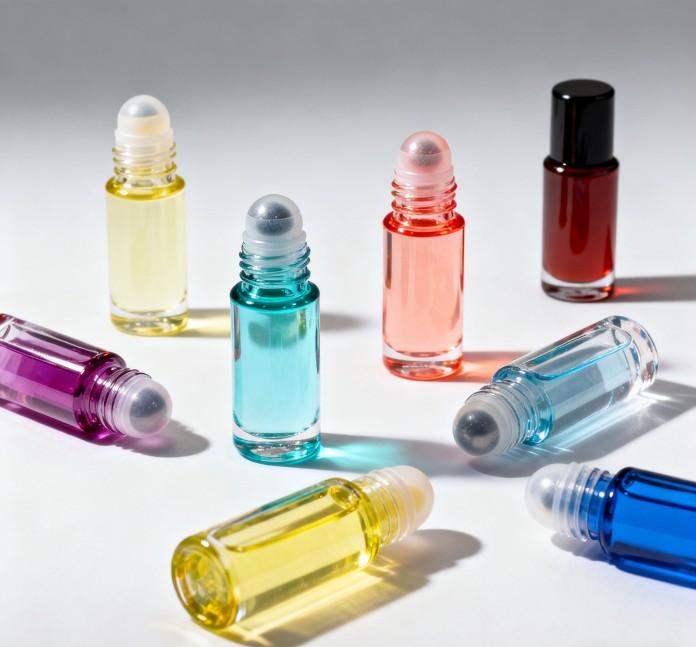
6. Manufacturing QC: The “Ball-Drop” and “Leid-Down” Tests
Quality control for empty roll on bottles involves more than just a visual check.
- The Leakage Test: Jars are filled with a surrogate liquid (low-tension alcohol) and placed horizontally on blotting paper for 48 hours. Any spotting indicates a failure in the fitment-to-glass seal.
- Torque Testing: The force required to rotate the ball is measured. A “stiff” ball often indicates that the plastic fitment has “shrunk” due to chemical interaction with the essential oils—a sign that the plastic grade is incorrect for the formula.
7. The Importance of the Outer Cap “Depressor”
A little-known fact in the industry is that the outer cap is part of the sealing mechanism. High-quality roller essential oil bottles feature a “depressor” or “nipple” inside the cap. When the cap is screwed on, it pushes the ball down firmly against the seat of the fitment, creating a secondary airtight seal that prevents the oil from oxidizing during storage.
8. Sustainability and the “Refill” Paradigm
Glass is infinitely recyclable, making roller bottles for essential oils an eco-friendly choice. However, the fitment and ball are often “single-use” because they are difficult to clean.
- Pro-Tip for Suppliers: Providing replacement fitments for 1 oz roll on bottles allows consumers to reuse the high-quality glass base, reducing plastic waste and increasing customer loyalty.
9. Common Industry Defects to Avoid
When sourcing from glass bottle makers, beware of:
- Neck “Waviness”: Inconsistent glass thickness in the neck that prevents a uniform friction fit.
- Ball Scratches: Micro-scratches on a steel ball can act as “channels” for oil to leak out even when the cap is on.
- Flash on Plastic: Excess plastic on the fitment mold that prevents the ball from rotating smoothly.
10. Conclusion
The 1 oz roll on bottle is a specialized piece of hardware that requires a deep understanding of material compatibility and mechanical tolerances. For essential oil brands, the bottle is the delivery system; if it fails, the product fails. By prioritizing glass quality, ball material, and fitment precision, manufacturers can ensure their botanical formulations remain stable and effective from the factory to the end-user’s skin.