 GlassBottleSupplies












Sales manager will contact you within 24 hours
Cobalt Blue Boston Round Bottles: The 2 oz Packaging Standard for Premium Serums
When a cosmetic brand manager looks at a shelf, the eye is physically drawn to Cobalt Blue. But beyond the aesthetic magnetism, there is a rigid framework of industrial standards and chemical protection that defines this packaging choice.
We are not just talking about a container; we are talking about the Boston Round bottle, a specific structural definition in the glass industry that has survived over a century of design changes to remains the gold standard for essential oils, serums, and pharmaceuticals.
Specifically, the 2 oz boston round bottles represent a critical volume in the market—bridging the gap between sample sizes and bulk storage. This article dissects the engineering, the optical science, and the supply chain realities of this specific SKU.
Defining the “Boston Round”: Is it just a shape?
Before we explain why you should choose this shape, we must define what it is strictly in manufacturing terms.
A boston round bottle is characterized by three non-negotiable structural elements:
- The Rounded Shoulder: Unlike the “French Square” or “Cylinder,” the Boston Round features a curved horizon where the body meets the neck.
- The Narrow Neck: Classically, the aperture is significantly smaller than the base diameter.
- The Circular Base: It provides high stability on filling lines.
Why does this matter for your production line? The “Round” is not just for ergonomics. In a high-speed filling plant, corners create weak points. When glass bottles collide on a conveyor belt at 300 units per minute, square bottles tend to chip or suffer stress fractures at the corners. The boston bottles design dissipates kinetic energy around the curve. If you are scaling your production from manual filling to automated capping, the Boston Round is statistically the safest shape to minimize breakage rates.
The Optical Science: Why Cobalt Blue?
Is blue glass just for looks? No. It is a functional light filter.
Many brands confuse “painted blue” with “cobalt blue.” As a manufacturer, we deal in True Cobalt Blue. This means the color is not a coating sprayed onto clear glass; it is achieved by adding cobalt oxide to the molten batch in the furnace at temperatures exceeding 1,500°C.
The Wavelength Game
Clear glass allows the full spectrum of visible light and UV radiation to pass through. This causes photo-oxidation—the enemy of natural ingredients.
- Amber Glass: Blocks the most light (blue and UV), but lacks “luxury” appeal.
- Blue Bottle Boston: This is the strategic compromise. Cobalt glass filters out a significant amount of UV light while allowing some violet light to pass.
Why choose blue over amber? While amber is technically superior for absolute light blocking, blue bottle boston packaging triggers a specific psychological response in the consumer: Clinical Cleanliness and Hydration. If your product is a hydration serum, a cooling gel, or a night repair oil, the blue spectrum signals “water” and “coolness” to the brain.
Furthermore, unless your formula is extremely photosensitive (like raw Retinol), the UV protection offered by cobalt blue is sufficient for a 2-year shelf life, provided the bottle is kept away from direct sunlight.
The “2 oz” Sweet Spot: Market positioning
Why are 2 oz boston round bottles (approximately 60ml) becoming the preferred size for hair oils and beard products, overtaking the standard 1 oz?
- The “Value” Perception: A 1 oz (30ml) bottle is the standard face serum size. A 2 oz bottle feels like “double the value” but doesn’t cost the manufacturer double to produce. The glass cost difference is marginal, but the retail price can be 40% higher.
- TSA Compliance: 2 oz is well under the 3.4 oz (100ml) limit for carry-on luggage. It is the maximum “safe” size for travel kits.
- Treatment Duration: For products like hair treatments or body oils, 1 oz is finished too quickly. 2 oz provides a 45-60 day supply, which is the ideal cycle for customer retention and re-ordering.
Technical Specifications & Neck Finishes
When sourcing boston bottles, the bottle is useless without the correct closure. The “Finish” (the threaded part of the neck) determines compatibility.
For 2 oz boston round bottles, the industry standard finish is usually 20-400 or 22-400.
- 20: Represents the external diameter of the threads (in millimeters).
- 400: Represents the thread style (one turn).
Pro-Tip on Leakage: A common failure in our industry happens when a brand matches a 20-410 dropper with a 20-400 bottle. They look similar, but the “410” has 1.5 turns of thread, while “400” has 1 turn. If you force a 410 cap onto a 400 bottle, it will not seal at the “land” (the top lip of the bottle), causing the oil to leak during shipping. Always verify the GPI (Glass Packaging Institute) standards of your closure.
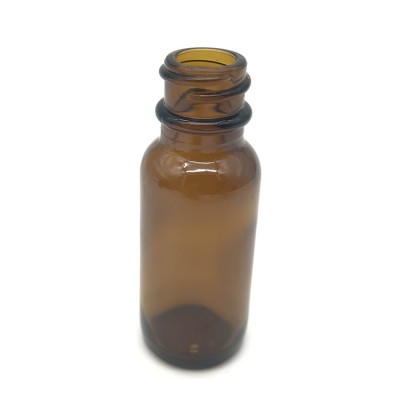
Real Product Case Study: “BeardGuard” Transition
To illustrate the impact of switching to blue bottle boston packaging, let’s look at a client scenario from 2024 (Company name anonymized as “BeardGuard” for privacy).
The Problem: BeardGuard was selling a premium Sandalwood & Jojoba beard oil. They were using a standard 1 oz Clear Boston Round with a black paper label.
- Issue 1: The oil was turning rancid (oxidizing) after 3 months because clear glass offers zero UV protection.
- Issue 2: Customers felt the $25 price point was too high for a small 1 oz bottle that looked like a generic sample.
- Issue 3: Breakage during Amazon FBA shipping was at 4%.
The Solution: We advised a transition to 2 oz boston round bottles in Cobalt Blue, paired with a Matte Black Phenolic Cone Cap (instead of a dropper, to prevent rubber deterioration).
The Execution:
- Volume Shift: By moving to 2 oz, they marketed the product as “The Barber Size” – appealing to the professional aesthetic.
- Color Shift: The Cobalt Blue glass hid the slight natural color variations of the organic Jojoba oil (which varies from crop to crop), ensuring a consistent look on the shelf.
- Protection: The blue glass extended the shelf life stability to 18+ months.
The Result: Six months post-launch, BeardGuard reported:
- Sales Increase: A 35% increase in conversion rate. The blue bottle popped in Amazon search results against a sea of amber bottles.
- Returns Drop: Returns due to “bad smell” (rancidity) dropped to near zero.
- Perceived Value: They raised the price to $38. The cost of goods (COGS) for the glass increased by only $0.12 per unit, but the profit margin increased by $12.88 per unit.
This case proves that the boston round bottle in the right color and size is not just a container; it is a revenue driver.
Manufacturing: The “Blow-and-Blow” Process
It is important to understand how your boston bottles are made to understand their quality.
Narrow-neck containers like these are produced using the IS (Individual Section) Machine via the Blow-and-Blow method.
- Gob Loading: A “gob” of molten blue glass drops into a blank mold.
- Settle Blow: Compressed air forces the glass into the neck ring (forming the threads).
- Counter Blow: Air is blown from the bottom to create a hollow space (the parison).
- Final Blow: The parison is transferred to the blow mold, and air forces it against the walls to create the final boston round bottle shape.
Quality Control Checkpoint: Cheap manufacturers often have uneven “bottom distribution”—where the glass is thick on one side of the base and thin on the other. This creates a “rocking” bottle. At our facility, we use automatic wall thickness inspection. For a 2 oz boston round bottle, the wall thickness must be uniform to withstand the pressure of capping machines.
Sustainability & The Recycling Myth regarding Blue Glass
A frequent question we face: “Is blue glass recyclable?”
Yes, and here is why. Unlike “frosted” or “painted” glass which introduces contaminants (paints/resins) into the recycling stream, True Cobalt Blue is purely glass. It is separated by optical sorters at recycling facilities.
However, from a sustainability marketing angle, the reusability of the 2 oz boston round bottles is the stronger selling point. Because the glass is durable and non-porous, end-users often wash and repurpose these blue bottles for DIY essential oil blends or travel containers. This “second life” extends your brand exposure long after the original product is gone.
Conclusion
Choosing the right packaging is a balance of chemistry, engineering, and psychology. The blue bottle boston offers the perfect triad: it protects the formula from UV degradation, it withstands the rigors of automated filling lines due to its rounded geometry, and it commands a premium price on the retail shelf.
Specifically, the 2 oz boston round bottles provide the ideal volume for modern consumer habits—large enough to build loyalty, yet small enough to be travel-friendly.
Whether you are launching a new men’s grooming line or a luxury facial serum, the data is clear: Cobalt Blue is not just a color; it is a competitive advantage.