 GlassBottleSupplies












Sales manager will contact you within 24 hours
Wide Mouth Glass Bottles: The Packer & Jar Sourcing Guide
In the packaging industry, the geometry of the opening dictates the function of the vessel. While narrow-neck bottles dominate the liquid market, the wide mouth glass bottle is the undisputed king of solid dose medication, viscous creams, and bulk powders.
For procurement managers and brand owners, sourcing these containers is not just about volume; it is about understanding neck finishes, dispensing utility, and the critical “Press-and-Blow” manufacturing process that ensures a perfect seal. This guide explores the technical landscape of wide mouth bottles, ensuring your product line meets both aesthetic standards and regulatory compliance.
1. Defining the Wide Mouth Advantage
What technically classifies a container as a glass wide mouth bottle? generally, if the opening diameter is roughly half of the bottle’s body diameter or larger, it falls into this category.
The demand for glass bottles with wide mouth designs is driven by three specific filling and dispensing challenges that narrow necks cannot solve:
- Solid Dose Filling: High-speed filling lines for capsules, gummies, and tablets require a large target area to prevent jamming at the hopper.
- Viscosity Management: For thick cosmetic creams or body butters, a consumer must be able to insert fingers or a spatula to retrieve the product.
- Powder Flow: Fine powders (like lyophilized extracts or supplements) require a wide aperture to prevent “bridging” or clogging during the filling process.
2. The Manufacturing Distinction: Press-and-Blow
To understand quality, you must understand the forming process. Unlike narrow vials which often use “Blow-and-Blow” or tubular conversion, high-quality wide mouth glass bottles are typically manufactured using the Press-and-Blow (P&B) method.
Why P&B Matters for Wide Mouths
In the Press-and-Blow process, a metal plunger is pressed into the molten glass gob to form the parison (the pre-shape) and the neck finish before the final shape is blown.
- Precision: This mechanical pressing creates a highly accurate internal neck diameter.
- Sealing Surface: It ensures the “land” (the top rim of the bottle) is perfectly flat. This is critical for wide mouth bottles because they often use induction heat seal (IHS) liners. If the glass rim has even a microscopic dip, the foil liner won’t seal, leading to oxidation or leakage.
- Weight Distribution: P&B allows for lighter weight bottles with uniform wall thickness, reducing shipping costs without sacrificing strength.
3. Core Categories of Wide Mouth Glass Containers
When you request a quote for a glass wide mouth bottle, you will likely be choosing between three industry standards. Understanding these terms will help you communicate faster with our engineering team.
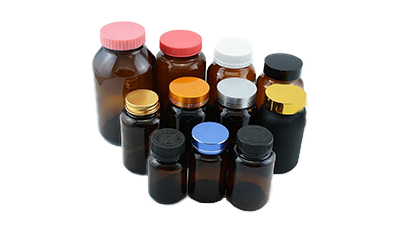
A. The “Packer” (Pharmaceutical Round)
This is the standard for the nutraceutical industry.
- Shape: Round body, short shoulders, very large opening.
- Common Use: Vitamins, soft gels, gummies.
- Glass Type: Usually Amber Type III Soda-Lime glass to filter UV light.
- Typical Finishes: 38-400, 45-400, 53-400.
B. Straight-Sided Jars
These are cylindrical with vertical walls that go straight up to the opening. There is no “shoulder.”
- Shape: Flush sides.
- Common Use: Premium cosmetic creams, salves, and candles.
- Aesthetic: The straight wall offers the maximum surface area for labeling or screen printing.
C. Blake Bottles (Rectangular Wide Mouth)
- Shape: Rectangular footprint.
- Common Use: Laboratory chemicals or pharmacy shelving (efficient use of shelf space).
4. The Critical Science of Neck Finishes (GPI Standards)
The “Finish” is the specific glass geometry at the opening that accepts the cap. In the world of glass bottles with wide mouth openings, the margin for error is slim.
We adhere to GPI (Glass Packaging Institute) standards. The two numbers you see (e.g., 53-400) represent:
- 53 (T dimension): The outside diameter of the thread in millimeters.
- 400 (Style): The thread style (e.g., 400 is one turn, 410 is one and a half turns).
Why “400” is the Standard for Wide Mouth
Most wide mouth bottles utilize a 400 continuous thread (CT) finish. Because the diameter is large (wide torque radius), a single turn is usually sufficient to secure the cap. A deep skirt cap (like a 415) is rarely used on wide mouths because the friction would make it too difficult for a consumer to unscrew.
5. Closure Systems: The Other Half of the Bottle
You cannot simply buy wide mouth bottles; you must buy a “sealing system.” Because the opening is large, the risk of air ingress is higher.
- Induction Heat Seal (IHS) Liners: Essential for freshness. A foil liner is adhered to the glass rim via a magnetic field. This is standard for pills.
- Pressure Sensitive Liners: Styrofoam liners that adhere via torque pressure. Good for dry solids, but not liquids.
- Child-Resistant Caps (CRC): For glass wide mouth bottle applications involving medication, a CRC (Push-down-and-turn) cap is often a legal requirement.
6. Real Industry Case Study: “NatureGuard Organics”
Client: NatureGuard Organics (A manufacturer of premium organic bee pollen granules).
The Challenge: NatureGuard was using PET plastic wide-mouth jars. However, they faced two issues:
- Moisture Permeation: Bee pollen is hygroscopic (absorbs water). The PET plastic allowed microscopic amounts of moisture in, causing the granules to clump into a solid brick after 4 months.
- Static Electricity: The plastic jar created static charge, causing the light pollen dust to stick to the walls, making the product look “messy” to the consumer.
The Solution: We transitioned their production line to 120cc Amber Wide Mouth Glass Packers with a 38-400 finish.
- The Technical Fix: We utilized Type III Soda-Lime glass. Glass is an absolute barrier to moisture (zero permeation).
- The Static Fix: Glass is an electrical insulator but does not hold static charge like plastic. The pollen granules remained loose and free-flowing.
- The Seal: We implemented a “Lift-n-Peel” induction liner. Because our wide mouth glass bottle manufacturing used the Press-and-Blow method, the land (rim) was perfectly flat, ensuring a 100% hermetic seal on every unit.
The Result:
- Shelf Life: Extended from 6 months to 24 months.
- Premium Branding: The switch to amber glass allowed them to raise the retail price by 15%, as consumers associate glass with “organic” and “premium” quality. The weight of the glass conveyed value that plastic could not.
7. Color Chemistry: Amber vs. Cobalt vs. Flint
When sourcing glass bottles with wide mouth designs, color is functional, not just decorative.
- Flint (Clear): Best for showcasing product texture (e.g., colorful gummies or pristine white creams). No UV protection.
- Amber (Brown): The industry standard for pharma. It blocks light in the critical UV spectrum (below 450nm). If your formulation contains Vitamin B, C, or light-sensitive lipids, Amber is non-negotiable.
- Cobalt Blue / Green: Offers some UV protection but is largely used for branding differentiation in the “Apothecary” style aesthetic.
8. Sourcing Checklist: Avoid Common Pitfalls
To ensure your wide mouth bottles perform on your filling line, check these parameters:
- Tolerances: Ask for the technical drawing. Check the “T” (Thread) and “E” (Wall) dimensions.
- Thermal Shock: If you are hot-filling a cream (above 60°C) into a glass wide mouth bottle, the glass must be annealed properly to prevent thermal shock cracking.
- Pack-Out: Wide mouth bottles have a high shoulder contact area. Ensure they are packed with dividers to prevent “scuffing” during transit.
Conclusion
The wide mouth glass bottle is the workhorse of the supplement and cosmetic industries. Its design prioritizes accessibility and filling efficiency, while the material (glass) prioritizes stability and purity.
Whether you need a classic Amber Packer for a new probiotic line or a heavy-base Flint jar for a luxury night cream, understanding the nuances of neck finishes and manufacturing methods is key to a successful launch. At our facility, we combine precision Press-and-Blow molding with rigorous quality control to deliver glass that protects your brand.