 GlassBottleSupplies












Sales manager will contact you within 24 hours
The Chemistry of Containment: Engineering the Perfect Glass Reagent Bottle
In the hierarchy of glass packaging, the reagent bottle sits at the apex of engineering requirements. Unlike a beverage container or a standard jam jar, a glass reagent bottle is not just a vessel; it is a shield. It must protect volatile chemicals from evaporation, photosensitive compounds from UV degradation, and aggressive solvents from leaching.
For procurement officers and lab managers sourcing reagent bottles, the specification sheet is often cluttered with generic terms. Understanding the difference between soda-lime glass, neutral glass, and low-expansion borosilicate glass is the difference between a safe laboratory and a hazardous contamination event.
This guide dissects the material science, the closure mechanics, and the manufacturing protocols defining the modern reagent bottles market.
Material Science: Is It Just Glass?
When a buyer searches for a reagent bottle borosil type or a standard lab bottle, they are usually asking a fundamental question about chemical durability. But before we discuss sourcing, we must validate the material.
Is all glass chemically inert?
No.
Why?
Glass is a universal solvent at the microscopic level. Standard soda-lime glass (Type III) contains alkali metal oxides (Sodium Oxide $Na_2O$ and Calcium Oxide $CaO$). When aggressive aqueous solutions are stored in Type III glass over long periods, an ion exchange can occur. Hydrogen ions ($H^+$) from the liquid replace the sodium ions ($Na^+$) in the glass network. This results in “alkali leaching,” which shifts the pH of the stored reagent and can cause “flaking” (delamination) of the glass surface.
The Borosilicate 3.3 Standard
For critical reagent bottles, the industry standard is Borosilicate 3.3 Glass (often referred to generically by brand names like Pyrex, Duran, or Borosil).
- Composition: It replaces the alkali/lime components with Boron Trioxide ($B_2O_3$, typically 12-13%) and high levels of Silica ($SiO_2$, >80%).
- Thermal Expansion: The “3.3” refers to the Coefficient of Linear Thermal Expansion ($\alpha = 3.3 \times 10^{-6} K^{-1}$). This is extremely low compared to soda-lime glass ($\sim 9.0 \times 10^{-6} K^{-1}$).
- Implication: A glass reagent bottle made of Borosilicate 3.3 can withstand thermal shocks of up to 160°C. You can take it from a cold storage unit and place it directly into an autoclave for sterilization without the bottom falling out—a critical requirement for microbiology and pharmaceutical applications.
Morphology: Wide Mouth vs. Narrow Mouth
The geometry of reagent bottles is dictated by the viscosity and state of the substance it holds.
Narrow Mouth (Ground Glass or Screw Cap)
Designed for liquids (solvents, acids, essential oils).
- Surface Area: The reduced neck diameter minimizes the surface area of the liquid exposed to air when the bottle is open, reducing evaporation rates for volatile organic compounds (VOCs).
- Pouring: The shoulder slope is calculated to allow smooth laminar flow, preventing the “glug-glug” effect that causes splashing of hazardous chemicals.
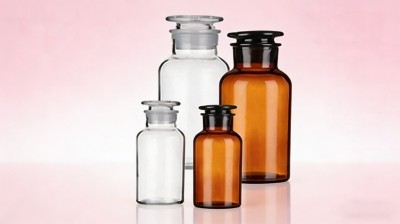
Wide Mouth
Designed for powders, pastes, and viscous slurries.
- Access: Allows for the insertion of spatulas or pipettes.
- Cleaning: Easier to clean mechanically or chemically, as brushes can reach the total inner surface area.
The GL45 Standard and Closure Systems
In the modern laboratory, the “Ground Glass Stopper” (a tapered glass plug that fits into a frosted glass neck) is being supplanted by the GL Thread System, specifically the GL45.
When sourcing reagent bottles, specifying the correct thread and cap material is as important as the glass itself.
The GL45 Thread
- Definition: A standard DIN thread with an outer diameter of 45mm.
- Utility: It allows for modularity. A single glass reagent bottle can be fitted with a simple storage cap, a membrane cap for gas exchange, or a septum cap for syringe extraction.
Cap Material Chemistry
If you buy high-quality glass reagent bottles but use cheap caps, you compromise the system.
- Polypropylene (PP):
- Color: Usually Blue.
- Temp Limit: Up to 140°C.
- Use: Standard storage and autoclaving.
- Polybutylene Terephthalate (PBT):
- Color: Usually Red.
- Temp Limit: Up to 180°C.
- Use: Dry heat sterilization and high-temperature reactions.
- PTFE (Teflon) Liners:
- Essential for storing aggressive solvents (Acetone, Toluene) that would dissolve a standard PP cap liner.
Optical Protection: Amber vs. Clear
Photochemical degradation is a primary enemy of reagent stability. Many reagent bottles are amber, but not all amber is created equal.
Is it coated or sprayed?
Many cheap manufacturers simply spray a brown coating onto clear glass. This scratches off and offers no real UV protection.
Why does this matter?
True Amber Glass (Actinic Glass) is colored in the molten state using iron oxide and sulfur.
- Spectra Blocking: Real amber glass reagent bottles must block light transmission effectively in the 290nm to 450nm range (UV and Blue light).
- Application: Essential for light-sensitive compounds like Silver Nitrate, Vitamins (Retinol), and certain biological stains. If you hold an amber bottle up to a light and see streaks or inconsistent color density, it is likely sprayed, not intrinsic amber, and will fail to protect high-value reagents.
Industry Case Study: The “PurePeptide” Transition
To illustrate the critical nature of selecting the right reagent bottles, we present a case study from a client in the cosmetic ingredient sector (anonymized as “PurePeptide Labs”).
The Challenge
PurePeptide manufactures concentrated copper peptides and active retinol serums for B2B skincare brands. They were shipping their raw ingredients in HDPE (High-Density Polyethylene) plastic jerrycans.
- The Incident: A client in Europe rejected a shipment of Retinol (Vitamin A) concentrate. The lab analysis showed significant oxidation and a reduction in potency.
- The Cause: Retinol is highly sensitive to oxygen and UV light. While HDPE is durable, it is not gas-impermeable. Over the 6-week sea freight period, oxygen ingress through the plastic wall degraded the active ingredient. Furthermore, the plasticizers in the HDPE were interacting with the carrier oil, altering the viscosity.
The Solution: Borosilicate GL45 Reagent Bottles
PurePeptide approached GlassBottleSupplies.com for a solution. They needed a container that was:
- Impermeable: Zero oxygen transmission.
- UV Blocking: To protect the photosensitive Retinol.
- Scaleable: Sizes ranging from 500ml to 5 Liters.
We recommended switching to Amber Borosilicate 3.3 Glass Reagent Bottles with GL45 Blue Polypropylene Caps and Pour Rings.
- Why Borosilicate? Even though they weren’t heating the product, the chemical purity of USP Type I glass ensured no leaching into the expensive peptide solution.
- The Pour Ring: We included a drip-free pouring ring on the neck. This plastic ring catches the last drop of liquid after pouring, preventing the expensive serum from running down the outside of the bottle and ruining the label.
The Outcome
- Potency Retained: Subsequent shipments showed 99.8% potency retention upon arrival.
- Brand Elevation: PurePeptide’s clients (luxury skincare brands) viewed the switch to glass reagent bottles as an upgrade in quality assurance. The glass bottles were cleaner, easier to sterilize before use, and looked professional in the formulation lab.
- ROI: Although the glass packaging and shipping weight cost more than plastic, the elimination of product rejection and the ability to charge a premium for “Medical Grade Packaging” resulted in a 20% net profit increase for that product line.
Manufacturing Protocol: The Annealing Process
Whether you are buying reagent bottles for a university lab or a cosmetic factory, the invisible quality metric is annealing.
Glass manufacturing induces stress. When the molten glass is blown into the mold, it cools rapidly on the outside while remaining hot inside. This thermal gradient creates tension. If left unchecked, the bottle becomes a “ticking time bomb” that can shatter spontaneously or under minor thermal stress (like adding hot water).
The Lehr Oven:
High-quality reagent bottles pass through an annealing lehr—a long oven that reheats the glass to its “annealing point” (approx. 560°C for borosilicate) and then cools it incredibly slowly.
- Stress Testing: We utilize polariscopes to inspect our bottles. Under polarized light, stress lines in the glass appear as colorful fringes. A properly annealed glass reagent bottle should appear neutral and uniform.
Customization for the Modern Lab
The days of generic bottles are fading. Modern laboratories and ingredient manufacturers demand functionality baked into the glass.
- Ceramic Graduations:Instead of ink that fades with solvent contact, we use ceramic enamel that is fired onto the glass surface. These graduation marks are permanent and chemical resistant.
- Traceability Codes:We can etch Retrace Codes onto the bottom of reagent bottles. This code allows the end-user to download a batch certificate online, detailing the date of manufacture, the glass melt composition, and the quality control specs—a requirement for cGMP and FDA-compliant facilities.
- Safety Coating:For highly dangerous chemicals, we offer PU (Polyurethane) coated glass reagent bottles. If the glass breaks due to impact, the clear plastic coating holds the shards and the liquid together, preventing a spill and protecting the user from cuts.
Sourcing Checklist: What to Ask Your Supplier
When you are ready to order reagent bottles or search for reagent bottle borosil equivalents, use this checklist to vet your supplier:
- Glass Type Verification: Ask for the “Hydrolytic Resistance Class.” It should be Class 1 (HGB1) according to ISO 719.
- Cap Compatibility: Ensure the caps offered are autoclavable if your process requires sterilization. Ask if they are “liner-less” (plug seal) or use a “liner.” Liner-less is often better for preventing contamination.
- Packing Standards: Glass is fragile. Does the supplier ship in “egg-crate” cartons with double-walled corrugated cardboard? For pallet shipments, are they shrink-wrapped with corner protectors?
Conclusion
The humble reagent bottle is the workhorse of scientific discovery and high-end cosmetic formulation. It is a vessel that must be chemically invisible yet physically robust.