 GlassBottleSupplies












Sales manager will contact you within 24 hours
Why Top Skincare Brands Are Switching to Reagent Glass Bottles
In the competitive landscape of “cosmeceuticals” (cosmetics with pharmaceutical benefits), the packaging is the silent salesman. We are seeing a massive shift where high-end niche brands are abandoning fancy, uniquely shaped molds in favor of the classic, stoic reagent bottle laboratory aesthetic.
But before you rush to source a reagent glass bottle 100ml for your next toner or serum launch, we must pause and ask the hard question: Is this trend just about aesthetics, or is there a functional necessity behind it?
Most packaging suppliers will tell you it looks “cool” or “scientific.” That is a superficial answer. The real reason lies in the chemistry of modern skincare ingredients and the limitations of standard cosmetic glass.
The “Clinical” Paradox: Why “Ugly” is the New Luxury
For decades, the cosmetic industry pursued complex shapes, heavy frosting, and gold stamping. The humble glass bottle reagent was relegated to the chemistry lab.
However, as consumers became more educated about ingredients like Retinol, L-ascorbic Acid (Vitamin C), and Peptides, their trust shifted from “luxury” to “efficacy.”
First, is it true that a reagent bottle creates trust?
Yes. Subconsciously, when a consumer sees a wide mouth reagent bottle, they associate it with the pharmacy or the compounding lab. It signals: “This contains a potent formula, not just perfumed water.”
But beyond psychology, the reagent glass bottle 100ml format offers a standardized geometry that is often superior to custom molds in terms of filling line stability and labeling area.
The Amber Necessity: Protecting the “Actives”
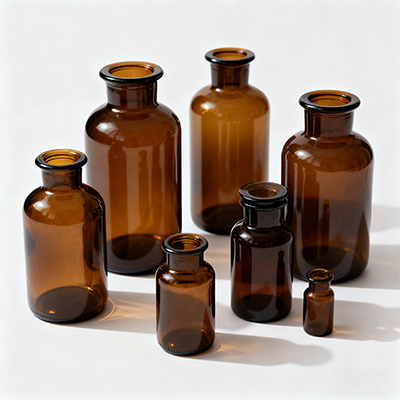
The most searched term in this niche is the amber reagent bottle. But many brand owners make a fatal mistake here. They ask for “Amber color” without asking “Why Amber?”
Ask: Is all amber glass the same?
No. In the cosmetic supply chain, there are two ways to achieve amber:
- Sprayed Amber: A clear bottle is sprayed with semi-transparent brown paint.
- Mass-Colored Amber: The glass itself contains iron and sulfur added during the melt.
The Functional Gap:
Modern “Clean Beauty” formulations often lack heavy preservatives. Ingredients like Vitamin C are notoriously unstable and photodegradable.
- Sprayed bottles may look the part, but if the coating is uneven (which happens often in mass production), UV rays will penetrate, oxidizing your Vitamin C serum within weeks. The product turns brown, and the customer demands a refund.
- A true glass bottle reagent made of mass-colored glass provides a consistent UV cutoff (typically blocking wavelengths below 450nm).
If your product formulation contains light-sensitive actives, you are not buying a bottle; you are buying a light filter. Using a standard clear bottle painted brown is a gamble with your product’s efficacy.
Viscosity Matters: The Wide Mouth Advantage
Why are we seeing a surge in the wide mouth reagent bottle specifically?
Traditionally, reagents in labs are liquids. But in cosmetics, we deal with emulsions, creams, and gels.
- The Narrow Neck Problem: A standard DIN18 or 24/410 cosmetic neck is fine for liquids. But try putting a thick night cream or a clay mask in a narrow-neck bottle. The consumer cannot get the product out, and filling lines slow down due to airlocks.
- The Wide Mouth Solution: A wide mouth reagent design (often with a GL45 or similar opening) allows for high-viscosity filling speeds. More importantly, it allows the consumer to use a spatula or get their fingers in (if appropriate), or allows for high-flow pumps to be inserted easily.
Engineering Insight: A wide mouth bottle also has a stronger “shoulder.” In shipping, the shoulder is a stress point. The gradual slope of a reagent bottle distributes impact force better than the sharp 90-degree shoulders of square cosmetic bottles, reducing breakage rates during transit.
Closure Systems: The “Reagent” Seal in a Cosmetic World
A reagent bottle laboratory setup typically uses a blue PP cap or a red PBT cap. For cosmetics, this looks too industrial.
However, the mechanics of the reagent seal are what we want to replicate.
- The Liner: Standard cosmetic caps often use simple PE wads. Reagent caps often use PTFE (Teflon) facings.
- Why it matters: If your formula uses essential oils or aggressive solvents (like high concentrations of alcohol or glycol), they can dissolve standard PE liners, leading to “cap relaxation” and leakage.
At Glass Bottle Supplies, we often hybridize this. We take the mold of the reagent glass bottle 100ml but pair it with a Bakelite or anodized aluminum cap that contains a lab-grade PTFE liner. This gives you the aesthetic of luxury, with the chemical resistance of a laboratory vessel.
Real Product Case Study: The “Retinol Rescue”
The Client: A boutique skincare brand specializing in high-strength Retinol (0.5%) oils.
The Problem: They were using a “luxury” clear square bottle with a black gradient spray (ombre effect) to hide the liquid. Despite the coating, customers reported the yellow retinol oil turning clear and smelling rancid after 2 months.
The Analysis (First ask is it true?):
- Was the gradient coating effective? We placed the bottle in our light transmission tester. The gradient effect meant that the bottom 30% of the bottle had almost zero UV protection. The “aesthetic” choice was killing the active ingredient.
- Why the smell? The oil was interacting with the decorative spray paint near the neck, where the coating had overspray inside the rim.
The Solution:
We transitioned them to a 100ml Amber Reagent Bottle (Mass-Colored).
- UV Protection: The solid amber glass offered complete protection for the Retinol.
- Aesthetics: To maintain the “luxury” feel, we avoided the standard blue plastic cap. Instead, we developed a custom matte-black phenolic cap with a dropper assembly that fits the reagent thread standard.
- Labeling: We used a screen-printed white clinical font directly on the glass, enhancing the “dermatologist prescribed” look.
The Result: The product stability testing passed 24 months. The brand marketing pivoted to highlight the “Pharmaceutical Grade Packaging” as a selling point, actually increasing their retail price by 15%.
Technical Specs for the “Cosmetic Reagent” Hybrid
If you are a brand owner looking to source this hybrid packaging, do not just ask for “Reagent Bottles.” You must specify:
| Feature | Standard Lab Spec | Cosmetic/Luxury Spec |
| Glass Type | Borosilicate 3.3 (High Heat) | Soda-Lime (High Clarity) or Borosilicate |
| Surface | Standard Mold Seam | Fire-Polished (Seamless look) |
| Color | Amber (UV Filter) | Amber or Cobalt Blue (Mass Colored) |
| Neck Finish | GL45 / Narrow Neck | Modified for Pump/Dropper fitment |
| Bottom | Standard Concave | Heavy Bottom (Weighted for luxury feel) |
Note on Weight: True lab bottles are designed to be light and strong. Cosmetic bottles are often designed to be heavy to feel “expensive.” We can adjust the glass gob weight in the mold to create a reagent glass bottle 100ml that feels substantial in the hand, unlike the thin-walled laboratory versions.
Summary
The adoption of the reagent bottle laboratory style into the beauty industry is not a fleeting trend; it is a maturation of the market. It represents a move towards transparency, efficacy, and ingredient protection.
Whether you need a wide mouth reagent bottle for a barrier repair cream or a classic amber reagent bottle for a facial oil, the key is to ensure the glass manufacturing process supports the chemical stability of your formula.
At Glass Bottle Supplies, we bridge the gap between the sterile requirements of the lab and the aesthetic demands of the beauty shelf.