 GlassBottleSupplies












Sales manager will contact you within 24 hours
Why Precision Glass Syrup Bottles Outperform Standard Food Packaging
The Definitive Guide to Professional-Grade Syrup Packaging
In the global beverage and culinary industry, the transition from functional utility to premium branding is often paved with glass. However, before asking why a brand should invest in high-end glass syrup bottles, we must first ask is the glass currently on the market meeting the rigorous safety and aesthetic standards required for 2026?
At Glass Bottle Supplies, we apply the same precision engineering used in cosmetic glass manufacturing to the world of food and beverage. Whether you are sourcing a simple syrup bottle for a boutique bar or mini syrup bottles for a tasting flight, understanding the material science is the key to brand longevity.
1. Material Superiority: Beyond Standard Soda-Lime
Most consumers see a glass syrup bottle and think only of its transparency. In the manufacturing sector, we look at the chemical composition.
The Cosmetic Grade “Extra Flint” Advantage
Traditional food-grade glass often carries a slight green or blue tint caused by iron oxide impurities. For premium syrups—especially those with vibrant natural colors—this is unacceptable. We utilize Extra Flint Glass, a standard in luxury cosmetic packaging.
- Refractive Index: Higher clarity allows for better light transmission, making the liquid inside appear more “vibrant.”
- Chemical Inertness: Unlike plastic, high-quality glass prevents the migration of chemicals, ensuring that a simple syrup bottle used for organic infusions maintains its flavor profile for years.
2. Engineering the Perfect Syrup Pump Bottle
A syrup pump bottle is a mechanical system, not just a jar. The failure of a pump is the failure of the brand experience.
Precision Neck Finishing (The 28-410 Standard)
One of the most common issues in the industry is “syrup creep”—where sugar crystallizes in the threads and causes the pump to seize or leak.
- The “Is It Sealed?” Test: We utilize a EPE (Expanded Polyethylene) or Surlyn liner technology borrowed from high-end skincare serums. This ensures that even under the pressure of a high-viscosity liquid, the seal remains airtight.
- The Pump Mechanism: Our pumps are calibrated for specific “shot” volumes ($5\text{ml}$ to $10\text{ml}$). By using medical-grade stainless steel springs, we prevent the internal corrosion that often plagues cheaper, non-specialized syrup pump bottles.
3. Mini Syrup Bottles: The New Frontier of Sample Marketing
The rise of the “Sample Economy” has made mini syrup bottles (typically $50\text{ml}$ to $100\text{ml}$) essential for e-commerce and gift sets.
Applying Cosmetic Miniature Standards
When manufacturing mini syrup bottles, the margin for error is razor-thin.
- Wall Thickness Consistency: Using “Press and Blow” technology, we ensure that the base of the bottle is heavy enough to prevent tipping, while the walls remain thin enough for crystal-clear visibility.
- Travel-Ready Durability: These bottles are designed to withstand the $1.2\text{m}$ drop test, a standard we carry over from our perfume bottle production lines.
4. Professional Industry Knowledge: Thermal and Chemical Stability
To understand “why” glass is the superior choice, we must look at the physics of the filling process.
Thermal Shock Resistance
Many artisan syrups are bottled at high temperatures ($85^\circ\text{C}$ to $95^\circ\text{C}$) to ensure sterility.
- The Science: Standard glass has a thermal shock resistance limit. If the temperature difference between the glass and the liquid is too great, the bottle will undergo catastrophic failure (shattering).
- The Solution: Our glass syrup bottles undergo a controlled “Annealing Lehr” process, where internal stresses are removed, allowing the glass to handle rapid temperature changes that would break inferior products.
Hydrolytic Resistance
In the cosmetic glass industry, we classify glass by its resistance to water attack (Hydrolytic Class). Our syrup containers are rated Type III, ensuring that the glass does not “flake” or leach alkaline ions into the syrup, which can alter the pH and spoil the taste.
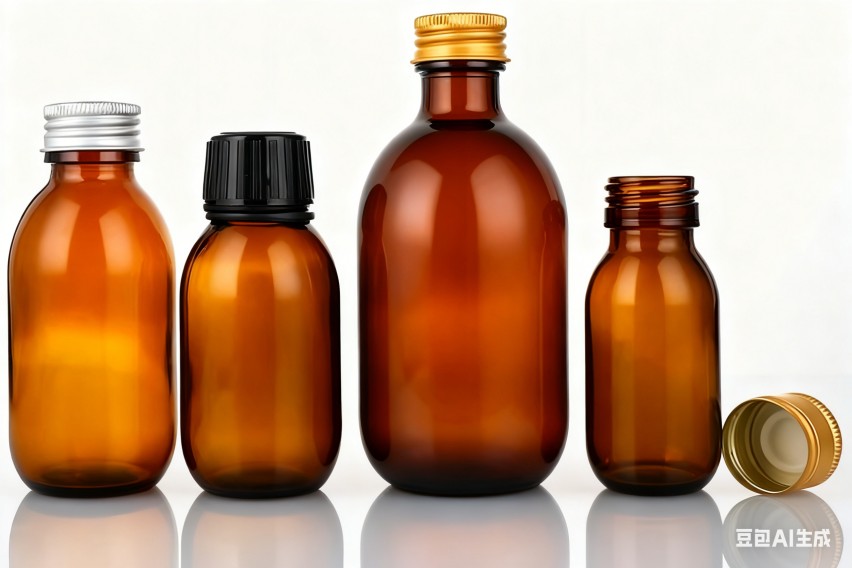
5. Case Study: Solving the “Sticky Neck” Problem for Artisan Brands
The Challenge: A high-volume coffee syrup manufacturer was losing $5\%$ of their inventory due to “stress cracks” at the neck of their syrup pump bottles during the capping process.
The Diagnostic (The “Is it the Glass?” Phase):
Upon inspection, we found the bottles they were using had inconsistent “Finish Dimensions.” The threads were too sharp, creating stress points when the high-torque automatic cappers applied pressure.
The Solution:
We redesigned their glass syrup bottles using a “Rounded-Thread” profile, a design frequently used in heavy-duty cosmetic jars.
- Result 1: Capping failure dropped to $0.01\%$.
- Result 2: The “Hand Feel” of the bottle improved, as the rounded threads allowed for a smoother manual opening experience for the end-user.
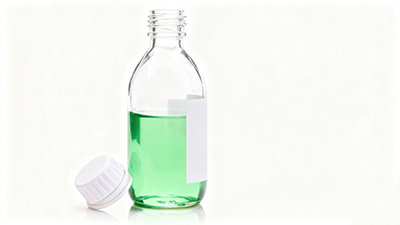
6. Aesthetic Customization: The Cosmetic Touch
A simple syrup bottle doesn’t have to look simple. We offer several “Cosmetic-Grade” finishes:
- Acid Frosting: Gives the glass a soft, satin touch while hiding fingerprints.
- Screen Printing: High-fire frit inks that are fused to the glass at $600^\circ\text{C}$, making them scratch-proof and resistant to the acids found in citrus syrups.
- Hot Stamping: Adding gold or silver foil elements to the neck for luxury branding.
7. Technical Specifications Table for Sourcing
| Feature | Standard Requirement | Glass Bottle Supplies Standard |
| Glass Type | Soda-Lime | Extra Flint (High Clarity) |
| Lead Content | $<100\text{ppm}$ | $0\text{ppm}$ (Lead-Free) |
| Annealing Quality | Grade 3 | Grade 1-2 (Superior Strength) |
| Neck Finish | Standard GCMI | Precision Machined 28-410 |
| Pump Output | $\pm20\%$ Variance | $\pm3\%$ Variance |
Conclusion: The Investment in Quality
Whether you are choosing mini syrup bottles for a subscription box or a 1-liter syrup pump bottle for a busy cafe, the “why” behind your choice should always be rooted in safety, durability, and brand perception. By choosing glass manufactured to cosmetic standards, you are not just buying a container; you are buying insurance for your brand’s reputation.