 GlassBottleSupplies












Sales manager will contact you within 24 hours
Why Amber Glass Dropper Bottles Are the Scientific Standard for Light-Sensitive Storage
In the world of precision chemistry and high-end cosmetics, the choice of a container is never merely about aesthetics. When we look at the widespread adoption of amber dropper bottles, we are looking at a solution rooted in physics, material science, and pharmaceutical history. The primary objective of an amber glass dropper bottles system is to provide a “controlled environment” for liquids that are susceptible to photo-oxidation or chemical leaching. However, to truly understand the value of these vessels, one must look beyond the color and into the molecular engineering of the glass itself.
Why Is Amber Glass the Gold Standard?
Before asking “why” amber is preferred, we must first ask: “Is it true that amber glass offers superior protection compared to other colored glass variants?”
The answer is a definitive yes, based on the light transmission spectrum. While clear glass (Flint) allows the full spectrum of visible and ultraviolet (UV) light to pass through, and cobalt blue glass blocks some UV but allows higher-energy blue light to penetrate, amber dropper bottles act as a specialized filter.
By incorporating iron, sulfur, and carbon into the glass batch, manufacturers create a lattice structure that effectively blocks wavelengths between 200nm and 450nm. This is the range where the most damaging photochemical reactions occur. If you are storing a high-potency Vitamin C serum or a volatile laboratory reagent, using an amber glass dropper bottles setup is the only way to ensure the “half-life” of your product remains consistent with its expiration date.
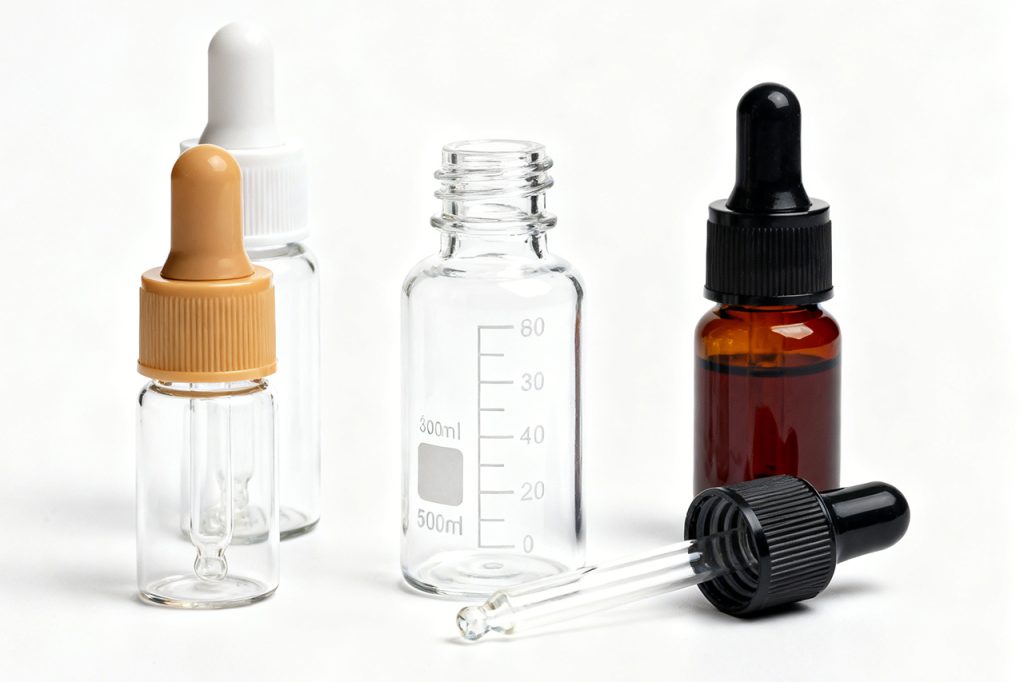
What Defines a High-Quality Bottle with Dropper?
A bottle with dropper is a two-part mechanical system. The efficacy of the seal is determined by the GPI (Glass Packaging Institute) neck finish and the elasticity of the bulb.
1. The Neck Finish (The 18-400 Standard)
Most amber dropper bottles used in the industry utilize the 18-400 neck finish.
- 18: The millimeter measurement of the neck diameter.
- 400: The thread style (single turn).
If the “land” (the flat top surface of the bottle rim) is not perfectly horizontal, the dropper and bottle connection will fail. Even a deviation of 0.05mm can cause the liquid to bypass the liner, leading to evaporation or “weeping” during transit.
2. Pipette Material: USP Type I vs. Type III
In a professional bottle with dropper assembly, the glass pipette (the tube) should ideally be made of USP Type I Borosilicate glass. While the bottle itself is often Type III Soda-Lime, the pipette comes into constant contact with the liquid and is subject to more mechanical stress. Using Type I glass for the pipette ensures it remains chemically inert and does not “flake” over time—a phenomenon known as delamination.
Top Standards: Reagent Bottle Borosil vs. Soda-Lime
In laboratory environments, you will often see the term reagent bottle borosil. It is vital to distinguish between standard soda-lime amber glass dropper bottles and those made from Borosilicate (Borosil) glass.
- Soda-Lime (Type III): Sufficient for most essential oils, tinctures, and cosmetic serums. It offers excellent UV protection in its amber state but has lower thermal shock resistance.
- Borosilicate (Reagent Bottle Borosil): This glass contains at least 5% boric oxide. A reagent bottle borosil can withstand extreme temperature fluctuations (low Coefficient of Expansion). This is crucial for laboratory reagents that might be heated or stored in cryogenic conditions.
If your process involves sterilization in an autoclave at 121°C, a standard soda-lime bottle with dropper might crack. In such cases, the high-silica content of a reagent bottle borosil is non-negotiable for safety and integrity.
Real Product Case Study: The “Pure-Extracts” Stability Crisis
Client Background:
Pure-Extracts, a high-end botanical lab specializing in rare CBD-terpene blends, was experiencing a “potency drop” in their products. Within 60 days of bottling, their lab tests showed a 22% degradation in specific terpene concentrations. They were using clear bottle with dropper sets with basic plastic caps.
The Diagnostic Process:
- Light Sensitivity Test: We placed their clear bottles under standard retail LED lighting for 30 days. The results showed significant photo-oxidation.
- Sealing Analysis: We found that their previous dropper and bottle interface used a generic TPE (Thermoplastic Elastomer) bulb, which was “off-gassing” and reacting with the terpenes.
The Solution:
We transitioned Pure-Extracts to our amber dropper bottles with the following upgrades:
- Container: 30ml amber glass dropper bottles (Type III Glass).
- Closure: 18-400 child-resistant dropper with a Fluorinated Rubber (Viton) bulb. Viton is far more resistant to aggressive botanical oils than standard rubber.
- The Reagent Standard: For their high-concentration “Mother Liquor” storage, we provided the reagent bottle borosil 500ml variants to ensure zero chemical interaction during the bulk storage phase.
The Results:
- Shelf Stability: Potency degradation dropped from 22% to less than 2% over a 6-month period.
- Customer Trust: The move to amber glass dropper bottles communicated a “clinical” and “premium” brand identity, allowing the client to justify a 15% price increase.
- Zero Leakage: By matching the 18-400 neck finish perfectly with our precision pipettes, shipping-related returns were eliminated.
What to Look for in a Dropper and Bottle Assembly
When procurement teams source amber glass dropper bottles, they often focus on price, but the hidden costs of poor glass quality can be devastating.
Hydrolytic Resistance
Every reagent bottle borosil or high-grade amber dropper bottles unit is rated for hydrolytic resistance. This measures how much alkali the glass releases into water. For high-purity reagents, you require “Class H1” glass. Lower quality glass can shift the pH of your formulation, rendering it unstable or causing skin irritation in cosmetic applications.
Dimensional Uniformity
A “cheap” bottle with dropper often has “thin spots” in the glass walls. During the blowing process, if the glass distribution is not even, the bottle becomes a liability. A professional manufacturer uses automated “wall thickness” sensors to ensure that every amber glass dropper bottles unit can withstand the vertical pressure of automated capping machines.
Top Benefits of Using Amber Glass in WordPress E-commerce Stores
If you are a distributor selling these products on a WordPress or WooCommerce platform, your SEO strategy should emphasize the technical reliability of your amber dropper bottles.
- UV Protection (The “Why”): Explain that the iron-oxide in the glass acts as a natural sunscreen for the liquid inside.
- Chemical Inertness: Emphasize that unlike plastic, a bottle with dropper made of glass won’t leach BPA or phthalates into the product.
- Sustainability: Glass is 100% recyclable. A reagent bottle borosil can be recycled into a new bottle without any loss in purity.
Technical Comparison: Standard Glass vs. Reagent Bottle Borosil
| Feature | Amber Dropper Bottles (Soda-Lime) | Reagent Bottle Borosil (Borosilicate) |
| UV Filtration (200-450nm) | Excellent (>90%) | Excellent (>90% if amber) |
| Max Temperature | ~100°C | ~500°C |
| Thermal Shock Resistance | Low (ΔT 40°C) | High (ΔT 160°C) |
| Primary Use Case | Cosmetics, Essential Oils, CBD | Laboratory Acids, High-Heat Chemicals |
| Chemical Resistance | Good (Class 3) | Superior (Class 1) |
Conclusion: The Precision of the Amber Vessel
The selection of amber glass dropper bottles is a hallmark of a brand that understands the science of its own product. Whether you are using a 10ml amber dropper bottles for a facial oil or a large reagent bottle borosil for laboratory solvents, the physics of protection remain consistent. By ensuring a perfect fit between the dropper and bottle, and choosing the correct glass chemistry, you secure your product’s future.
Precision in packaging is not just an expense; it is the final step of the manufacturing process that guarantees your liquid reaches the consumer in its most potent, untainted state.