 GlassBottleSupplies












Sales manager will contact you within 24 hours
What Defines the High-Performance 1 oz Perfume Bottle in Professional Manufacturing?
The global fragrance market has undergone a fundamental shift. While 100ml flacons once dominated vanity tables, the rise of “scent wardrobes” has catapulted the 1 oz perfume bottle (30ml) to the top of the production list. For manufacturers, this size represents the “Golden Ratio” of profitability, portability, and product freshness. However, as designs become more eccentric—exemplified by the iconic shoe perfume bottle—the technical challenges of glass distribution and structural integrity become paramount.
1. Why the 1 oz Perfume Bottle is the Strategic Choice for 2025
The 1 oz perfume bottle is no longer just a “travel size.” It is a strategic tool for market penetration.
Consumer Psychology and the “Entry Price”
In a luxury market, a $300 price tag for 100ml can be a barrier. A 1 oz perfume bottle allows brands to offer the same prestige at a $75–$95 price point. This “prestige entry” increases conversion rates for first-time buyers while maintaining high margins for the manufacturer.
Preserving Formula Integrity
High-end perfumes often contain natural absolutes and essential oils that degrade upon contact with oxygen. A 1 oz perfume bottle is typically consumed within 3–6 months, ensuring the user experiences the top notes before they oxidize. From a manufacturing standpoint, this smaller volume allows for a more controlled “headspace” (the air gap between the liquid and the pump), which is critical for preventing premature aging of the scent.
2. The Complexity of the Shoe Perfume Bottle: Engineering Non-Symmetrical Glass
The shoe perfume bottle—often shaped like a high-heeled stiletto—is one of the most difficult shapes to produce in a high-volume glass factory.
The Challenge of “Glass Distribution”
In a standard cylindrical bottle, molten glass (the “gob”) expands evenly against the mold walls. However, in a shoe perfume bottle, the “heel” and the “toe” create sharp angles.
- The Risk: If the glass is too thin at the “heel,” it becomes a structural weak point.
- The Solution: We utilize “Press-and-Blow” molding rather than traditional “Blow-and-Blow.” This allows us to mechanically press the glass into the narrow extremities of the shoe mold, ensuring a uniform wall thickness that prevents the bottle from feeling “top-heavy” or fragile.
Mold Seam Management
For a high-fashion shoe perfume bottle, visible mold seams are considered a defect. We use specialized CNC-machined stainless steel molds with vacuum-venting to ensure the seams are virtually invisible, giving the glass a seamless, “crystal-cast” appearance.
3. The Science of the Blue Perfume Bottle: Cobalt vs. Coating
When a brand requests a blue perfume bottle, they are often choosing between two distinct manufacturing paths: “Glass-through” color or “Surface Decoration.
Cobalt Glass (Internal Color)
To create a true blue perfume bottle, Cobalt oxide is added directly to the furnace. This results in a deep, rich blue that is chemically part of the glass.
- Advantage: It will never scratch or peel.
- Technical Note: Cobalt blue glass provides excellent UV protection, blocking wavelengths below 400nm, which is essential for protecting the “juice” from sunlight-induced discoloration.
Organic Spray Coating
For brands that want a specific shade of “Tiffany Blue” or “Midnight Navy,” we use organic water-based sprays on clear 1 oz perfume bottle blanks.
- The Secret to Adhesion: To prevent the color from peeling, the glass must undergo “Silanization” or a “Flame Treatment” before spraying. This changes the surface tension of the glass, allowing the blue pigment to bond at a molecular level.
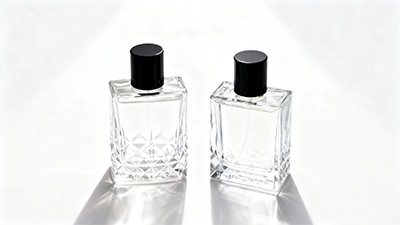
4. Preventing the “Broken Perfume Bottle” Disaster
Nothing destroys a brand’s reputation faster than a broken perfume bottle arriving at a customer’s doorstep. In the industry, we analyze breakage through the lens of “The Three Stresses.”
1. Thermal Stress (The Annealing Lehr)
If a bottle is cooled too quickly after molding, internal tension remains trapped. This is why a broken perfume bottle might seemingly “explode” on a shelf without being dropped. We pass every batch through an 80-meter-long Annealing Lehr (oven) where the temperature is dropped by only $1^\circ C$ every few minutes, neutralizing internal stress.
2. Vertical Load Stress
During the “crimping” process—where the metal pump is squeezed onto the glass neck—the bottle must withstand up to 150kg of downward force. If the “shoulder” of your blue perfume bottle is not engineered with a specific radius, the glass will succumb to “hoop stress,” resulting in a broken perfume bottle right on the assembly line.
3. Impact Resistance
For non-symmetrical shapes like the shoe perfume bottle, we perform “Pendulum Impact Tests.” We strike the bottle at its weakest points to ensure it meets international safety standards for retail handling.
5. Case Study: The “Azure Stiletto” Project
The Client: A European luxury house launching a limited-edition “Midnight” fragrance.
The Brief: A 30ml (1 oz perfume bottle) in the shape of a stiletto, with a deep gradient blue perfume bottle finish.
Our Engineering Solution:
- Weighted Base: We designed the “sole” of the shoe to be 12mm thick. This moved the center of gravity to the bottom, ensuring the bottle wouldn’t tip over on a dressing table.
- Gradient Vacuum Metallization: Instead of simple paint, we used Vacuum Metallization (PVD) to create a “blue-to-clear” gradient. This allowed the consumer to see the liquid level while maintaining the “high-fashion” aesthetic.
- Transit Optimization: Because of the fragile “heel” design, we engineered a custom EPE foam insert for the wholesale master cartons.
The Result: Despite the complex shape, the breakage rate during sea-freight was 0%. The client sold out of the 50,000-unit run within two weeks of launch, specifically citing the “tactile weight” of the glass as a key selling point.
6. Professional Industry Knowledge: The “Neck Finish”
When sourcing wholesale perfume bottles, you must understand the “Neck Finish” standards. Most 1 oz perfume bottle designs use one of two standards:
- FEA 15: The European standard for “crimp” pumps. It requires a specialized machine to seal the pump.
- 18/415 or 20/410: Threaded necks for “screw-on” pumps. While easier for DIY brands, these are rarely used in luxury perfumery because they are not “tamper-proof.”
At GlassBottleSupplies, we recommend FEA 15 for any blue perfume bottle intended for professional retail, as it provides a cleaner aesthetic and a superior airtight seal.
7. Sustainability in Glass Manufacturing
Is a broken perfume bottle recyclable? Yes. Glass is infinitely recyclable. However, for a blue perfume bottle, the cobalt colorant means it must be recycled with other “colored glass” (cullet). We are currently developing “Lightweighting” techniques for our 1 oz perfume bottle lines, reducing glass mass by 15% without sacrificing the 1.5-meter drop-test rating.