 GlassBottleSupplies












Sales manager will contact you within 24 hours
What Top Niche Brands Know About the Mini Perfume Bottle Economy in 2026
The fragrance industry is undergoing a structural shift. The era of the blind buy—purchasing a $200 100ml bottle based on a magazine ad—is dead. In 2026, the market is driven by the “Discovery Economy.”
For brand owners and procurement managers, this means the perfume bottle mini is no longer an afterthought or a “gift with purchase.” It is the primary vehicle for customer acquisition. Simultaneously, sustainability mandates are forcing a transition from crimped, disposable necks to the refill perfume bottle architecture.
This analysis explores the technical realities of sourcing perfume sample bottles, the engineering behind leak-proof refill perfume bottle systems, and the critical compatibility factors of perfume for perfume bottles in smaller formats. We move beyond aesthetics to discuss tubular glass physics, pump dosage metrics, and the logistics of the “nomadic” scent market.
1. The Engineering of the “Mini”: Tubular vs. Molded Glass
When sourcing a perfume bottle mini, the first decision is the manufacturing process. Unlike standard 50ml or 100ml bottles which are exclusively “molded,” small formats (2ml to 15ml) offer two distinct paths: Tubular Glass and Molded Glass.
Tubular Glass Vials (The Sample Standard)
Most perfume sample bottles (1ml – 5ml) are made from glass tubing.
- The Process: Long tubes of borosilicate or neutral glass are heated and cut (flamed) to length. The neck is formed by tooling the end of the tube.
- The Pros:
- Wall Uniformity: The walls are incredibly thin and uniform (approx. 1mm), making the bottle lightweight.
- Clarity: High-quality neutral glass offers excellent optical clarity for displaying the liquid color.
- Cost: significantly cheaper tooling costs than molds.
- The Cons:
- Fragility: They are more prone to crushing than molded glass.
- Design Limits: You are limited to cylinders. You cannot have a square or custom-shaped tubular vial.
Molded Glass Minis (The Luxury Choice)
For a premium perfume bottle mini (7ml – 15ml), brands use the “Blow-and-Blow” molding process.
- The Process: Molten glass is dropped into a mold (parison) and blown into shape.
- The Aesthetic: This allows for heavy glass distribution at the bottom (the “slug” or “heel”). A 10ml molded bottle with a heavy bottom feels like a luxury object; a 10ml tubular vial feels like a lab sample.
- 2026 Trend: We are seeing a surge in “Baby Molded Bottles”—exact 1:1 miniaturizations of the full-size 100ml bottle. This maintains brand identity in the travel-size market.
2. The Refill Revolution: Screw Necks vs. Crimp Necks
The definition of a refill perfume bottle has changed. Historically, this meant a cheap plastic atomizer you filled with a funnel. In 2026, it refers to the primary packaging being refillable.
The Death of the Crimp?
Traditionally, perfume pumps are “crimped” (metal clinched over the glass lip). This is permanent. To make a bottle refillable, the industry is moving to Screw Necks (e.g., GPI 15/415 or FEA 15 Screw).
The Engineering Challenge: A screw-on pump is risky for perfume for perfume bottles.
- Back-Off: Vibrations during shipping can cause a screw pump to loosen, leading to leakage.
- Oxidation: If the user doesn’t tighten the pump enough after refilling, air enters, oxidizing the top notes of the fragrance.
The Solution:
- Ratchet Systems: Modern screw necks feature microscopic “teeth” on the glass and the pump collar. When tightened, they click into place (like a child-proof cap), preventing the pump from backing off while still remaining removable with intentional force.
- Sepa Srl / Aptar Technologies: Leading pump manufacturers are developing “crimpless” screw pumps that look like crimped metal (sleek, low profile) but hide a threaded internal mechanism.
3. The Mechanics of “Travel Sprays” (Refill Perfume Bottle Systems)
Beyond the bottle itself, the perfume refill bottle category includes the “Travel Atomizer” market—the aluminum shells that house inner glass vials.
Bottom-Fill Technology
The most significant innovation in perfume refill bottle tech is the “Bottom-Fill” valve (popularized by Travalo).
- How it Works: The travel bottle has a valve at the bottom. The user removes the spray head from their main perfume bottle, exposing the stem. The travel bottle is pumped onto the stem. Liquid flows directly from the big bottle to the small bottle without exposure to air.
- Why It Matters: This preserves the integrity of the perfume for perfume bottles. Traditional pouring via a funnel exposes the alcohol to air, causing rapid evaporation and scent degradation. Bottom-fill systems keep the system hermetic.
The “Twist-Up” Mechanism
For luxury perfume sample bottles (10ml size), the “Twist-Up” chassis is the standard.
- Construction: An inner glass vial (replaceable) sits inside a weighted aluminum or zamac shell. Twisting the shell pops the nozzle up.
- Sourcing Spec: When sourcing these, the critical tolerance is the “Friction Fit.” The inner vial must not rattle inside the shell, but it must be loose enough to be pulled out for replacement. A tolerance of ±0.1mm on the plastic liner is required.
4. Evaporation Physics in Mini Bottles
A critical, often overlooked aspect of perfume bottle mini engineering is the Surface-Area-to-Volume Ratio.
In a 100ml bottle, the liquid surface area exposed to the headspace (air gap) is small relative to the total volume. In a 2ml perfume sample bottle, this ratio is massive.
- The Risk: Ethanol permeates through plastic. If the closure (stopper or pump) is not perfect, a 2ml sample can evaporate to 1ml in 6 months, changing the concentration of the perfume oil (making it syrupy and altering the scent profile).
- The Fix:
- Glass vs. Plastic: Never use plastic (PET/PP) vials for long-term storage of high-end perfume. Glass is impermeable.
- Orifice Reducers: For non-spray sample bottles (dabbers), the plastic plug (orifice reducer) must be made of LDPE or PE with a specific shore hardness that creates a compression seal against the glass ID (Inner Diameter).
- Snap-on Pumps: For 2ml samples, “Snap-On” pumps offer a better seal than simple plugs. They require a machine to apply force to snap them over the glass bead, creating a tighter seal than a screw-on variant.
5. Case Study: The “Discovery Set” Strategy of ScentLab Architects
To understand the business impact of selecting the right perfume refill bottle architecture, we look at “ScentLab Architects” (a composite case study based on real 2024-2025 data).
The Challenge: ScentLab was a niche brand selling $250 bottles. Their Customer Acquisition Cost (CAC) was high because customers were hesitant to blind-buy expensive scents online.
The Strategy: They launched a “Discovery Library”—a set of five 2ml perfume sample bottles.
The Packaging Failure (Phase 1): Initially, they sourced cheap, plastic 2ml vials with pop-off caps to save money.
- Result: The alcohol in the perfume reacted with the cheap plastic, giving the scent a “chemical” off-note. Furthermore, 15% of the vials leaked in transit because the plastic caps popped off under air pressure in cargo planes. Customers felt the brand was “cheap.”
The Packaging Pivot (Phase 2): ScentLab switched to Glass Tubular Vials (High Borosilicate) with a Snap-On Bayonet Pump.
- Volume: 2.5ml (filled to 2ml to allow headspace for expansion).
- Material: The glass ensured the perfume for perfume bottles remained chemically stable (neutral pH).
- The Refill Incentive: They included a voucher. If the customer bought a full-size bottle, they received a complimentary 10ml perfume refill bottle (empty) and a mini funnel.
- The Bottle: The full-size bottle was redesigned with a screw-off pump (FEA 15) to allow users to pour into the 10ml refill bottle.
The Financial Outcome:
- Conversion Rate: The Discovery Set conversion rate (people buying the full bottle after sampling) jumped from 8% to 22%.
- Brand Perception: The glass snap-on vials felt like “miniature perfumes” rather than “testers.”
- Sustainability: The refillable ecosystem increased customer retention (LTV), as customers bought “refill pouches” (aluminum spout bags) to fill their 10ml travel bottles.
6. Sourcing “Perfume for Perfume Bottles”: Compatibility
When we discuss perfume for perfume bottles, we are discussing the interaction between the juice (Fragrance Oil + Ethanol + Water) and the component materials.
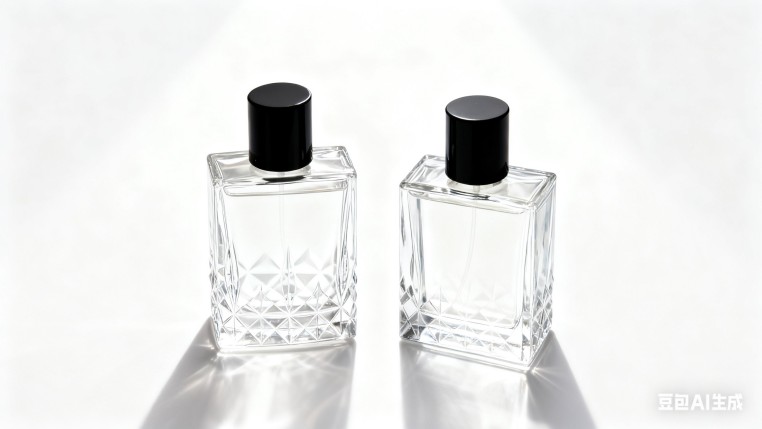
The Dip Tube Dilemma
In a perfume bottle mini, the dip tube (the straw) is critical.
- Material: It must be PE or PP.
- Visibility: In 2026, the trend is “Invisible Dip Tubes.” These are made from a specialized polymer with a refractive index identical to that of perfume alcohol. When submerged, the tube disappears. This is a massive aesthetic upgrade for clear perfume sample bottles.
- Length: In a 50mm tall bottle, the dip tube must be cut to exactly 51mm.
- Too Short: The user cannot spray the last 10% of the product.
- Too Long: The tube curves excessively (“J” shape) and gets stuck against the wall, potentially blocking the intake.
The Actuator (Spray Nozzle)
A 2ml perfume bottle mini cannot have the same spray output as a 100ml bottle.
- Dosage: A standard pump dispenses 100mcl to 140mcl (microliters) per spray. This is too much for a mini bottle; it would empty in 15 sprays.
- Mini Specification: For perfume sample bottles, specify a Low-Dosage Actuator (40mcl – 60mcl). This creates a finer mist (better for smelling notes) and extends the life of the sample, giving the customer more “wear tests” per vial.
7. The Future of Refill: 2026 and Beyond
As EU packaging waste regulations tighten, the refill perfume bottle is moving from “Niche” to “Mandatory.”
Aluminum Refill Stations
We are seeing the rise of aluminum refill canisters. Brands sell a beautiful, heavy glass perfume bottle mini (10ml) once. Then, they sell 100ml aluminum cans with spouts. The user refills the glass mini at home.
- The Glass Requirement: This requires the glass mini to be robust. It will be opened and closed hundreds of times. The threads on the glass neck must be reinforced (fire-polished) to prevent chipping during repeated refilling.
Customization at Scale
Laser engraving on perfume refill bottle aluminum shells is becoming standard. Brands utilize fiber lasers to etch customer initials onto the travel case, making the refillable item a personalized keepsake that is never thrown away.
Conclusion
The shift to the perfume bottle mini and refill perfume bottle systems is an engineering challenge disguised as a marketing trend.
For the brand owner, success lies in the details: choosing glass over plastic for perfume sample bottles to preserve scent integrity; selecting the correct screw-neck tolerances to ensure leak-proof refilling; and calculating the precise dosage of the actuator to maximize the customer’s trial experience.
In 2026, the bottle is no longer just a container for the perfume; it is a durable, refillable tool for the modern, nomadic lifestyle. Whether you are scaling a startup or managing a legacy brand, prioritizing the engineering of your small-format packaging is the most direct path to building brand loyalty.