 GlassBottleSupplies












Sales manager will contact you within 24 hours
The Science of Smooth: Engineering the Perfect Glass Roller Bottle for Premium Brands
In the competitive world of cosmetics and aromatherapy, the application experience is just as critical as the formulation itself. For brand owners, sourcing packaging isn’t merely about aesthetics; it is an engineering challenge. When a customer uncaps a perfume roller bottle, they expect a seamless glide, consistent dosage, and zero leakage.
This guide delves into the technical nuances of glass roller bottles, moving beyond basic descriptions to the specific manufacturing tolerances, material interactions, and quality control protocols that separate a luxury component from a generic failure.
The Mechanics of Application: “Fitment” and Capillary Action
Before discussing the aesthetic appeal of a essential oil roller bottle, we must address the core functionality: the fitment. Many brands ask, “Why do our bottles leak?” or “Why is the roller stuck?” To answer this, we first look at what constitutes the roller mechanism.
A bottle roller system consists of three distinct parts:
- The Sphere (The Ball): The dynamic component that transfers liquid.
- The Housing (The Fitment): The plastic or metal casing that holds the sphere.
- The Bottle Neck: The glass finish that secures the housing.
The functionality relies on controlled capillary action. The gap between the sphere and the housing is measured in microns.
- If the gap is too tight: The surface tension prevents the liquid from coating the ball. Result: A “dry” roll that drags on the skin.
- If the gap is too loose: The vacuum seal breaks, and gravity takes over. Result: Leakage in the consumer’s purse or during shipping.
High-quality manufacturing requires a tolerance level of ±0.05mm for the housing fitment. This precision ensures that when the ball rotates, it pulls up exactly the right amount of high-viscosity essential oil or low-viscosity perfume.
Material Selection: Stainless Steel vs. Glass vs. Plastic Balls
Selecting the right bottle roller material is not a matter of cost; it is a matter of chemical compatibility and sensory experience.
1. Stainless Steel (304 vs. 316L)
The industry standard for premium essential oils roller bottles.
- The “Is it?”: Is it just about durability?
- The “Why?”: No, it is about thermodynamics and chemistry. Stainless steel provides a “cooling effect” upon contact with the skin, which enhances the perception of freshness in eye serums and headache relief blends.
- 304 Steel: Suitable for general oils.
- 316L Steel: Required for highly acidic formulations or medical-grade applications to prevent corrosion (rusting) inside the housing.
2. Glass Spheres
Often used in high-end perfume vials.
- Chemical Inertness: Glass is non-reactive. If your formulation contains aggressive solvents or extremely delicate top notes that might react with metal ions, glass is the superior choice.
- Friction: Glass-on-plastic housing creates a smoother, more “gliding” sensation compared to metal.
3. Plastic (PP/PE)
Generally reserved for lower-cost items or very thick gels where the lighter weight helps the ball rotate more easily against high resistance.
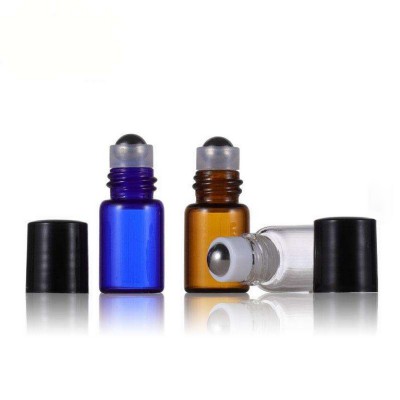
The Glass Vessel: Why Amber and Cobalt Blue Matter
When sourcing glass roller bottles, the color is rarely just for branding. It serves a functional purpose: Photoprotection.
Many essential oils (like Bergamot, Lemon, and other citruses) are photosensitive. Exposure to UV light causes oxidation, breaking down the chemical compounds. This turns a therapeutic oil into a skin irritant.
- Amber Glass: Filters out the highest percentage of UV light (blue and ultraviolet spectrums). It is the gold standard for pure essential oils.
- Cobalt Blue / Green: Offers moderate protection but is often chosen for its premium visual appeal on the shelf.
- Clear/Frost Glass: Best for synthetic perfumes where UV stability is managed by chemical stabilizers, allowing the color of the liquid to be the star.
Industry Note: True colored glass (molded from colored molten glass) is superior to painted glass. Painted glass can chip or react with essential oils if they drip down the side of the bottle.
Case Study: Solving the “Viscosity Mismatch” for a European Skincare Brand
To illustrate the importance of matching the essential oil roller bottle to the formulation, let us look at a real-world scenario from our manufacturing archives.
The Client: A mid-sized European skincare brand launching a new “Night Repair Eye Serum.”
The Formulation: A dense, carrier-oil-heavy blend (Rosehip and Argan base) with a high viscosity.
The Problem: The client initially sourced standard generic roller bottles. During pre-launch testing, they faced a critical failure: The “Dry Roll.” Customers complained that nothing was coming out. The brand assumed the roller balls were “stuck.”
The Root Cause Analysis: We analyzed the client’s previous packaging.
- Is the ball stuck? No, the ball rotated freely manually.
- Why is no oil dispensing? The housing they selected was designed for perfume (low viscosity, water-like). The gap between the ball and housing was too narrow for the thick Argan oil to penetrate via capillary action. The oil was effectively “sealing” the gap rather than flowing through it.
The Solution: We did not change the glass bottle. Instead, we engineered a custom fitment solution:
- Housing Modification: We increased the clearance gap in the housing by 0.1mm.
- Surface Texture: We switched to a “frosted” finish on the stainless steel ball. The microscopic texture on the ball grabbed the thick oil more effectively than a polished smooth ball, dragging it out of the housing.
The Result: The “Night Repair Eye Serum” launched successfully. The revised bottle roller dispensed a generous, consistent layer of serum with a single swipe. The brand reported a 0% return rate regarding functionality in the first quarter.
Quality Control: The Vacuum Test
How do you ensure a shipment of 50,000 perfume roller bottles won’t leak in an airplane cargo hold? The answer lies in negative pressure testing.
At the factory level, reliable manufacturers perform random sampling vacuum tests.
- Bottles are filled with a dyed liquid.
- The roller mechanism is inserted.
- The bottles are placed in a vacuum chamber.
- Pressure is reduced to simulate high-altitude conditions (0.06 MPa).
If any dye escapes around the roller ball or the neck fitment, the batch is flagged. This is crucial for brands engaging in international e-commerce, where packages undergo significant pressure changes.
Customization: Beyond the Label
In a crowded market, the glass roller bottles must act as brand ambassadors. Secondary processing is where differentiation happens.
- Hot Stamping: Applying gold or silver foil directly to the glass. This is far more durable than a paper label, which can peel when exposed to oil.
- Silk Screen Printing: Ideal for 360-degree branding on the cylindrical surface.
- Electroplating: turning the glass cap or the shoulder into a metallic finish.
Currently, the trend is moving towards minimalist design with heavy glass. “Heavy bottom” glass rollers create an optical illusion of volume and provide a luxurious weight in the hand, signaling quality to the consumer before they even smell the product.
Sustainability and Refillability
The modern consumer is eco-conscious. Essential oils roller bottles are naturally positioned as sustainable packaging because they are:
- Durable: Glass does not degrade.
- Refillable: The fitments can be removed (with a proper tool) to allow the user to refill the bottle, extending the product lifecycle.
Marketing your roller bottles as “Refillable Travel Companions” adds significant value to the end product, justifying a higher price point.
Conclusion: precision in Packaging
Sourcing perfume roller bottles or containers for essential oils is not a commodity purchase; it is a technical decision. From the UV rating of the glass to the micron-level tolerance of the steel ball, every detail impacts the user experience.
Whether you are launching a calming lavender roll-on or a high-end botanical perfume, understanding the interplay between your liquid’s viscosity and the bottle roller mechanism is the key to market success. Ensure your manufacturing partner understands not just glass, but the science of application.