 GlassBottleSupplies












Sales manager will contact you within 24 hours
Beyond the Mold: Transforming Wholesale Glass Jars into Luxury Brand Assets
In the high-stakes world of cosmetic and home fragrance marketing, the vessel is the first salesman. When a consumer picks up a product, the weight, the texture, and the closure mechanism communicate value before they ever smell the fragrance or test the cream.
For many emerging and established brands, the assumption is that “Luxury requires a custom-molded bottle.” Is this true? No. Some of the world’s most iconic luxury brands utilize “stock” (ready-made) glass molds. Why? Because the mold defines the shape, but the secondary processing (decoration) and the closure engineering define the brand identity.
This guide explores how to leverage wholesale glass jars and advanced decoration techniques to create a unique market presence without the six-figure investment of a private mold.
1. The Economics of Distinction: Custom Mold vs. Custom Decor
When sourcing glass jars wholesale, you face a fork in the road: Private Mold or Stock Mold.
- Private Mold: You own the design.
- Cost: High ($15,000+ tooling fees).
- Time: 3-4 months for development.
- MOQ: Usually 50,000+ units per run.
- Stock Mold with Custom Decor: You use existing shapes (Straight Sided, Boston Round) but alter the surface.
- Cost: Low (Setup fees ~$200).
- Time: 3-4 weeks.
- MOQ: Flexible (often 3,000 – 10,000 units).
The Strategic “Why”: Why do big brands often stick to stock molds? Because speed-to-market is critical. By utilizing standard glass jars with lid configurations, they can launch seasonal variations (e.g., a red matte finish for Christmas, a frosted finish for Spring) using the exact same glass inventory, simply by changing the decoration line.
2. Advanced Decoration Technologies for Glass
To transform a generic container into a premium product, we utilize several industrial processes. It is vital to understand the difference between them to communicate effectively with your supplier.
Silk Screen Printing (Ceramic vs. Organic Ink)
This is the direct application of ink onto the glass through a mesh screen.
- High-Temperature Ceramic Ink: The jar is printed and then baked in a lehr at ~600°C.
- Pros: The ink fuses with the glass. It is scratch-proof and permanent. Ideal for glass candle jars because the heat of the candle won’t peel the ink.
- Cons: Limited color range (matte colors are difficult).
- Low-Temperature Organic (Epoxy) Ink: Cured at ~180°C.
- Pros: Can achieve vibrant Pantone matches, including bright pinks and violets.
- Cons: Less scratch-resistant than ceramic. Not recommended for the bottom of jars that slide on surfaces.
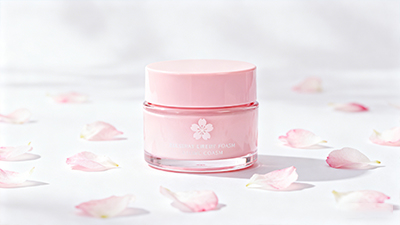
Hot Stamping (Foil Stamping)
This gives the metallic gold or silver logo effect. Is it true that you can hot stamp directly on glass? No. Foil does not stick to raw glass. Why? Glass has low surface energy. The Solution: We must first apply a primer or a base coat of spray paint/silk screen ink. The foil is then stamped onto that organic layer. This is why you often see gold logos on painted bottles, but rarely on clear bare glass without a visible “pad” of clear ink underneath.
Acid Etching vs. Sandblasting vs. Spray Frosting
The “Frosted” look is timeless for glass jars with lid sets used in luxury face creams.
- Acid Etching: The glass is dipped in hydrofluoric acid. Result: A smooth, silky, premium satin finish. (Most expensive, highest quality).
- Sandblasting: Particles are blasted at the glass. Result: A rougher, sandy texture. Good for high-grip requirements.
- Spray Frosting: A semi-transparent paint is sprayed on. Result: Looks like frost but can scratch off over time. (Cheapest option).
3. The Critical Role of the Lid (Closure Engineering)
When buying wholesale glass jars, the jar is only 50% of the equation. The interaction between the user and the lid creates the “psychological click” of quality.
Material Selection
- Urea (Thermoset) Caps: Unlike standard PP (Polypropylene) plastic which feels light and “cheap,” Urea is hard, dense, and feels like ceramic or stone. It makes a distinct “clink” sound when tapped.
- Aluminum-Sheathed: A plastic inner thread covered by a metal shell. Popular for glass candle jars to reflect the flame’s light.
- Bioplastics & Wood: Real wood lids (Bamboo, Acacia) are trending. However, as noted in our previous guide, they require a PP or Silicone inner insert to maintain a hermetic seal against the glass rim.
The “Flush Fit” Aesthetics
A mark of high-end design is the “Flush Fit,” where the outer diameter of the cap matches the outer diameter of the jar perfectly, creating a seamless cylinder.
- Design Tip: When browsing glass jars wholesale, look for “Straight Sided” jars (e.g., the standard 9oz jar). These are engineered specifically so that a standard 70-400 or 89-400 lid aligns with the jar’s sidewall.
4. Safety First: The Specifics of Glass Candle Jars Decoration
Decorating candle vessels carries unique risks compared to cosmetic jars.
Is it true that you can paint the inside of a candle jar? Generally, No. Why?
- Flammability: Many organic paints are flammable. If the wick wanders and touches the glass wall, the paint can ignite.
- Chemical Leaching: The heat of the molten wax pool can cause chemicals from the paint to leach into the wax, altering the fragrance throw or creating toxic fumes.
The Professional Approach: For colored candle glass, we either use:
- Solid Color Glass: The glass itself is colored in the furnace (safe).
- External Coating: Spraying the outside only, leaving the inside raw glass.
- Water-Soluble Paints: Advanced eco-friendly paints that are non-flammable and certified for high-heat exposure (up to 200°C).
5. Real Product Case Study: “The Golden Honey” Resurrection
Client Profile: A mid-sized organic skincare brand (Client name anonymized) specializing in Manuka honey masks. The Problem: They were using a generic, clear 50ml glass jar with a black plastic lid. Sales were stagnant. Retailers complained the product “looked cheap” ($20 look for a $60 product). Constraint: They had 20,000 units of the clear wholesale glass jars already in stock and could not afford to scrap them.
The Transformation Strategy: We didn’t change the jar; we changed the perception of the jar.
- Secondary Processing (The Jar): We took their existing clear stock. We applied a translucent amber spray gradient.
- Technique: The bottom of the jar was sprayed solid amber, fading to clear at the top. This mimicked the look of honey settling in a pot. It also protected the active ingredients from UV light at the base where the bulk of the product sat.
- The Decoration: Instead of a paper label (which peels in bathrooms), we used High-Temperature Screen Printing in pure white text. The contrast of white on amber was striking.
- The Lid Swap: We discarded the black plastic lids. We sourced Electroplated Gold ABS caps.
- Why ABS? ABS plastic takes electroplating better than PP, resulting in a mirror-like “liquid gold” finish that didn’t look like plastic.
The Outcome: The “new” packaging was actually the “old” packaging, re-engineered.
- Cost: The re-decoration cost was $0.15 per unit.
- Value: The retail price was successfully raised from $60 to $75.
- Sustainability: No glass was wasted; existing inventory was upcycled. The brand saw a 200% increase in retail placement requests because the product now “popped” on the shelf. This case proves that smart utilization of glass jars with lid customization yields higher ROI than investing in custom glass shapes.
6. Sourcing Strategy for Maximum ROI
To replicate this success, follow this workflow when contacting us at GlassBottleSupplies.com:
- Select the Canvas: Choose a popular stock shape (Boston Round, Straight Sided, Cosmetic Pot) to ensure long-term availability of wholesale glass jars.
- Define the Finish: Do you want soft-touch? Gloss? Frost?
- Prioritize the Closure: Spend 30% of your packaging budget on the lid. The lid is the primary touchpoint.
- Prototype: Always ask for a “Pre-production Sample” (PPS). Never go to mass production based on a digital PDF mock-up. Colors look different on computer screens than they do on curved glass surfaces.
Conclusion
The market for glass jars wholesale is vast, but the market for unique brands is exclusive. The bridge between the two is technical knowledge. By understanding the physics of ink adhesion, the thermal limits of glass candle jars, and the engineering of glass jars with lid combinations, you can create a luxury experience using accessible industrial tools.