 GlassBottleSupplies












Sales manager will contact you within 24 hours
The Science of Photochemical Integrity: Engineering High-Performance Glass Packaging for Modern Professional Lacquers
The intersection of polymer chemistry and precision glass manufacturing defines the modern nail care industry. As formulations transition from traditional nitrocellulose-based fluids to complex, UV-curable oligomers, the demands placed upon nail polish bottles have shifted from mere aesthetic containment to active structural preservation. For a brand to sustain market share, the glass vessel must function as a laboratory-grade shield, ensuring that the kinetic stability of the formula remains uncompromised from the factory floor to the technician’s station.
Beyond Aesthetics: The Material Science of Borosilicate and Soda-Lime Glass
In the context of wholesale nail polish bottles, the choice of glass substrate is the primary determinant of shelf-life. While soda-lime glass remains the industry standard due to its cost-efficiency and clarity, its chemical durability must be reinforced for high-pH or solvent-heavy formulations. Precision manufacturing involves a controlled cooling process—annealing—to eliminate internal stresses that could lead to spontaneous breakage during high-speed filling lines or mechanical capping.
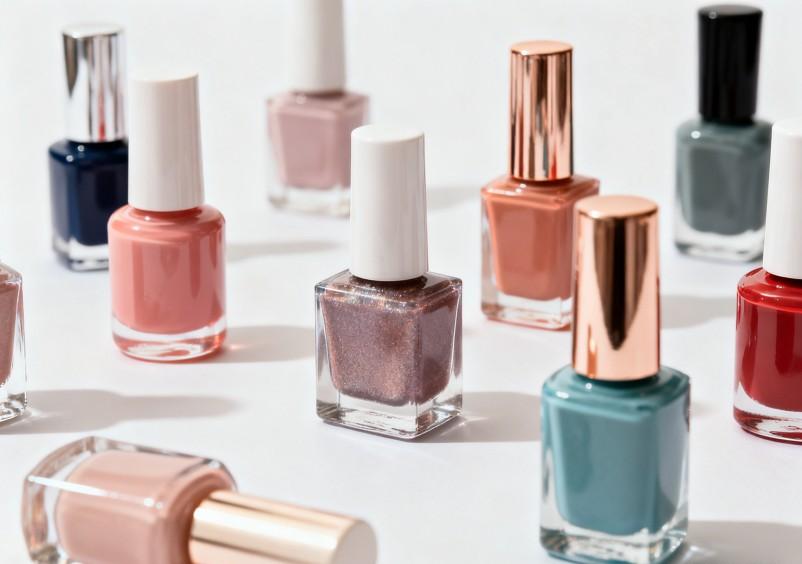
The internal surface energy of the glass is equally critical. For high-viscosity products found in gel bottle nail polish, the “drain-back” effect is a common technical hurdle. If the glass surface tension is too high, the gel adheres to the walls, leading to perceived product waste and consumer dissatisfaction. Advanced manufacturers now utilize internal de-alkalization treatments to create a more inert contact surface, ensuring that every drop of high-value pigment is accessible to the brush.
The Photochemical Barrier: Engineering Light-Inert Packaging
The most significant challenge in contemporary nail packaging is the rise of light-sensitive chemistry. Photo-initiators within gel formulas are designed to react to specific UV wavelengths (typically 365–405nm). However, ambient indoor lighting and incidental sunlight contain enough spectrum overlap to trigger premature polymerization within the bottle.
To combat this, the engineering of gel bottle nail polish containers has moved toward multi-layer opaque coatings. Rather than simple spray painting, professional-grade vessels undergo an electrostatic powder coating or a vacuum metallization process. These methods ensure a 100% opacity rating, preventing “neck curing”—a phenomenon where gel hardens around the bottle opening, compromising the seal and ruining the remaining product.
Technical Comparison: Glass vs. Plastic in Professional Manicure Systems
| Feature | Soda-Lime Glass (Type III) | Polyethylene Terephthalate (PET) | Polypropylene (PP) |
| Solvent Resistance | Absolute (Non-reactive) | Moderate (Risk of crazing) | High |
| Gas Permeability | Zero (Hermetic) | Low | Moderate |
| UV Protection | Requires coating/amber tint | Requires UV stabilizers | Requires pigment |
| Recyclability | Infinite (Cradle-to-cradle) | Down-cycling common | Down-cycling common |
| Thermal Stability | High (Up to 500°C) | Low (Warps at 70°C) | Moderate (Warps at 120°C) |
Scaling Micro-Luxury: The Logistics of Mini Nail Polish Bottles
The market for mini nail polish bottles (typically 3ml to 7ml) has expanded beyond “sample” status into a standalone “micro-luxury” category. From an engineering perspective, downscaling a bottle is not a simple linear reduction. As the volume decreases, the ratio of surface area to liquid increases significantly, which accelerates solvent evaporation if the neck finish is not perfectly calibrated.
For these smaller vessels, the “E-neck” or “GCMI” thread standards must be executed with tighter tolerances. Even a 0.2mm deviation in the neck diameter can lead to “cap-climb,” where the internal pressure of the volatile solvents pushes the cap upward, breaking the airtight seal. In professional kits, where twenty or more mini nail polish bottles are stored together, a single leak can contaminate the entire inventory, making precision molding non-negotiable.
Case Study: Solving Delamination and Viscosity Drift in Professional Gel Systems
Brand Background and Requirement
A Tier-1 European professional salon brand required a bespoke 15ml packaging solution for a new “Extra-Bond” gel series. The formula contained a high concentration of acidic monomers and a proprietary photo-initiator sensitive to visible blue light (up to 450nm). Previous off-the-shelf solutions resulted in “viscosity drift”—the product thickened significantly within 90 days of storage.
Technical Challenges
The primary failure point was identified as monomer-ink interaction. Standard organic inks used on the exterior of the bottles were leaching through microscopic pores in the glass (a rare but documented occurrence in low-density soda-lime glass) or reacting at the neck interface, causing the exterior coating to bubble and peel. Furthermore, the light-blocking capability of standard black coatings was insufficient for the 420-450nm range.
Technical Parameter Specifications
To resolve these issues, the following engineering parameters were implemented:
- Substrate Modification: Transitioned to a high-density “Heavy Base” glass mold to increase thermal mass and decrease thermal fluctuations during shipping.
- Barrier Coating: Applied a dual-layer UV-cured ceramic coating. The base layer utilized a carbon-black dispersion for 100% UV opacity, while the top layer was a chemical-resistant matte finish.
- Wavelength Protection: The coating was tested to ensure 0.0% transmittance between 200nm and 500nm.
- Gasket Engineering: Specified a PTFE-faced EPE (Expanded Polyethylene) liner. Unlike standard PE liners, the PTFE face provided a total chemical barrier against the acidic monomers, preventing liner swelling and “cap-seize.”
- Torque Standard: Set a mechanical capping torque of 1.2 to 1.5 Newton-meters (Nm) to ensure an airtight seal without stripping the plastic threads of the custom-molded cap.
Mass Production and Quality Control
During production, an automated visual inspection (AVI) system was deployed to check for “pinholes” in the coating—microscopic gaps where light could penetrate. Each batch underwent a 48-hour vacuum leak test and a “hot-cold” cycle test (-10°C to 50°C) to simulate international air freight conditions.
Final Market Performance
The redesigned packaging eliminated the viscosity drift issue entirely. The brand reported a 98% reduction in “defective product” returns and a significant increase in consumer trust due to the weighted, premium feel of the heavy-base glass.
Global Supply Chain Dynamics for Wholesale Nail Polish Bottles
Managing the procurement of wholesale nail polish bottles requires an understanding of “Total Cost of Ownership” (TCO) rather than just the per-unit price. In the current global economy, factors such as carbon border adjustment mechanisms (CBAM) and regional glass shortages play a vital role.
Reliable supply chains prioritize “molds for life” programs. When a brand invests in custom nail polish bottles, the longevity of the steel mold determines the consistency of the glass over millions of units. A high-quality chrome-steel mold can produce upwards of 500,000 units before requiring significant maintenance, ensuring that the neck dimensions and wall thickness remain constant across years of production.
Furthermore, the integration of UV-resistant glass coatings and sustainable packaging materials has moved from a marketing “extra” to a regulatory necessity in many jurisdictions. Brands must now consider the “end-of-life” for their packaging, favoring glass that can be easily separated from its plastic cap and nylon brush for recycling.
Advanced Keyword Integration: Emerging Trends
To stay ahead of market shifts, professionals are now focusing on ergonomic nail bottle design, sustainable cosmetic glass, and professional lacquer containment systems. These areas represent the next frontier in SEO-driven product development, focusing on the user experience and the environmental footprint of the beauty industry.
FAQ: Precision Engineering in Nail Packaging
Q1: Why do some gel polish bottles have a small “window” in the coating?
While a window allows users to see the color, it is an engineering risk. If a window is included, the glass must be treated with a UV-stable tint within the glass matrix itself, or the window must be made of a specialized light-filtering polymer that blocks reactive wavelengths while remaining transparent to the human eye.
Q2: What causes the brush to “splay” or deform inside the bottle?
This is often a result of “neck-bottom clearance” mismanagement. If the bottle’s internal depth varies during the blowing process, the brush may hit the bottom and bend permanently. Precision manufacturing ensures a consistent “well” at the bottom of the bottle to center the brush without distortion.
Q3: How does glass weight affect the perceived quality of nail polish?
Psychologically, consumers equate weight with value—a concept known as “sensory marketing.” From an engineering perspective, a thicker base also lowers the center of gravity, significantly reducing the risk of accidental tips and spills during the application process in a salon environment.
Q4: Can any glass bottle be used for UV gel polish?
Technically, no. Without a verified light-blocking coating or an actinic (light-resistant) glass composition, the gel will cure inside the bottle. Standard transparent nail polish bottles are only suitable for air-dry nitrocellulose lacquers.