 GlassBottleSupplies












Sales manager will contact you within 24 hours
The Mechanics of Fluid Displacement: Engineering the Professional Roller Ball System
In the specialized sector of aromatherapy and topical wellness, the bottle with roller ball is an exercise in micro-mechanical engineering. While the external glass vessel provides the chemical barrier, the actual functionality of the device—the controlled release of viscous or volatile liquids—is governed by the physics of the “interference fit” between the spherical applicator and its polymer housing. For brands navigating the complexities of 10ml glass roller bottles wholesale procurement, success is determined not by the price point, but by the technical synergy of the three-piece assembly: the glass neck, the fitment, and the ball.
The Physics of Ball-Point Dispensing: Surface Tension and Gravity
The primary function of a roller ball is to overcome the surface tension of the liquid within the bottle without allowing for uncontrolled flow. This is achieved through a “Controlled Gap” engineering approach. The ball must be held with enough tension to prevent leakage when at rest, but with enough “play” (typically between 0.05mm and 0.15mm) to allow the liquid to coat the ball’s surface as it rotates.
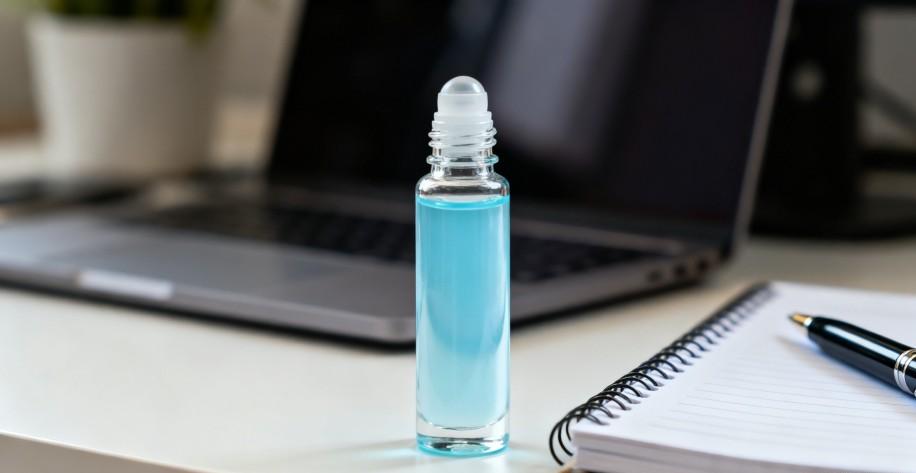
For essential oils roller bottles, the viscosity of the carrier oil (such as Jojoba, MCT, or Sweet Almond oil) must be matched to the ball material. Stainless steel balls, with their higher density and smoother surface finish ($Ra < 0.04 \mu m$), are ideal for low-viscosity, alcohol-based perfumes or lightweight oils. Conversely, glass or gemstone balls (like Amethyst or Rose Quartz) have higher surface friction, which can be advantageous for high-viscosity “salve” formulations where a slower dispensing rate is required.
Material Science: Polymer Selection for Terpene Resistance
One of the most frequent points of failure in 10ml glass roller bottles wholesale is the degradation of the plastic fitment (the housing). Essential oils are rich in terpenes and phenols, which act as powerful organic solvents. Standard Low-Density Polyethylene (LDPE) housings often suffer from “Environmental Stress Cracking” (ESC) or “Polymer Swelling” when exposed to oils like Oregano, Clove, or Citrus.
When the polymer swells, the internal diameter of the housing shrinks, “choking” the ball and preventing rotation. In severe cases, the plastic becomes brittle and snaps. Engineering-grade housings utilize Polyoxymethylene (POM) or Fluorinated Polypropylene, which offer superior chemical inertness and “Elastic Recovery,” ensuring that the housing maintains its grip on the glass neck even after repeated thermal expansion cycles.
| Feature | Soda-Lime Glass (Type III) | Borosilicate Glass (Type I) |
| Hydrolytic Resistance | Average | Superior (Low Alkali) |
| Thermal Expansion | $9.0 \times 10^{-6}/K$ | $3.3 \times 10^{-6}/K$ |
| Chemical Inertness | Good for carrier oils | Best for pure essential oils |
| Wall Thickness | 1.0mm – 1.2mm | 0.8mm – 1.1mm (Precision) |
Case Study: Solving “Atmospheric Pressure Leakage” for a Travel-Focused Wellness Brand
A California-based wellness brand specializing in “Travel Recovery” rollers faced a 15% return rate due to leakage. The products were frequently carried in pressurized airplane cabins, where the pressure differential caused the liquid to bypass the roller seal and flood the cap.
Brand Background & Requirements:
The brand produced high-end essential oil blends for jet lag and anxiety. They utilized a standard 10ml glass roller bottles wholesale source with a 316 stainless steel ball and a standard PE housing.
Technical Challenges:
- Pressure Differential: As cabin pressure dropped, the air inside the bottle expanded, forcing the oil through the gap between the ball and the housing.
- Capillary Action: Once the oil reached the threads of the glass neck, it would “climb” the threads, leading to a greasy exterior.
- Liner Failure: The standard PE foam liner in the cap was not “recovering” its shape after being compressed, losing its secondary seal capability.
Technical Parameters & Engineering Solution:
- Housing Redesign: Implemented a “Dual-Valve” fitment. This housing features a secondary internal “flap” that acts as a check-valve, allowing air into the bottle but preventing liquid from exiting under pressure.
- Cap Specification: Switched to a “Plug-Seal” cap design. The interior of the cap was engineered with a central “pin” that makes direct contact with the top of the ball when tightened, physically locking the ball against the housing seat.
- Torque Standardization: Increased the application torque to 12-15 in-lbs to ensure the “Plug-Seal” was fully engaged.
- Glass Neck Precision: Utilized a “16-415” finish with a polished land area to ensure a hermetic seal against the cap’s internal plug.
Outcome:
The leakage rate dropped to near zero (0.05%). The brand successfully marketed the product as “Aviation-Grade,” and the “Plug-Seal” technology became a unique selling point, emphasizing the precision of the bottle with roller ball engineering.
Photochemical Stability and Light-Fastness
For many high-value essential oils, exposure to the UV spectrum triggers a process called “Photolysis,” where chemical bonds are broken, leading to a loss of therapeutic efficacy and the development of “off-notes.” While amber glass is the traditional solution, many modern brands prefer clear or frosted glass for aesthetic reasons.
In these cases, custom glass manufacturers apply an internal or external UV-coating. This coating is engineered to be “Spectrally Selective,” allowing visible light to pass through (maintaining transparency) while blocking 99% of wavelengths between 200nm and 400nm. When sourcing 10ml glass roller bottles wholesale, asking for a “UV Transmission Map” is a standard requirement for packaging engineers to ensure the longevity of the formulation.
The Logistics of Precision: Quality Control in Glass Forming
In the manufacturing of a bottle with roller ball, the “Neck ID” (Internal Diameter) is the most critical dimension. If the ID is too large, the fitment will “spin” or pull out easily. If it is too small, the fitment will be deformed during insertion, causing the ball to seize.
Advanced manufacturing lines utilize “In-Line Air Gauging.” This non-contact measurement system uses a blast of air to detect the internal volume and diameter of every bottle neck at the speed of production. Jars that deviate by more than $\pm$ 0.15mm are automatically ejected. For the glass jar trading professional, this level of automation is what separates a reliable industrial partner from a simple broker.
Expanded Technical Keywords
- Interference fit tolerances: The specific measurement of the tightness between the plastic fitment and the glass neck.
- High-sphericity steel applicators: Grade 100 or higher stainless steel balls for ultra-smooth rotation.
- UV-cutoff wavelength: The specific point on the electromagnetic spectrum where the glass begins to block light.
FAQ: Professional Engineering Insights
Q1: What causes “Ball Fall-out” in cheap roller bottles?
A: This is usually a failure of the polymer’s “Hoop Strength.” When exposed to heat or certain oils, the plastic housing loses its tension and stretches, allowing the ball to be pushed through the orifice. Using a POM (Polyoxymethylene) housing prevents this.
Q2: Why use 10ml as the standard size for roller bottles?
A: It is a matter of “Dosage Control” and “Portable Ergonomics.” 10ml provides enough volume for approximately 80-100 applications while maintaining a “Slenderness Ratio” that fits comfortably in the human hand for precision application to pulse points.
Q3: Is it possible to use roller balls with highly viscous “balm” products?
A: Yes, but it requires a “Large-Gap” fitment and often a plastic ball. Plastic (PP) balls have a higher surface energy, which helps “grab” the thick balm and pull it through the housing orifice more effectively than a smooth metal ball.