 GlassBottleSupplies












Sales manager will contact you within 24 hours
The Geometrical and Thermal Integrity of Industrial Stock Reagent Systems
When a glass reagent bottle is transitioned from a production mold to the cooling lehr, it enters a critical phase defined by its “Strain Point”—the temperature at which the internal viscosity of the glass is high enough to prevent permanent structural deformation but low enough to allow molecular relaxation. For a high-performance chemistry reagent bottle, managing this cooling curve is paramount.
If the base of a stock reagent bottle is significantly thicker than its neck—a common occurrence in lower-grade manufacturing—the differential cooling rates create “Residual Stress.” In an industrial environment where a 100 ml reagent bottle might be moved from a 121°C autoclave directly to a 20°C laboratory bench, these internal stresses act as invisible fault lines. Engineering excellence at glassbottlesupplies.com focuses on the “Annealing Schedule,” ensuring that the thermal expansion coefficient ($\alpha$) remains uniform across the entire geometry to prevent catastrophic failure.
Volumetric Precision and the Meniscus Effect
For a reagent bottle to serve as a reliable measurement tool, the internal geometry must account for the “Meniscus Effect”—the curve in the surface of a molecular substance when it touches another material. In a reagent glass bottle, the interaction between the liquid and the borosilicate surface is influenced by the glass’s surface energy.
When we engineer a 100 ml reagent bottle, the graduation lines are not merely etched; they are calibrated based on the “Containment Volume” vs. “Delivery Volume.” Through high-precision molding, we ensure the internal diameter (I.D.) remains constant. This allows the user to achieve a volumetric accuracy of ±5%, which is critical for the preliminary mixing of reagents before they are transferred to Class A volumetric flasks.
Table 2: Comparative Analysis of Cap and Liner Inertness
| Component Material | Chemical Resistance | Temperature Range | Gas Permeability | Ideal Application |
| Polypropylene (PP) | Good (Alcohols/Bases) | -40°C to 120°C | Low | Standard Buffer Solutions |
| PBT (Polybutylene) | Excellent (Acids/Solvents) | -45°C to 180°C | Very Low | High-Purity Stock Acids |
| ETFE (Tefzel) | Exceptional (All) | -200°C to 150°C | Minimal | High-Volatility Solvents |
| Silicone/PTFE Liner | Universal | -60°C to 200°C | Near Zero | Analytical Standards |
Case Study: Optimizing a 100 ml Reagent Bottle for Ultra-Pure Diagnostic Reagents
Brand Background and Requirement
A leading diagnostic manufacturer required a specialized 100 ml reagent bottle for a new “Luminescence-Based Enzyme” used in cancer screening. The enzyme was highly reactive to trace heavy metals (such as Lead or Arsenic) often found in standard glass. Furthermore, the reagent was highly sensitive to pH shifts; even a 0.1 change in pH would render the diagnostic kit invalid.
Technical Challenges
The client’s previous supplier used a “Type III” soda-lime glass that had been internally coated. However, during the autoclave sterilization cycle, the coating suffered from “Delamination”—microscopic flakes of the coating began to float in the reagent. These flakes interfered with the optical sensors of the diagnostic machines, causing “False Positive” results.
Technical Parameter Settings
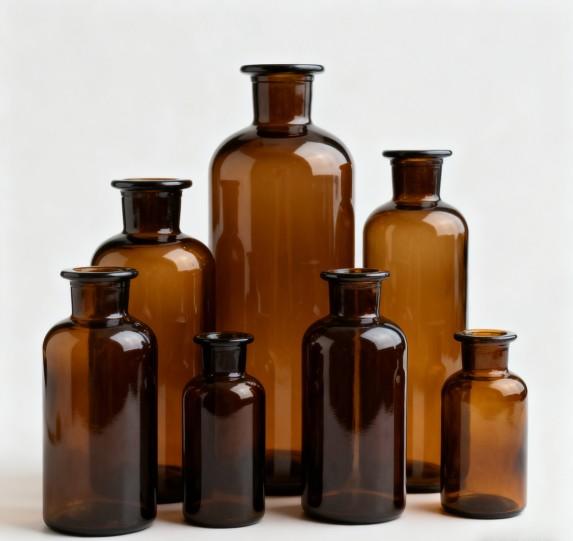
- Glass Composition: 100% Virgin Borosilicate 3.3 (ASTM E438 Type I, Class A).
- De-alkalization: An additional “Surface Neutralization” step using sulfur vapor at the hot end to remove any surface-level alkali ions.
- Closure System: GL45 thread with a specialized “Drip-Free” pouring ring made of ETFE.
- Wall Thickness: Minimum 2.8mm to maximize the “Thermal Mass” and minimize external temperature influence.
- Hydrolytic Resistance: Tested to ISO 719-HGB1 standards.
Mass Production and Quality Control
We utilized a “Polariscopic Inspection” on 100% of the batch. This tool uses polarized light to visualize the stress patterns within the reagent glass bottle. Any bottle showing a “Birefringence” pattern (indicating uneven stress) was automatically rejected. Following this, we performed “ICP-MS” (Inductively Coupled Plasma Mass Spectrometry) testing on water samples stored in the bottles for 30 days to ensure that heavy metal leaching was below detectable limits (parts per trillion).
Final Market Performance
The transition to a pure borosilicate chemistry reagent bottle with surface neutralization eliminated the delamination issue. The diagnostic manufacturer reported a 100% pass rate in their QA/QC protocols over a 12-month period. The “Drip-Free” ring also saved an estimated $12,000 per year in wasted high-value reagent that previously ran down the side of the bottle during dispensing.
The Engineering of “Drip-Back” and Pouring Rings
In a stock reagent bottle, the moment of truth occurs during the pour. When a technician decants a corrosive acid, the liquid’s surface tension often pulls the last drop toward the exterior wall of the bottle. This “Drip-Back” is a major safety hazard and leads to label degradation.
The solution is the “Pouring Ring”—a secondary component, usually made of PP or ETFE, that snaps onto the neck of the glass reagent bottle. The ring’s edge is engineered with a sharp “Break Angle” that exceeds the liquid’s ability to maintain a cohesive bead. By calculating the “Bond Number” ($Bo$)—a dimensionless number expressing the ratio of body forces to surface tension—engineers can design a ring that ensures a clean cut-off of the liquid stream every time.
Advanced Mold Engineering: The “Parison” Distribution
The secret to a high-quality 100 ml reagent bottle lies in the “Parison”—the hot blob of glass that is first dropped into the mold. In standard manufacturing, the parison is often lopsided, leading to a bottle that is thicker on one side than the other.
At a premium level, we use “Vacuum-Assisted Molding.” This process pulls the parison into the mold with a consistent vacuum pressure, ensuring that the glass reaches the “Heel” (the bottom corner) and the “Shoulder” simultaneously. For reagent glass bottles, this uniformity is essential for “Axial Load Strength,” allowing the bottles to be stacked and transported without the risk of the bottom “popping” under the weight of the pallet.
Environmental Compliance: Lead and Cadmium-Free Standards
Modern chemistry reagent bottles must comply with stringent environmental regulations such as REACH and RoHS. This is particularly important for the “Enamel” used in the graduation marks. Historically, these enamels contained lead to lower the firing temperature.
Current engineering standards require the use of “Low-Frit” lead-free enamels. These are fired at a higher temperature ($>600°C$), which actually creates a superior bond with the glass surface. This ensures that a stock reagent bottle can withstand thousands of cycles of “Acid-Wash” without the graduation marks fading, which is a critical safety requirement for long-term chemical storage.
Professional FAQ
Q1: What is the difference between “Clear” and “Amber” borosilicate 3.3 for reagent storage?
A: Chemically, they are identical in their resistance to acids and bases. However, the amber version has iron-sulfur compounds added to filter out UV and short-wave visible light (up to 500nm). Use clear reagent glass bottles for reagents where visual inspection of color or clarity is vital, and amber for any light-sensitive compounds like Silver Nitrate or certain vitamins.
Q2: Can I use a 100 ml reagent bottle for long-term storage of strong bases like NaOH?
A: While borosilicate 3.3 is highly resistant, strong bases will eventually “etch” any glass. For long-term storage of concentrated Sodium Hydroxide or Potassium Hydroxide, an HDPE or PFA bottle is often superior. If you must use a glass reagent bottle, ensure it has undergone surface de-alkalization and monitor for “Glass Frosting” over time.
Q3: Is the GL45 thread standard across all reagent bottle brands?
A: Most industrial-grade reagent bottles follow the GL45 (Glass 45mm) thread standard, allowing for interchangeability of caps, pouring rings, and even automated dispensing pumps. However, always verify the “Thread Pitch” and “Major Diameter” before attempting to use a cap from a different manufacturer.
Q4: How does “Hydrolytic Resistance” impact the shelf life of an aqueous reagent?
A: High hydrolytic resistance means the glass releases fewer ions into the water. In a chemistry reagent bottle, if the glass has low resistance, the pH will gradually rise as alkali ions are leached. For a “Standardized Solution” (e.g., 0.1M HCl), this leaching would neutralize the acid and change the concentration, ruining the accuracy of your analytical work.