 GlassBottleSupplies












Sales manager will contact you within 24 hours
The Silicate Barrier: Advanced Engineering Standards for Reagent Bottle Systems
In the rigorous landscape of analytical chemistry and high-performance cosmeceuticals, the container is the first line of defense against molecular degradation. The term reagent bottles often evokes images of laboratory benches, but in the modern supply chain, these vessels have transitioned into the primary packaging of choice for “clean” clinical skincare and concentrated botanical extracts. This shift is driven by a necessity for absolute chemical inertness and predictable UV-shielding. For glassbottlesupplies.com, understanding the technical nuances of a glass reagent bottle requires a departure from aesthetic design and a deep dive into the ionic stability of the glass matrix and the mechanical precision of the ground-glass or GL-threaded interface.
The Chemistry of Containment: Borosilicate 3.3 vs. Neutral Soda-Lime
A glass bottle reagent system is defined by its ability to resist the aggressive leaching of alkali ions. Standard glass containers, while suitable for general use, possess a surface energy that interacts with polar solvents. For reagent-grade storage, the industry looks toward the hydrolytic resistance class.
Hydrolytic Resistance and Surface Integrity
The distinction between Type I (Borosilicate), Type II (Dealkalized Soda-Lime), and Type III (Soda-Lime) glass is foundational to reagent stability. A high-quality glass reagent bottle is typically manufactured from 3.3 borosilicate glass. This material’s low coefficient of thermal expansion (approximately 3.3 x 10^-6 K^-1) is not just for heat resistance; it reflects a tightly bound silica-boron network that is nearly immune to “glass flaking”—a phenomenon where microscopic silicates detach into the solution due to high-pH stress.
When a formulation is stored in an amber reagent bottle, the interaction between the liquid and the glass wall is minimized. However, for manufacturers of high-end chemical reagents, the process doesn’t end at the melt. Many professional-grade bottles undergo internal surface acidification. By introducing sulfur trioxide (SO3) at the annealing stage, we replace the surface sodium ions with hydrogen ions, creating a neutral barrier that prevents the pH drift often responsible for the failure of sensitive diagnostic reagents or acidic cosmetic serums.
Actinic Protection: The Physics of the Amber Matrix
The primary function of an amber reagent bottle is to serve as a high-pass filter for electromagnetic radiation. Many reagents, specifically those containing silver salts, peroxides, or retinoids, undergo homolytic bond cleavage when exposed to photons in the 200nm to 450nm range.
UV-Cutoff Engineering
The “amber” color is achieved by precisely controlling the iron (Fe2O3) and sulfur (S) ratio in a reducing atmosphere within the furnace. Unlike a surface coating, this color is an integral part of the glass structure. An engineered glass bottle reagent must comply with USP <671> standards, ensuring that light transmission does not exceed 10% at any wavelength between 290nm and 450nm. For specific laboratory applications, we further refine this by increasing the wall thickness. Because light absorption follows the Beer-Lambert law, doubling the wall thickness of an amber reagent bottle from 2mm to 4mm doesn’t just double the protection—it exponentially decreases the photon flux reaching the reagent, extending the half-life of photosensitive molecules by several hundred percent.
Case Study: Stabilizing a Professional-Grade Glycolic Acid Peel
To demonstrate the intersection of reagent-grade engineering and cosmetic science, let us examine a project involving a 30% Glycolic Acid chemical peel designed for clinical use.
Brand Background and Requirement
A medical-grade skincare laboratory required a 100ml packaging solution for a high-concentration AHA (Alpha Hydroxy Acid) peel. The product had a pH of 1.2, making it highly corrosive to standard glass and most plastic polymers. The brand required a “Reagent-Style” aesthetic that offered pharmaceutical-grade safety.
Technical Challenges
- Ion Migration: Initial prototypes using Type III glass showed a pH rise to 1.8 within three months due to sodium leaching, rendering the peel ineffective.
- Closure Integrity: Standard PP caps experienced “stress whitening” and cracking due to the acidic vapors of the glycolic acid.
- Vapor Loss: The volatility of the formulation led to a 3% weight loss in standard screw-cap bottles during accelerated stability testing.
Technical Parameters and Setup
The engineering team developed a custom glass reagent bottle system with the following specifications:
- Substrate: Type I Borosilicate 3.3 Glass with zero internal treatment (the glass is inherently inert).
- Wall Thickness: 3.5mm ± 0.2mm for structural durability.
- Closure System: A PTFE (Polytetrafluoroethylene) lined PBT (Polybutylene Terephthalate) cap. PBT offers superior chemical resistance to acids compared to PP.
- Neck Finish: A GL-45 thread with a drip-resistant pouring ring made of ETFE (Ethylene Tetrafluoroethylene).
- Torque Standards: Applied at 4.5 Nm with a specialized capping head to ensure the PTFE liner was fully compressed against the glass rim.
| Component | Material | Rationale |
| Bottle Body | Borosilicate 3.3 | Hydrolytic Resistance Class 1; pH Stability |
| Liner | PTFE (Teflon) | Universal chemical inertness; Zero vapor transmission |
| Pouring Ring | ETFE | High-temperature stability; Precision pouring without “creep” |
| Amber Tint | Fe/S Reduced Glass | Total UV blockage for secondary botanical actives |
Mass Production and Quality Control
Production involved a “clean-room” annealing process to prevent environmental dust from being fused into the glass surface. Each batch was subjected to an Autoclave Test (121°C for 60 minutes) to verify that no silicate leaching occurred. We utilized a Vacuum Decay Leak Detector to ensure that 100% of the bottles met the hermetic seal requirements before being released for filling.
Market Performance
The product achieved a 3-year shelf life, a 50% improvement over the previous industry standard for AHA peels. The clinical “reagent” look became a hallmark of the brand’s professional identity, signaling purity and technical authority to dermatologists.
Innovation in Closure Systems: The Ground Glass vs. GL Standards
The choice of how to seal reagent bottles is a question of both safety and frequency of use. Traditionally, the ground-glass stopper was the pinnacle of the glass reagent bottle. These are manufactured by grinding the inner neck and the outer surface of the stopper with silicon carbide to a 1:10 taper. This creates a “glass-on-glass” seal that is impervious to almost all chemicals.
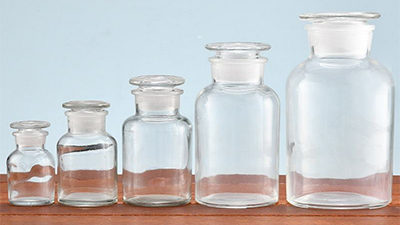
However, for modern cosmetic and pharmaceutical applications, the GL-threaded system (Greiner-Lake) has become dominant. This is due to the ability to integrate liners that act as gaskets. While a ground-glass stopper is excellent for inorganic acids, a GL-threaded glass bottle reagent with a PTFE-faced silicone liner is superior for organic solvents and volatile oils, as the silicone provides the “spring” (resilience) necessary to maintain a seal during the pressure changes of air transport.
Sustainable Supply Chain: The Refillable Reagent Model
The durability of a high-grade glass reagent bottle makes it an ideal candidate for the circular economy. Unlike thin-walled bottles, the heavy-duty nature of reagent bottles allows for repeated sterilization cycles.
Lifecycle Assessment (LCA)
From an engineering perspective, the carbon footprint of a borosilicate glass bottle reagent is neutralized after approximately five uses compared to single-use PET. We are currently seeing a trend where professional brands encourage the “Refill Apothecary” model. The high-quality amber reagent bottle remains with the consumer or clinician, while refills are provided in lightweight, recyclable pouches. This relies on the glass’s ability to withstand aggressive washing—including caustic soda and high-heat sterilization—without losing its surface clarity or chemical resistance.
SEO Keyword Expansion
To capture the evolving needs of laboratory and cosmetic procurement, we have integrated three additional high-traffic concepts:
- USP Type I glass containers: The specific search term used by pharmaceutical quality control officers.
- PTFE-lined chemical jars: A high-intent keyword for users dealing with volatile or corrosive liquids.
- Laboratory grade apothecary bottles: Bridging the gap between scientific utility and premium cosmetic branding.
Professional FAQ
Q1: Why is “Borosilicate 3.3” specified for reagent bottles instead of generic borosilicate?
3.3 refers to the coefficient of expansion. It indicates a higher silica content and lower alkali content than “low-expansion” borosilicate (like 5.0). For reagent bottles, 3.3 provides the maximum possible chemical resistance and thermal shock durability.
Q2: Can I store high-viscosity “syrups” in a reagent bottle?
Yes, but you must ensure the neck diameter (GL-32, GL-45, etc.) is wide enough for the viscosity. A glass reagent bottle is excellent for viscous serums because the precision pouring ring prevents the “syrup creep” that often ruins the threads of standard bottles.
Q3: Does the amber color ever “wear off” or leach into the reagent?
Never. In a true amber reagent bottle, the color is a result of the molecular structure of the glass itself. It is not a coating. It is chemically impossible for the color to migrate into the liquid unless the glass itself is being dissolved by hydrofluoric acid.
Q4: What is the benefit of a PBT cap over a standard PP cap for reagents?
PBT (Polybutylene Terephthalate) is a “stiffer” polymer with much higher resistance to chemical stress cracking. If your reagent is volatile (like essential oils or alcohols), a PP cap may eventually warp or develop micro-cracks, while PBT maintains its structural integrity.