 GlassBottleSupplies












Sales manager will contact you within 24 hours
The Definitive Guide to Laboratory Glassware: Reagent Bottle Uses, Types & Selection (2025)
In the world of scientific research and industrial chemistry, the container is just as important as the chemical inside it. A poor-quality bottle can contaminate samples, shatter under thermal shock, or degrade light-sensitive compounds.
For laboratory managers and procurement officers, understanding the nuances of laboratory glassware is critical.
As a specialized manufacturer, we often get asked: “What is the difference between your bottles and top brands?” or “When should I use a wide mouth vs. a narrow mouth?”
In this comprehensive guide, we will explore the science behind borosilicate glass, detail specific reagent bottle uses, and explain how to select the right packaging that meets international standards (comparable to reagent bottle borosil specs) at a fraction of the cost.
Part 1: The Material Science – Why Borosilicate 3.3?
Not all glass is created equal. In a kitchen, you might find “soda-lime glass.” But in a laboratory, borosilicate glass is the only acceptable standard.
What is Borosilicate 3.3?
Borosilicate glass is made with silica and boron trioxide. The “3.3” refers to its Coefficient of Linear Thermal Expansion ($3.3 \times 10^{-6} K^{-1}$).
- Thermal Shock Resistance: It can withstand sudden temperature changes (e.g., taking a bottle from a $140^\circ\text{C}$ autoclave to room temperature) without cracking.
- Chemical Inertness: It has extremely high resistance to water, acids, salt solutions, organic substances, and halogens. It will not leach minerals into your reagents.
Comparing to Major Brands
Many clients search for “reagent bottle borosil” because Borosil is a famous Indian brand known for this glass type.
The Factory Truth: Our reagent bottles are manufactured using the exact same ISO 3585 borosilicate 3.3 glass formula. This means you get the same thermal and chemical performance as the top branded bottles, but you are buying directly from the wholesale manufacturer, avoiding the brand premium.
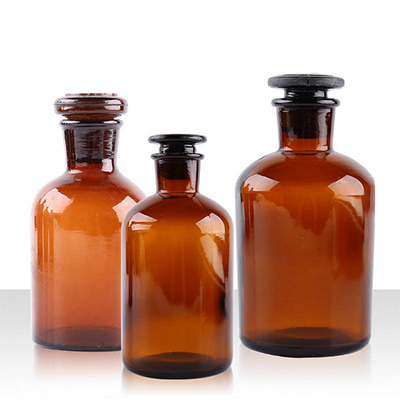
Part 2: Wide Mouth vs. Narrow Mouth – Choosing the Right Shape
The shape of the bottle dictates its function. When we discuss reagent bottle uses, the neck width is the primary deciding factor.
1. Wide Mouth Bottles (Solid Storage)
Wide mouth bottles (often called “Packers” in the US) feature a large opening relative to the body size.
- Primary Uses: Storage of powders, granules, pastes, crystals, and specimens.
- Why: Have you ever tried to pour flour through a funnel? It clogs. The wide mouth allows chemists to use a spatula or spoon to remove solid chemicals easily without spillage.
- Our Specs: Our wide mouth reagent bottles come with GL80 or GL45 threads, providing easy access.
2. Narrow Mouth Bottles (Liquid Storage)
Narrow mouth bottles have a tapered neck.
- Primary Uses: Storage of liquids, solvents, acids, and titrants.
- Why: The narrow opening reduces the surface area of the liquid exposed to air (reducing evaporation) and allows for more precise pouring with less splashing. Ideally suited for decanting into test tubes or beakers.
Part 3: Color Coding – Amber vs. Clear
Selecting the right color is a matter of chemistry, not aesthetics.
Amber Reagent Bottles (UV Protection)
- Function: Amber glass filters out ultraviolet (UV) light and blue light (up to 500nm).
- Typical Uses: Storage of light-sensitive chemicals such as:
- Silver Nitrate
- Hydrogen Peroxide
- Vitamins and pharmaceutical intermediates
- Warning: Never store light-sensitive compounds in clear glass wrapped in foil. It is unprofessional and risky. Always use intrinsic amber glass.
Clear Reagent Bottles (Visibility)
- Function: Maximum visibility.
- Typical Uses: General buffers, non-reactive solvents, and display samples where seeing the color or clarity of the liquid is important.
Part 4: The Cap System – The Unsung Hero
A reagent bottle is only as good as its seal. We use the GL Thread System (GL45, GL32, GL80).
The Blue Screw Cap (Polypropylene)
You will often see our bottles topped with the iconic blue cap.
- Material: Reinforced Polypropylene (PP).
- Autoclavable: These caps can withstand temperatures up to $140^\circ\text{C}$, meaning the entire bottle (with cap on loosely) can be sterilized in an autoclave.
- Drip-Ring: Our caps include a pouring ring (drip-ring) that prevents liquid from dripping down the side of the bottle, protecting the label and the user’s hands.
Part 5: Maintenance & Care of Laboratory Glassware
To ensure longevity and safety, proper care is essential.
- Cleaning: Use a laboratory-grade detergent (like Alconox) and a brush. For wide mouth bottles, cleaning is easier. For narrow mouths, ensure the brush reaches the shoulders.
- Autoclaving: When autoclaving liquids, never screw the cap on tightly. The pressure buildup can cause the bottle to explode. Always leave the cap loose (1/2 turn).
- Inspection: Before each use, inspect the glass for “star cracks” or chips on the rim. A chipped rim can prevent the cap from sealing properly, leading to dangerous leaks.
Part 6: Why Source from GlassBottleSupplies.com?
For chemical distributors, universities, and pharmaceutical companies, sourcing glassware is a balance of quality and cost.
- Standard Compliance: Our bottles meet ISO 4796-1 standards.
- Graduations: All our reagent bottles feature durable, baked-on white enamel graduations for easy volume estimation.
- Traceability: Each batch is quality tested for thermal shock resistance.
- Bulk Availability: We stock sizes from 30ml to 20,000ml (20L). Whether you need a single pallet of 30ml amber reagent bottles or a container of 500ml clear bottles, we can ship globally.
Conclusion
Whether you are setting up a new university lab or packaging high-value chemical reagents for sale, choosing the right glassware is an investment in safety and precision.
Don’t compromise on materials. Choose Borosilicate 3.3.