 GlassBottleSupplies












Sales manager will contact you within 24 hours
The 2026 Guide to Mini Scent Architecture
In 2026, the fragrance market has inverted. The entry point for a luxury customer is no longer the 100ml flagship vessel; it is the 2ml to 10ml perfume bottle mini.
This shift is driven by the “Discovery Economy.” Customers demand to live with a scent before committing to a $300 investment. Consequently, the perfume sample bottles found in discovery sets have transitioned from cheap, disposable giveaways into high-value brand ambassadors.
For procurement officers and brand founders, this creates a critical engineering challenge. How do you replicate the luxury experience of a heavy, crimped, wide-spray flagship bottle in a tiny, lightweight refill perfume bottle? This analysis unpacks the hydrodynamics of mini-pumps, the sealing logic of travel sprays, and the supply chain necessary to support a robust “Trial-to-Full-Size” funnel.
1. The “Spit” vs. The “Mist”: Engineering Spray Quality in Minis
The number one consumer complaint regarding perfume sample bottles is the spray quality. Often, small bottles “spit” a jet of liquid rather than atomizing a cloud.
The Physics of Pre-Compression
In a standard 100ml bottle, the pump engine is large enough to build significant hydraulic pressure before releasing the liquid. In a perfume bottle mini, the engine is microscopic.
- The Failure Mode: Standard mini-pumps rely on direct displacement. If the user presses slowly, the liquid dribbles out. This ruins the “top note” experience because the alcohol doesn’t evaporate instantly, leaving a wet, sharp smell on the skin.
- The 2026 Standard: You must specify “Pre-Compression” Mini Engines. These pumps contain a secondary spring mechanism that holds the liquid back until a specific pressure threshold (e.g., 4 bar) is reached. Once reached, the valve snaps open, forcing the liquid through the nozzle at high velocity. This guarantees a fine mist (particle size < 50 microns) regardless of how slowly the user presses the button.
Dosage Control
- Perfume for perfume bottles in sample sizes is precious. A standard pump dispenses 130mcl (microliters). A mini pump should dispense 40mcl to 60mcl.
- Why? A 2ml sample vial with a 130mcl pump only lasts 15 sprays. A 50mcl pump lasts 40 sprays. Those extra sprays give the customer 3-4 more days to fall in love with the scent, statistically doubling the conversion rate to a full bottle.
2. The Architecture of the Refill: Bayonet vs. Screw
Sustainability mandates in 2026 require that even perfume sample bottles be recyclable or refillable. This has killed the plastic stopper. The industry is now split between two neck finishes for glass vials.
The Screw Neck (GPI 13 / FEA 13)
- Pros: Theoretically allows the user to unscrew the pump and pour in more perfume for perfume bottles from a larger vessel.
- Cons: “Back-off.” In a handbag, vibration causes the screw pump to loosen. Evaporation occurs, or worse, the bottle leaks. To fix this, you need a “Ratchet” system (teeth on the neck) which is expensive for small vials.
The Bayonet (Snap-Click)
This is the dominant tech for premium perfume bottle mini designs in 2026.
- Mechanism: The glass neck has a specific groove. The pump housing has internal lugs. It is pushed down and twisted 90 degrees to lock, or simply snapped on with vertical force.
- The “Click”: High-end suppliers engineer a tactile “click” into the bayonet mount. This signals to the user (and the assembly machine) that the seal is hermetic.
- Refillability: While harder to open than a screw cap, specialized tools (or strong hands) can remove a bayonet pump to refill the vial, satisfying “design for disassembly” regulations without the leakage risk of a screw thread.
3. The Travel Spray Ecosystem: Shells and Inserts
The 10ml perfume refill bottle (Travel Spray) is the highest-margin item in a fragrance portfolio. It bridges the gap between a $30 sample and a $200 bottle.
The “Rattle” Tolerance
A luxury travel spray consists of an aluminum or Zamac outer shell and a glass inner bottle.
- The Engineering Flaw: If the tolerance between the glass diameter and the shell’s inner plastic sleeve is off by even 0.2mm, the glass rattles. It feels cheap.
- The Fix: Sourcing “Ribbed” Liner Sleeves. The plastic insert inside the metal shell should have vertical crush-ribs. These ribs deform slightly when the glass vial is inserted, gripping it firmly to prevent rattle while allowing it to be pulled out for refilling.
Bottom-Loading vs. Top-Loading
- Top-Loading: The standard. You pull the glass out, unscrew the pump, and fill with a funnel.
- Bottom-Loading (Valve Tech): The refill perfume bottle has a valve in the base. You pump the main bottle directly into the travel bottle.
- 2026 Insight: While convenient, Bottom-Loading requires the main bottle to have a compatible stem. If you are selling a perfume refill bottle as a standalone accessory, Top-Loading is safer because it works with any fragrance the customer owns.
4. Material Science: Glass vs. The “Juice”
Perfume for perfume bottles is a chemically aggressive mixture of ethanol (solvent) and essential oils (terpenes, aldehydes, esters).
The Plastic Fallacy
Startups often use PP (Polypropylene) vials for samples to save money/weight.
- The Reaction: Terpenes (found in citrus oils) attack PP over time. The plastic clouds, becomes sticky, and—crucially—leeches plasticizers (phthalates) into the perfume. This alters the scent profile, making it smell “flat” or “plastic-y” after 3 months.
- The Glass Mandate: For any “Eau de Parfum” or higher concentration, High Borosilicate Glass or Type I Neutral Glass is non-negotiable. It is chemically inert.
- UV Protection: If your perfume bottle mini is clear glass, you must add a UV absorber (like Avobenzone) to the formula, or spray the bottle. Small bottles warm up faster than large ones (thermal mass), accelerating oxidation.
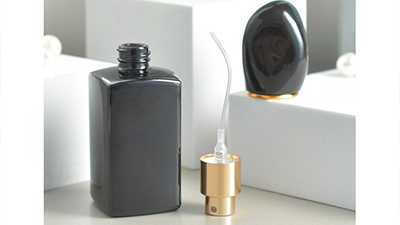
5. Case Study: “Aetheria” Discovery Set Optimization
To illustrate the ROI of better engineering, let’s examine “Aetheria,” a niche brand (composite case study).
The Baseline: Aetheria sold a “Discovery Set” of five 2ml samples for $35.
- Packaging: Standard 2ml plastic vials with snap-caps.
- Customer Feedback: “Smells weak,” “Leaked in shipping,” “Hard to open.”
- Conversion Rate: Only 4% of sample buyers bought a full bottle.
The Engineering Pivot:
- Material: Switched to 2.5ml Glass Vials (Type I Glass).
- Pump: Installed a Pre-Compression Bayonet Pump (black matte finish).
- Dosage: Reduced dosage from 120mcl to 50mcl.
- Secondary Packaging: Created a “Matchbox” style drawer box that held the glass vials securely, preventing movement.
The Financials:
- Cost Increase: The packaging cost went from $0.12/unit to $0.45/unit.
- Price Adjustment: They raised the set price to $45.
- Outcome:
- Perceived Value: Unboxing videos praised the “heavy glass” feel and the “satisfying spray mist.”
- Conversion Rate: Jumped to 18%.
- The “Juice” Savings: Because they reduced the pump dosage, the 2ml sample lasted longer, but they actually filled slightly less (1.8ml) while the customer perceived more usage due to the fine mist.
6. The “Invisible” Logistics: Dip Tubes and Decoration
In the world of perfume sample bottles, the aesthetics are microscopic.
The Invisible Dip Tube (No-C)
On a 100ml bottle, a visible plastic straw is forgivable. On a tiny perfume bottle mini, a thick dip tube dominates the visual.
- Technology: Use “No-C” (No Color) dip tubes made from amorphous fluoropolymers. These have a refractive index of approx 1.37, which matches the refractive index of ethanol/perfume. When wet, the tube disappears. This is the hallmark of luxury in 2026.
360-Degree Decoration
Labeling a 2ml vial is a nightmare. Labels peel at the overlap.
- Direct Print: Brands are moving to rotary silk-screen printing for vials.
- The “Vertical” Layout: Because the horizontal curve is tight, printing horizontal text often distorts. 2026 design trends favor vertical logos running up the height of the vial. This maximizes legibility and looks modern.
7. Supply Chain Strategy: The “Mother Bottle” Connection
If you are launching a refill perfume bottle, you must consider the source.
In 2026, brands are launching “Refill Stations” (aluminum cans with spouts) to support their glass minis.
- The Thread Standard: If your 10ml travel spray uses an FEA 15 screw neck, your 200ml aluminum refill can must have a spout that fits inside an 8mm opening.
- The Funnel is Dead: Do not ask customers to use tiny funnels. They spill, they are messy, and they look amateur.
- The Spout: The refill can must have a “Stop-Flow” spout (like a gas can) that stops pouring when the liquid hits the tip, preventing overflow.
Conclusion
The perfume bottle mini is the most dangerous SKU in your portfolio. If it leaks, fails to spray, or smells like plastic, you have lost the customer before they have even experienced the “heart notes” of your fragrance.
Sourcing perfume sample bottles in 2026 requires a shift in mindset: treat the 2ml vial with the same engineering rigor as the 100ml flagship. Use pre-compression pumps to ensure mist quality. Use inert glass to preserve olfactory integrity. And use precision-fit refill perfume bottle systems to extend the lifecycle of the product.
In the Discovery Economy, the sample is not a throwaway; it is the hook. Make sure it is sharp.