 GlassBottleSupplies











ผู้จัดการฝ่ายขายจะติดต่อคุณภายใน 24 ชั่วโมง
วิทยาศาสตร์แห่งความทนทานต่อความร้อน: มาตรฐานทางวิศวกรรมสำหรับแก้วเทียนความจุสูง
In the competitive landscape of การค้าขายขวดแก้ว, technical superiority is often hidden within the molecular structure and geometric uniformity of the vessel. For organizations sourcing ขายส่งโหลแก้วเทียน, the primary challenge is not the initial aesthetic, but the long-term structural integrity under repeated thermal cycling. As ผู้ผลิตโหลแก้วสั่งทำพิเศษ push the boundaries of design with heavier bases and thinner walls, the engineering required to prevent mechanical failure becomes increasingly complex.
Molecular Homogeneity and the “Striae” Risk
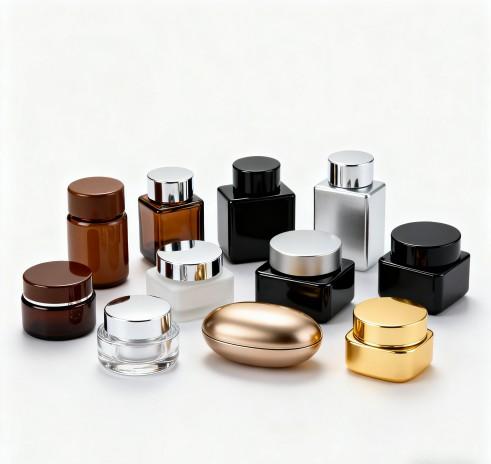
The quality of glass used in ขวดแก้วสำหรับทำเทียนขายส่ง begins in the melting furnace. “Striae” are cords or streaks in the glass caused by localized variations in the chemical composition or temperature during the melt. In standard food containers, minor striae are an aesthetic nuisance; in a candle jar, they are a structural liability.
Because different glass compositions expand at different rates, a jar with significant striae contains “frozen-in” tension. When a candle burns, the heat causes these different chemical zones to expand at disparate rates, leading to spontaneous fracture. High-end manufacturing utilizes laser-based “Cord Analyzers” to ensure that the glass melt is perfectly homogeneous before it enters the mold cavities.
The Physics of Heat Sinks: Base Thickness vs. Cooling Rates
Modern luxury trends favor a “heavy base” (thick bottom) for candle jars, often exceeding 15mm in thickness. While this provides a premium tactile experience, it presents a massive “Thermal Lag” problem.
During the cooling phase of manufacturing, the thin side walls cool and solidify rapidly, while the thick base remains semi-molten for longer. This creates a “tug-of-war” at the base-to-wall junction. If the annealing process is not precisely calibrated to the mass of the glass, the base will eventually “choke” the side walls, creating micro-fissures. Engineering a successful heavy-base jar requires a multi-stage annealing lehr that can extend up to 100 meters, ensuring the temperature drops at a rate of no more than 1°C per minute through the “Annealing Point.”
Surface Treatment: The “Cold End” Coating Standard
When jars are produced at high speeds, they inevitably rub against each other on the conveyor. This “glass-to-glass” contact creates “frizzels”—microscopic scratches that can reduce the glass’s overall strength by up to 50%.
To combat this, นิสัย ผู้ผลิตขวดแก้ว apply two layers of protection:
- การเคลือบหัวฉีดร้อน: A thin layer of Tin Oxide ($SnO_2$) applied as the jar leaves the mold. This creates a hard, durable surface that bonds to the glass.
- การเคลือบส่วนเย็น: A Polyethylene-based wax applied after the annealing lehr. This acts as a lubricant, allowing jars to slide against each other during the “wholesale” packing process without scratching.
| Engineering Parameter | Measurement Unit | Specification for 10oz Jar |
| สัมประสิทธิ์การขยายตัวทางความร้อน | $10^{-7}/K$ | 85 – 92 |
| จุดอบอ่อน | °C | 540°C $\pm$ 5°C |
| Strain Point | °C | 500°C $\pm$ 5°C |
| Max Vertical Load | Newton (N) | > 2500 N |
Case Study: Solving “Base Pop-off” in a Signature 3-Wick Soy Candle
A major European home fragrance retailer reported an alarming trend: the bottom of their 16oz jars was “popping off” in a perfect circle during the final 20% of the burn. The jars were sourced through a การค้าขายขวดแก้ว intermediary and featured a deep-colored translucent red spray.
ประวัติแบรนด์ & ข้อกำหนด:
The brand used a 3-wick configuration, which creates a massive combined heat output (BTU). The jar was a wide-mouth design with a 100mm diameter.
ความท้าทายทางเทคนิค:
- Triple-Wick Heat Concentration: The three heat sources created a “super-heated” air pocket at the bottom of the jar as the wax level depleted.
- Thermal Expansion Mismatch: The red translucent coating was an “organic” spray that trapped heat, significantly increasing the external surface temperature.
- Mold Seam Weakness: The mold used was a “two-part” base design. The cooling air was not reaching the center of the base during production, leaving the “push-up” area thinner than the perimeter.
โซลูชันทางวิศวกรรม:
The technical team performed a “Finite Element Analysis” (FEA) to simulate the heat flow. The solution involved a “Single-Part” base mold to eliminate the seam stress. Furthermore, the glass formula was adjusted to include a higher percentage of Magnesium Oxide ($MgO$) to improve thermal shock resistance.
ชุดพารามิเตอร์ทางเทคนิค:
- Push-up Depth: Increased to 5mm to create a larger air insulating gap.
- Wall-to-Base Transition: Implemented a “graduated taper” to eliminate the sharp 90-degree corner.
- Thermal Shock Testing: The “Delta T” threshold was raised from 42°C to 65°C.
- การเคลือบ: Switched to a “High-Transmittance” pigment that allowed infrared heat to pass through rather than being absorbed by the glass.
ผลลัพธ์:
The “base pop-off” issue was eliminated. The brand was able to continue with the 3-wick design safely, and the new mold geometry actually reduced the total glass weight by 8% without sacrificing strength, leading to significant savings in candle making jars wholesale shipping costs.
The Importance of “Cavity Identification” in Quality Control
In mass-scale ผู้ผลิตโหลแก้วสั่งทำพิเศษ‘ facilities, a single machine might have 24 cavities. If one cavity has a microscopic burr or a misaligned neck, it will produce a defective jar every few seconds.
Modern “Vision Inspection Systems” use high-speed cameras to check every jar for “Checks” (small cracks), “Seeds” (air bubbles), and “Lean” (vertical deviation). For high-volume การค้าขายขวดแก้ว, it is imperative to demand a “Cavity Sorting” report, which ensures that if a failure occurs in the field, the brand can trace it back to the exact mold and production hour, preventing a total recall.
Sustainable Coatings: Water-Based vs. Solvent-Based
The industry is rapidly shifting toward water-based UV-cured coatings. Unlike traditional solvent-based paints used in ขวดแก้วสำหรับทำเทียนขายส่ง, water-based coatings do not emit Volatile Organic Compounds (VOCs) and are far more resistant to the high temperatures generated by wooden wicks. These coatings also provide a “harder” finish that is less likely to be marred by the adhesive of a label or the friction of shipping inserts.
คำสำคัญทางเทคนิคที่ขยายเพิ่มเติม
- Finite Element Analysis (FEA) for glass: Using computer models to predict where a jar will break under heat.
- Isothermal annealing: A process of holding glass at a constant temperature to ensure uniform molecular relaxation.
- Cullet ratio optimization: Balancing recycled glass content with structural safety requirements.
คำถามที่พบบ่อย: ข้อมูลเชิงลึกด้านวิศวกรรมมืออาชีพ
Q1: How does “Vertical Load Strength” affect candle manufacturers?
A: This is the amount of pressure a jar can withstand from the top. While candles aren’t heavy, automated capping and wicking machines apply significant downward force. A jar with poor vertical load strength will shatter during the production process.
Q2: What is “Glass Blooming” and how can it be prevented in wholesale storage?
A: Blooming is a white, hazy film caused by moisture reacting with the sodium in the glass. It usually happens in humid warehouses. Using “De-alkalized” glass or ensuring a “Cold-End” coating with moisture inhibitors is the engineered solution.
Q3: Is there a safety difference between “molded” and “blown” candle jars?
A: Most wholesale jars are “Press-and-Blow” (molded). This provides much more consistent wall thickness than hand-blown glass, making it significantly safer for the high-heat environment of a burning candle.