 GlassBottleSupplies












ผู้จัดการฝ่ายขายจะติดต่อคุณภายใน 24 ชั่วโมง
ลำดับชั้นทางวิศวกรรมของระบบกักเก็บแก้วพรีเมียม: เกินกว่าความสวยงามในบรรจุภัณฑ์เครื่องสำอางและเทียนหอม
In the rigorous landscape of high-end dermatological and home fragrance brands, the vessel is far more than a marketing canvas; it is a critical protective barrier and a functional component of product stability. For procurement directors and packaging engineers, navigating the landscape of ผู้ผลิตโหลแก้วสั่งทำพิเศษ requires an understanding of silicate chemistry, mechanical tolerances, and the fluid dynamics of product interaction. When a brand scales to wholesale glass candle jars or cosmetic vessels, the margin for error evaporates. A minor deviation in the annealing curve or a sub-micron error in neck finish threading can result in batch-wide failures that erode consumer trust and bottom-line profitability.
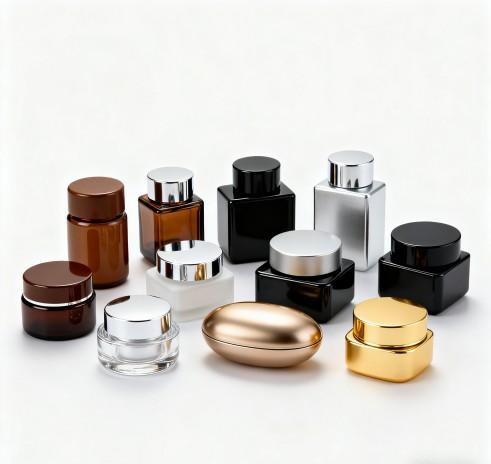
Molecular Integrity and the Chemistry of Glass Substrates
The primary differentiator among ผู้ผลิตขวดเครื่องสำอาง outputs is the purity and stability of the glass batch. While Type III Soda-Lime glass is the industry standard, its performance is highly dependent on the “Batch-to-Cullet” ratio and the presence of transition metal oxides.
For cosmetic formulations containing active peptides, electrolytes, or high-viscosity emulsions, the surface alkalinity of the glass is a hidden risk. If the “Hydrolytic Resistance” is insufficient, ion exchange between the formulation and the glass wall can trigger a pH drift, causing the emulsion to split or the active ingredients to lose efficacy. Advanced manufacturing involves “Sulfur Treatment” during the lehr phase to de-alkalize the internal surface, creating a chemically inert environment that rivals Type I borosilicate glass but at a scale suitable for wholesale cosmetic ขวดแก้ว with lids.
Thermal Shock Resistance and Fracture Mechanics
In the context of candle jars, the engineering focus shifts to the “Coefficient of Thermal Expansion” (CTE). A candle jar functions as a heat sink. As the wax pool liquefies, the thermal gradient between the internal wall (contacting molten wax) and the external wall (contacting ambient air) creates immense hoop stress.
Precision manufacturing ensures that the “Annealing Point” and “Strain Point” are meticulously managed. If the glass is cooled too rapidly, latent stresses remain trapped in the molecular lattice. These microscopic “Griffith Flaws” are the precursors to spontaneous fractures during a consumer’s power-burn. Verification of the “Residual Stress Retardation” via polarized light (ASTM C148) is a non-negotiable standard for any reputable manufacturer.
Mechanical Precision in Closure Systems and Seal Integrity
The relationship between the jar and its lid is the most common failure point in the industry. Whether it is a screw-thread cosmetic lid or a friction-fit candle lid, the engineering must account for “Creep” and “Stress Relaxation.”
The “Land” Area and Bore Seal Engineering
เมื่อจัดหา wholesale cosmetic glass jars with lids, the flatness of the “Land” (the top surface of the jar rim) dictates the seal’s success.
- Planarity: Any deviation beyond 0.2mm across the rim will cause a bypass for volatile oils.
- The “E” and “T” Dimensions: These are the thread’s major and minor diameters. Custom ผู้ผลิตขวดแก้ว must synchronize these with the injection-molded lid to ensure that the “Thread Engagement” is sufficient to withstand the internal pressure build-up during shipping in unpressurized aircraft cargo holds.
- Lining Materials: The choice between EPE (Expanded Polyethylene), Induction Heat Seals, or Silicone gaskets is determined by the “Chemical Compatibility” with the product’s terpene and surfactant profile.
Comparative Material Analysis for Industrial Scale
| พารามิเตอร์ | High-Flint Cosmetic Glass | Amber/Doped Candle Glass | Recycled (PCR) Glass |
| Optical Clarity | 92% (Extra White) | 15% (UV Blocking) | 75-80% (Natural Tint) |
| ชั้นไฮโดรไลติก | Class HGB1 (High) | Class HGB3 (Moderate) | ตัวแปร |
| Max Thermal Delta | 45°C | 65°C | 38°C |
| Fe2O3 Content | < 0.015% | > 0.15% | > 0.10% |
| Recycled Content | 0-10% | Up to 50% | 70-100% |
Expanded Semantic Keywords for Optimization:
- Sustainable Packaging Compliance
- Precision Injection Molded Closures
- Leachable and Extractable (L&E) Testing
Industry Case Study: Solving Delamination and Seal Degradation in Vitamin-A Infused Night Creams
Brand Background and Requirements
A Tier-1 clinical skincare brand developed an “Advanced Retinol Recovery Cream.” The formula was exceptionally sensitive: it required a 50ml wide-mouth glass jar that was 100% opaque to UV light and featured an airtight seal to prevent the oxidation of the Retinol, which degrades rapidly in the presence of oxygen.
ความท้าทายทางเทคนิค
During the initial “Stress Aging” (6 months at 40°C/75% RH), the brand observed two catastrophic failures with their previous supplier’s packaging. First, the “Rose Gold” vacuum-metallized coating on the exterior of the jar began to peel (delaminate) near the rim. Second, the silicone gasket in the lid swelled by 12%, causing the lid to jam. The chemical analysis revealed that the high concentration of emollients in the cream was migrating through the seal and attacking the coating’s primer.
Technical Parameters and Solution
- Substrate Engineering: We transitioned to a “Double-Wall” glass construction. The inner jar was treated with a silane-based vapor barrier to reduce surface energy.
- เทคโนโลยีการเคลือบ: Instead of traditional vacuum metallization, we utilized “Physical Vapor Deposition” (PVD) with a secondary UV-cured protective top-coat. This created a molecular bond that was resistant to the cream’s specific surfactant system.
- Seal Optimization: The silicone gasket was replaced with a “Multi-Layer Fluorinated PE” liner. This material provided the necessary elasticity for an airtight seal while being chemically inert to the Vitamin-A esters.
- มาตรฐานแรงบิด: The capping torque was calibrated to 15-18 inch-pounds, ensuring the liner compression was exactly 0.3mm—the “Golden Zone” for preventing oxygen ingress.
การผลิตจำนวนมากและการควบคุมคุณภาพ
During mass production, we implemented an “Automated Vacuum Leak Test” (ASTM D3078) on 1 out of every 100 jars. Furthermore, a “Cross-Hatch Adhesion Test” was performed every 4 hours on the PVD-coated units to ensure that the coating would remain intact even if the consumer accidentally spilled product on the exterior.
ผลการดำเนินงานตลาดสุดท้าย
The product launch was a global success, with zero returns related to packaging failure. The brand’s lab confirmed that the Retinol stability remained at 98.5% over a 24-month period, compared to only 70% in the previous packaging iteration. The heavy-weight glass and the “click” of the precision-threaded lid reinforced the brand’s luxury clinical positioning.
Logistics and Supply Chain Resilience: The Wholesale Reality
การเปลี่ยนผ่านสู่ ขายส่ง ขวดแก้วสำหรับเทียน involves more than unit cost negotiation. It requires a “Risk Mitigation” strategy for the global supply chain.
- IS Machine Cavitation: When ordering in high volumes (e.g., 500,000 units), the glass is produced across multiple “cavities.” Each cavity has a unique fingerprint. If one cavity has a microscopic burr, it can lead to intermittent leaking. Professional manufacturers use “Cavity-Specific Coding” at the base of the jar for rapid traceability.
- Palletization and Top-Load: Glass is heavy. A standard pallet of 100ml jars can weigh over 800kg. The “Crush Strength” of the secondary packaging must be engineered to withstand triple-stacking in sea containers to optimize freight costs without risking bottom-layer collapse.
Consumer Haptics and the Psychology of the “Unboxing”
In the luxury sector, the “Weight-to-Volume” ratio is a primary driver of perceived value. Cosmetic jar manufacturer experts often recommend a “Weighted Base” design. By concentrating glass mass at the bottom, the jar achieves two things: a lower center of gravity (reducing tip-over risk during filling) and a substantial “heft” that consumers subconsciously associate with higher ingredient quality. This is “Haptic Engineering”—using physical properties to validate the brand’s price point.
FAQ: Expert Technical Guidance for Sourcing
Q: Why do some glass jars develop “Seeds” or “Blisters”?
A: These are tiny air bubbles trapped during the melting process. While small “seeds” are often an aesthetic issue, “blisters” near the surface are structural risks. They indicate poor furnace temperature control or improper “refining” of the molten glass batch.
Q: What is the benefit of a “Matte Frost” finish vs. a “Painted” finish?
A: Acid etching (frosting) actually strengthens the glass surface slightly by removing microscopic imperfections, whereas painting is a topical layer that can be scratched. For products with high essential oil content, frosting is often safer as there is no paint to dissolve.
Q: How does “Neck Finish GCMI” affect my lid sourcing?
A: GCMI (Glass Packaging Institute) standards ensure that a 48/400 neck finish on a jar from one manufacturer will perfectly fit a 48/400 lid from another. Always request the “Drawing” to confirm the “H” dimension (height of the finish) to ensure the lid sits flush against the shoulder.