 GlassBottleSupplies












Sales manager will contact you within 24 hours
Beyond Transparency: The Engineering and Psychology of Frosted Glass in Luxury Skincare
In the hierarchy of cosmetic packaging, clear glass is functional, but frosted glass is emotional. When a consumer picks up a serum bottle with a velvet-matte finish, their perception of the product’s value instantly increases by roughly 30%. This is known as “Haptic Transfer”—the transfer of the packaging’s quality to the perceived quality of the formula inside.
However, for a procurement manager or brand owner, “Frosting” is a dangerous word. It is often used loosely to describe two completely different manufacturing processes with vastly different price points and durability profiles.
We need to clarify the industry reality: Are you buying Acid Etched Glass or Spray Coated Glass?
First Ask: Is it truly “Frosted” or just “Painted”?
Before we ask why you should use it, we must determine what it is.
In the glass bottle supply chain, a frosted glass dropper bottle creates a matte, translucent appearance. But the method matters:
- Chemical Etching (Acid Frosting): This is the “True Frost.” The glass bottles are submerged in a bath of hydrofluoric acid. The acid violently eats away the microscopic top layer of the silica, leaving a permanently rough, pitted surface.
- Spray Coating (Simulated Frost): A transparent matte varnish is sprayed onto a clear bottle and cured in an oven.
Why does this distinction matter for your brand? If you scratch an Acid Etched bottle with a key, it makes a sound, but the visual doesn’t change. The “frost” is the glass itself. If you scratch a Spray Coated bottle, you will peel off the varnish, revealing clear glass underneath.
For luxury skincare packaging, we almost exclusively recommend Acid Etching. While Spray Coating allows for custom colors (like matte black glass bottles or pink frost), for a pure white/mist look, Acid Etching offers a permanence that survives the rough handling of shipping and the humid environment of a consumer’s bathroom.
The “Soft Focus” Effect: Why Formulators Love Frosting
Why do brands like Estée Lauder or Lancôme often utilize frosted vessels for their high-performance serums? It is not just about the touch; it is about visual forgiveness.
Many active ingredients—especially Vitamin C, Retinol, and certain botanical extracts—are not visually stable. Over time, they may:
- Develop slight sedimentation.
- Separate into layers (phase separation).
- Change color slightly due to minor oxidation.
In a clear bottle, these natural chemical reactions look like “spoilage” to an uneducated consumer. A frosted glass dropper bottle acts as an optical diffuser. It creates a “soft focus” lens. It allows light to pass through so the consumer can see the fill level, but it blurs the details of the liquid. It hides the minor imperfections of a natural formula while maintaining a glowing, ethereal aesthetic that suggests “purity.”
Decoration Compatibility: Silk Screen vs. Hot Stamping
Once you have selected a 30ml frosted bottle, you must label it. Paper labels often peel off frosted surfaces because the adhesive struggles to bond with the microscopic peaks and valleys of the etched glass.
The industry standard for decoration here is Direct Silk Screen Printing.
The Challenge: On clear glass, ink flows smoothly. On acid-etched glass, the ink can sometimes “bleed” into the microscopic pits, creating fuzzy text.
The Solution: As a manufacturer, we use “High-Viscosity UV Inks” specifically for frosted surfaces. These inks cure instantly under UV light before they have a chance to spread.
Furthermore, Hot Stamping (gold or silver foil) looks significantly more premium on frosted glass than clear glass. The contrast between the matte background and the shiny metallic foil creates a high-impact visual pop that stands out on retail shelves.
Real Product Case Study: The “Lumina C” Pivot
To illustrate the ROI of investing in surface treatment, let’s review a case from a mid-sized client, “Lumina C” (Name changed for confidentiality), specializing in a 15% Vitamin C brightener.
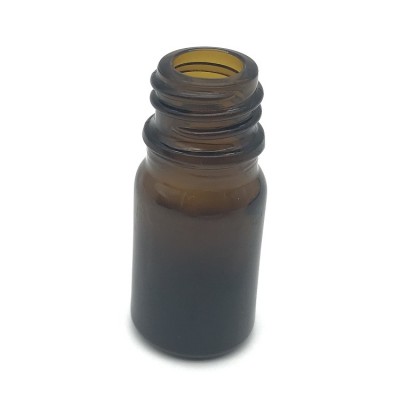
The Context: Lumina C launched in 2023 using a standard Amber Boston Round bottle. They chose amber for UV protection.
- The Problem: Customers complained that the product felt “medicinal” and “apothecary-style,” not “luxury.” They couldn’t justify the $58 price tag for a bottle that looked like cough syrup packaging.
- The Secondary Problem: The amber glass hid the beautiful light orange color of the serum, which was a key selling point (citrus/freshness).
The Pivot: We transitioned them to a Frosted Clear Glass Dropper Bottle (Acid Etched) with a custom silver hot-stamped logo.
The “Why” Logic:
- UV Issue: We addressed the UV protection concern by simply instructing the user to keep the box (secondary packaging) or adding a UV-inhibitor to the glass batch, though mostly, the frosting itself diffuses direct light intensity.
- Visuals: The frosting turned the bright orange liquid inside into a soft, glowing peach hue. It looked like a “sunset” in a bottle.
- Haptics: The tactile sensation of the acid-etched glass felt like a sea stone—smooth yet grippy—which contrasted perfectly with the slick, oily texture of the serum.
The Outcome:
- Brand Perception: Influencers began showcasing the bottle “uncapped” in videos because the glow of the liquid through the frost was aesthetically pleasing for Instagram/TikTok.
- Price Elasticity: They successfully raised the MSRP to $65 with the new packaging launch.
- Retention: Customer complaints about “cheap packaging” vanished.
Production Reality: The Environmental Cost of “Matte Black”
We must address a rising trend: the matte black glass bottle. This is the epitome of masculine or minimalist luxury.
However, “Black Glass” (Violet Glass) is extremely expensive to produce as raw material. Therefore, 95% of the “Matte Black” bottles you see on the market are actually clear bottles sprayed with matte black paint.
Is this bad? No, but it requires different handling. If you are ordering cosmetic packaging decoration involving sprayed matte finishes, you must perform a “Tape Test” (ASTM D3359) during Quality Control.
- Apply aggressive pressure-sensitive tape to the painted bottle.
- Rip it off rapidly.
- If any black paint comes off on the tape, the curing oven wasn’t hot enough, or the glass wasn’t cleaned before spraying.
We see this failure often with cheap suppliers. For our clients, we ensure a double-pass curing process to ensure that a matte black finish is as scratch-resistant as physically possible for a coating.
Conclusion
Choosing between Clear, Amber, and Frosted glass is not an artistic decision; it is a strategic one involving chemistry and economics.
If your formula is ugly but effective, hide it in matte black glass bottles or amber. If your formula is beautiful and needs to convey “light” and “renewal,” the frosted glass dropper bottle is your strongest asset. It provides the heavy, premium hand-feel of luxury while solving the optical challenges of natural ingredients.
In the competitive world of luxury skincare packaging, the bottle is the first interaction the customer has with your promise. Don’t let a cheap finish break that promise before the cap is even unscrewed.