 GlassBottleSupplies











Sales manager will contact you within 24 hours
Why Your 10ml Roller Bottles Are Limiting Your Pricing Power in 2026
In the essential oil and fragrance market, the barrier to entry is low, but the barrier to premium retail is incredibly high.
As we navigate 2026, the market is saturated with generic “Amazon-grade” packaging. For a brand owner, the challenge is no longer just “containing” the oil; it is about elevating the user experience to justify a $35+ MSRP for a product that competitors sell for $12.
The secret lies in the tactile engineering of the package. This analysis explores how upgrading from standard vials to engineered roller bottles for oils—specifically leveraging heavy glass, gemstone mechanics, and advanced decoration—can transform your product from a commodity into a luxury asset.
1. The Psychology of Weight: Heavy-Wall Engineering
When a consumer picks up a product, their brain makes a subconscious value judgment within 0.3 seconds based on one metric: Density.
Standard 10 ml roller bottles for essential oils are typically made from tubular glass. They have uniform, thin walls and a flat bottom. They function perfectly, but they feel “disposable.”
The “Heavy Base” Advantage
In 2026, top-tier brands are migrating to Molded Heavy Base bottles.
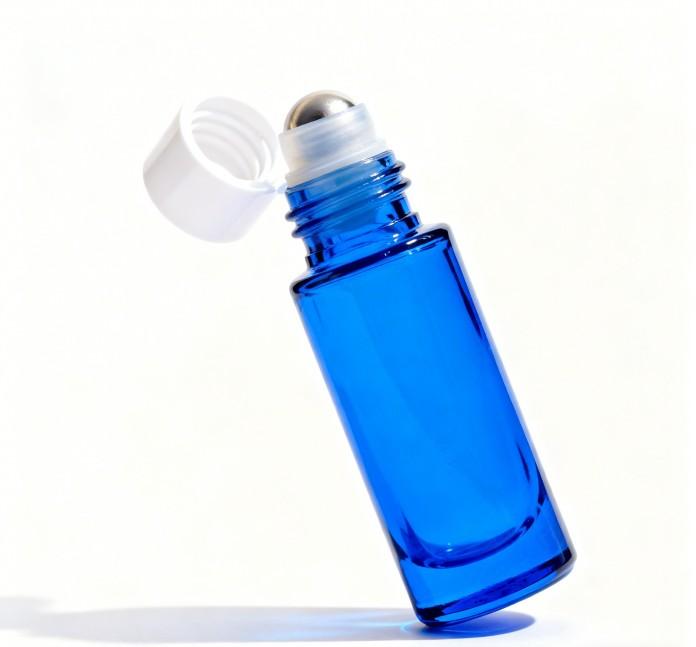
- The Difference: Unlike drawn tubular glass, these are formed in a mold (similar to high-end perfume bottles). This allows for a “glass slug”—a solid 5mm to 8mm thick layer of glass at the bottom.
- The Optical Effect: The thick glass base acts as a lens, refracting light through the oil. For colored oils (like Blue Tansy or golden Jojoba), this creates a “glowing” effect on the shelf that thin glass cannot replicate.
- The Stability Factor: Standard tubular 10ml essential oil roller bottles are top-heavy when the cap is off, leading to spills. A heavy base lowers the center of gravity, anchoring the bottle to the vanity.
ROI Insight: Sourcing heavy-base bottles increases unit cost by roughly 15-20%, but market data suggests it supports a retail price increase of 40-50% due to the “Perfume Grade” perception.
2. The Gemstone Application: Beyond the Rose Quartz Roller Bottle
The integration of crystals into packaging is no longer a “woo-woo” niche; it is a mainstream “holistic wellness” standard for 2026. However, utilizing a rose quartz roller bottle is not just about spiritual marketing; it is about thermal thermodynamics.
The “Cool Touch” Effect
Why do consumers prefer stone over steel?
- Thermal Mass: Natural stone (Quartz, Jade, Amethyst) has a high specific heat capacity. It stays cold. When a user applies an eye serum or a headache relief blend using a rose quartz roller bottle, the stone provides an immediate cooling sensation (cryotherapy effect) that reduces puffiness and inflammation. Stainless steel warms up almost instantly; stone remains cool.
- The Texture: Stone has a microscopic texture that holds oil differently than polished steel. It deposits a slightly heavier “dose” of product, which is often preferred for perfume oils where the user wants a distinct scent trail.
Sourcing Warning: The “Reconstituted” Trap
When buying wholesale roller bottles for oils with gemstones, be wary of “Reconstituted Stone.” This is stone dust mixed with epoxy resin and molded.
- How to Test: Real stone is cold to the touch and varies slightly in color. Resin feels room temperature (plastic-like) and looks too perfect. Resin reacts with certain essential oils (citrus), turning sticky over time. Always specify “Natural Polished Stone” in your purchase orders.
3. Decoration: The End of the Paper Label
Nothing cheapens a luxury oil faster than a paper label that is peeling at the corners because it got damp with oil.
In 2026, the “No-Label Look” is the defining characteristic of premium 10 ml roller bottles for essential oils.
Direct-to-Glass Printing
- Silk Screen (Ceramic Ink): The most durable option. Ink is applied and baked at 600°C. It becomes part of the glass. It is impervious to oil, alcohol, and water.
- Hot Stamping: For the logo, brands are using foil hot stamping directly on the glass (Gold, Silver, Rose Gold). On an amber or matte black bottle, this high-contrast metallic finish pops under retail lighting.
Electroplating and Gradient Sprays
To differentiate from the sea of plain amber bottles, brands are using:
- Gradient Spray: A 10ml essential oil roller bottle that fades from opaque black at the bottom to transparent at the top. This hides the “ugly” bottom of the stem/tube while allowing the customer to see how much product is left at the top.
- UV Electroplating: Coating the glass in a metallic finish (e.g., Gold). While striking, ensure the supplier leaves a “window” or stripe so the fill level is visible. Consumers in 2026 distrust packaging where they cannot see the quantity of liquid.
4. The Cap: The Forgotten Touchpoint
The cap is the first point of interaction. Standard black plastic caps are functional but forgettable.
The Rise of Natural Materials
- Bamboo & Wood: Real bamboo shells over a plastic inner cap are standard for “Natural/Organic” brands.
- 2026 Spec: Ensure the wood is sealed/varnished. Raw wood absorbs essential oil vapors and will stain or smell rancid over time.
- Anodized Aluminum: A weighted metal cap adds to the “heavy hand feel.”
- The “Double Shell” Design: Premium caps use an outer metal shell and a hidden inner plastic weight. This makes the cap feel substantial when unscrewed, echoing the “click” of a luxury lipstick.
5. Case Study: “Serenité Apothecary” Repositioning
To understand the financial impact of these choices, let’s look at “Serenité Apothecary” (a composite case study based on 2024-2025 industry shifts).
The Baseline: Serenité sold a “Headache Relief Blend” (Peppermint/Lavender).
- Packaging: Standard thin-wall amber 10ml essential oil roller bottles, stainless steel ball, black plastic cap, paper adhesive label.
- Cost of Goods (Packaging): $0.35 / unit.
- Retail Price: $14.00.
- Sales Channel: Local markets, Etsy.
The Pivot (The 2026 Strategy): They wanted to enter boutique retail and spas. They needed to look like a $40 product.
The New Specs:
- Bottle: 10ml Heavy Base Clear Glass with a “Matte Frost” finish.
- Roller: Amethyst Roller Ball (marketing connection to “calm/headache relief”).
- Decoration: Direct Silk Screen printing in Charcoal Grey (No paper label).
- Cap: Brushed Silver Aluminum (Double Shell).
- Box: Rigid setup box instead of a tuck carton.
The Financials:
- New Cost of Goods (Packaging): $1.15 / unit (3x increase).
- New Retail Price: $42.00.
- Outcome: The unit cost increased by $0.80, but the profit per unit increased by $27.20.
- Market Reception: The product was picked up by a luxury spa chain because the Amethyst roller allowed the spa to market the product as a “Mini-Treatment” rather than just an oil. The “frost” finish meant no fingerprints were visible on the shelf.
6. Manufacturing Logistics: Managing the “Exotic” Supply Chain
Sourcing standard roller bottles for oils is easy. Sourcing custom, heavy-base, gemstone-fitted bottles requires tighter supply chain management.
Component Matching
The biggest risk in custom packaging is tolerance mismatch.
- Scenario: You buy the heavy glass bottles from Factory A, the Amethyst balls from Factory B, and the caps from Factory C.
- The Failure: The heavy glass bottle often has a slightly different neck height (“H” dimension). The standard cap from Factory C might bottom out before sealing, causing leaks.
- The Fix: Consolidated Sourcing. Use a specialized supplier (like
glassbottlesupplies.com) who matches the fitment and cap to the specific mold of the heavy glass. If you must split suppliers, send physical samples of the glass to the cap manufacturer for “Fitment Verification” before mass production.
Lead Times for Customization
- Standard Amber Bottles: In stock (1 week).
- Custom Color Spray/Silk Screen: 25-35 Days.
- Custom Mold (Unique Shape): 60 Days + Mold Cost ($1500-$3000).
- 2026 Planning: For Q4 holiday sales, orders for custom 10 ml roller bottles for essential oils must be placed by July.
7. The Sustainability Angle: Refillability
In 2026, “Luxury” also means “Responsible.” A heavy glass bottle is an investment.
The Refill Trend: Brands are selling the premium rose quartz roller bottle unit once (the hardware) and then selling “Refill Pouches” or larger dropper bottles to refill the roller.
- Design Requirement: The fitment (the plastic housing holding the ball) must be removable.
- The “Orifice Reducer” Tool: Smart brands are including a small “key” or tool in the box to help the customer pry off the roller fitment without breaking a nail. This turns the packaging into a permanent, refillable beauty tool, justifying the higher initial price.
Conclusion
The era of the disposable plastic roller is fading in the premium sector. In 2026, the 10ml roller bottle is a canvas for brand storytelling.
By shifting your focus from “lowest cost per unit” to “highest perceived value,” you can leverage the physics of heavy glass, the allure of rose quartz roller bottles, and the permanence of direct printing. These are not just aesthetic choices; they are business decisions that protect your margins and secure your place on the top shelf.
Don’t just sell oil. Sell the application experience.