 GlassBottleSupplies












Sales manager will contact you within 24 hours
Why Boston Round Glass Bottles Define Modern Packaging Standards
The Boston Round bottle is not merely a container; it is a masterpiece of geometry and structural integrity. Characterized by its rounded shoulders and rounded base, this silhouette has remained the industry gold standard for over a century. For brands ranging from apothecary startups to industrial chemical suppliers, choosing between 2 ounce, 4 oz, or 8 oz Boston Round glass bottles is a decision that impacts product shelf-life, shipping safety, and consumer perception.
The Anatomy of a Classic: More Than Just Curves
To understand why the Boston Round remains a market leader, one must look at the physics of its design. Unlike square or rectangular bottles, the cylindrical shape of the Boston Round allows for even pressure distribution. This makes it exceptionally durable during the carbonation process or when containing volatile essential oils that may exert internal pressure.
Material Integrity: Type III Soda-Lime vs. Borosilicate
In the professional glass industry, we distinguish primarily by the glass composition. Most commercial Boston Rounds are manufactured from Type III Soda-Lime glass.
- Chemical Resistance: It offers excellent resistance to water and acids.
- Clarity: Provides a premium, transparent view of the product.
- Recyclability: 100% infinitely recyclable, appealing to the modern eco-conscious consumer.
Strategic Sizing: Choosing Your Capacity
The versatility of the Boston Round lies in its standardized sizing. At GlassBottleSupplies.com, we see distinct usage patterns across the four most popular volumes.
1. The Precision Choice: 2 Ounce Boston Round Bottle
The 2 oz (approx. 60ml) variant is the “Swiss Army Knife” of small-capacity packaging.
- Primary Uses: Beard oils, facial serums, high-potency tinctures, and travel-sized bitters.
- The 20-400 Neck Finish: Most 2 oz bottles utilize a 20mm neck width with a 400 thread style, making them perfectly compatible with glass pipettes (droppers) for precise dosage.
2. The Golden Standard: 4 Oz Boston Round Bottles
The 4 oz (approx. 120ml) bottle is arguably the most searched and utilized size in North America.
- Industry Fit: Essential oil blends, room sprays, and pharmaceutical liquids.
- Ergonomics: It fits perfectly in the palm of a hand, providing a balanced center of gravity when equipped with a finger sprayer.
3. The Bulk Utility: 8 Oz Boston Round Glass Bottles
When you move to 8 oz (approx. 240ml), the focus shifts to refills and household products.
- Applications: Luxury hand soaps, organic cleaning concentrates, and cold-brew coffee concentrates.
- Durability: The thicker glass walls of the 8 oz variant provide increased thermal shock resistance compared to smaller sizes.
Technical Industry Insight: The Criticality of Neck Finishes
A common mistake for buyers is focusing solely on the bottle volume while ignoring the GPI/GCMI neck finish. A “Boston Round” is defined by its shape, but its functionality is defined by its neck.
- 18-400 vs. 20-400: A 2 oz bottle might come in both. If you are using a thick viscous liquid like a heavy syrup, a wider 20mm opening is necessary to prevent “clogging” during the pouring process.
- Phenolic Caps vs. Polypropylene: For chemical storage in 4 oz or 8 oz bottles, a phenolic (Bakelite) cap with a LDPE cone liner is essential to create a wedge-like seal that prevents evaporation of volatile organic compounds (VOCs).
Case Study: Optimizing the Supply Chain for “Aura Botanicals”
The Challenge: Aura Botanicals, a high-end skincare client, was experiencing a 12% breakage rate during trans-Pacific shipping of their organic facial oils housed in standard 4 oz Boston Round bottles.
The Analysis: Upon auditing their packaging, we discovered that the bottles had inconsistent wall thickness (thin spots at the shoulder) due to low-quality molds used by their previous vendor.
The Solution:
- Mold Redesign: We transitioned their production to a high-pressure blow-and-blow process, ensuring a uniform glass distribution of at least 2mm at the thinnest point.
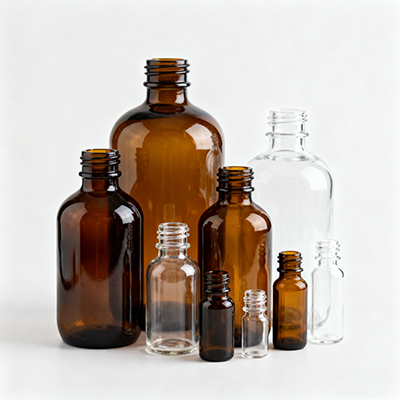
- Color Shift: We moved them from Clear to Amber glass. Amber glass filters out UV light (wavelengths under 450nm), which was crucial for their light-sensitive botanical ingredients.
- The Result: Breakage dropped to <0.5%, and the product’s shelf life extended by 6 months due to the UV protection of the Amber Boston Round.
Manufacturing Excellence: How We Ensure Quality
At Glass Bottle Supplies, our manufacturing process for boston round bottles glass follows a rigorous five-step quality control protocol:
- Annealing Lehr Treatment: Every bottle passes through a temperature-controlled kiln to relieve internal stresses created during the molding process.
- Vertical Load Testing: We ensure that an 8 oz boston round glass bottle can withstand the pressure of stacking during palletization.
- Dimensional Accuracy: Using digital calipers, we verify that neck threads are within 0.01mm of the specified GPI standard to ensure leak-proof seals.
- Surface Treatment: We offer “Hot End” and “Cold End” coatings (such as tin or polyethylene) to reduce surface friction, preventing “scuffing” where bottles rub together on a conveyor belt.
- Hydrostatic Pressure Testing: Crucial for bottles intended for carbonated beverages or pressurized chemical storage.
Why Glass Over Plastic?
While PET plastic is lightweight, glass remains the superior choice for high-end or chemically sensitive products.
| Feature | Glass (Boston Round) | Plastic (PET/HDPE) |
| Impermeability | Absolute (No oxygen transmission) | Permeable (O2 can degrade product) |
| Chemical Inertness | High (Won’t leach chemicals) | Risk of leaching (BPA/Phthalates) |
| Heat Resistance | Up to 500°C (depending on type) | Warps at 70°C – 100°C |
| Consumer Perception | Luxury / Professional | Value / Disposable |
Sustainability and the Circular Economy
In 2025, the narrative around boston round bottles glass is centered on sustainability. Unlike plastic, which degrades in quality every time it is recycled, glass is a closed-loop material. Using “cullet” (recycled glass) in our furnaces allows us to drop the melting temperature, significantly reducing CO2 emissions during the production of your 2 ounce, 4 oz, and 8 oz bottles.
Frequently Asked Questions
Is there a difference between a Boston Round and a Winchester bottle?
Yes. While similar, the Winchester bottle (often used in the UK) typically has a slightly taller neck and sometimes a finger ring for carrying larger volumes. The Boston Round is the preferred American standard for its sleek, compact shoulder profile.
What is the best way to clean 8 oz boston round glass bottles for reuse?
For commercial reuse, bottles should be subjected to a caustic wash at high temperatures, followed by a deionized water rinse to ensure no mineral deposits remain on the glass surface.
Can I use these bottles for essential oils?
Absolutely. However, we strictly recommend Amber or Cobalt Blue glass. Clear glass allows UV rays to oxidize the delicate terpenes in essential oils, rendering them ineffective within weeks.