 GlassBottleSupplies












Sales manager will contact you within 24 hours
Wholesale Glass Jars 2026: The Economics of Weight, Clarity, and Customization
In the B2B packaging landscape of 2026, the glass jar is no longer a commodity; it is a strategic asset. For brand owners scaling from kitchen batches to retail distribution, the selection of wholesale glass jars determines not just the product’s shelf appeal, but its shipping viability, breakage rates, and profit margins.
Why do successful brands invest heavily in the engineering of a simple container? Because the interaction between the consumer and the jar—the weight of a 2oz glass jar in the hand, or the clarity of an 8oz glass jar on a backlit shelf—directly influences the perceived value of the product. This analysis explores the hidden technicalities of sourcing glass, moving beyond the catalog photos to the engineering realities that drive profitability.
1. The Strategic Divergence: 2oz vs. 8oz Applications
When sourcing wholesale glass jars, buyers often treat all sizes with the same procurement logic. This is a mistake. The engineering requirements for small-format (2oz) and medium-format (8oz) containers are fundamentally different because they serve opposing market functions.
The 2oz Glass Jar: The “High Margin” Vessel
The 2oz glass jar (approx. 60ml) is the standard for high-potency, high-cost products: eye creams, concentrated salves, saffron, and premium CBD balms.
- The “False Bottom” Engineering: In this category, “less is more” regarding capacity, but “more is better” regarding size. A standard 2oz jar might look too small on a shelf. Therefore, in 2026, brands are sourcing “Heavy Base” or “False Bottom” jars. These jars utilize extra glass in the base to increase the external height and weight without changing the internal volume.
- Why? Neuromarketing studies consistently show that consumers associate physical weight with potency and luxury. A heavier jar justifies a higher price point ($50+) for a small amount of product.
- Neck Finish Dominance: For 2oz glass jars, the industry is moving away from the narrow 48-400 finish to the wider 53-400 or 58-400 finish. A wider opening suggests “abundance” and allows for easier finger access, critical for thick creams.
The 8oz Glass Jar: The “High Volume” Workhorse
The 8oz glass jar (approx. 240ml) is the backbone of the pantry and home fragrance market—jams, pickles, honey, and candles. Here, the economics are driven by freight density.
- The “Lightweighting” Imperative: Unlike the luxury 2oz sector, the goal here is to reduce glass weight. Modern NNPB (Narrow Neck Press and Blow) technology allows manufacturers to produce 8oz glass jars with thinner walls that are structurally stronger than older, thicker designs.
- The Math: Reducing a jar’s weight from 180g to 140g saves 40g per unit. On a container of 50,000 jars, that is a reduction of 2,000 kg. This significantly lowers ocean freight costs and domestic trucking fuel surcharges, a key metric for 2026 sustainability reporting.
2. The Transparency Paradox: Mastering Clear Glass Jars
Clear glass jars (Flint glass) are the default choice for 90% of products because they showcase the texture and color of the contents. However, transparency brings technical challenges that must be managed.
The “Graying” of Recycled Glass
In 2026, regulatory pressure in the EU and California demands higher percentages of PCR (Post-Consumer Recycled) content in packaging.
- The Problem: When you mix recycled glass (cullet) into the batch, it is difficult to control the color purity. High PCR content often results in a slight gray or green tint in clear glass jars.
- The Solution: Premium manufacturers use “Color Correction” additives (Selenium and Cobalt) in the melt to neutralize the tint. When buying wholesale glass jars with PCR claims, always request a physical sample from the current production run, as the clarity can fluctuate between batches based on the quality of the recycled cullet used.
UV Mitigation in Clear Glass
If your product is photosensitive (e.g., a Vitamin C cream or a natural colored jam), clear glass jars pose a risk.
- 2026 Trend: Invisible UV Coatings. Rather than switching to amber or blue glass which hides the product, manufacturers are now applying a transparent, UV-absorbing spray coating to the exterior of the jar. This allows the consumer to see the product while blocking up to 80% of harmful UV rays. This technology transforms a standard commodity jar into a functional barrier packaging component.
3. The Closure Ecosystem: It’s Not Just a Lid
A glass jar is useless without a hermetic seal. The compatibility between the glass finish and the cap liner is where most product failures occur (leakage, mold, oxidation).
Understanding “Land Area”
The “Land” is the top rim of the jar that makes contact with the cap liner.
- Glass Defect: In cheap wholesale glass jars, the Land often has a “Dip” or “Saddle”—it is not perfectly flat.
- The Consequence: If you use a rigid liner (like Teflon/PTFE), it will not conform to the dip, causing a leak. If you use an Induction Heat Seal (foil), the current won’t fuse the foil to the glass in that depression, creating a breach.
- The Fix: For liquid products, specify “Flatness Tolerance < 0.2mm” in your purchase order.
Liner Chemistry 101
- Plastisol (for Foods): If you are hot-filling jams into 8oz glass jars, you need a metal Lug Cap with a Plastisol liner. The heat softens the plastisol ring, which then forms a vacuum seal around the glass rim as it cools. Warning: You cannot use Plastisol for cold-fill products; it won’t seal.
- F217 / PE Foam (for General Use): The industry standard for cosmetics. A tri-ply liner (Low-density polyethylene). It provides a good moisture barrier but is not air-tight enough for long-term food storage.
- PVDC (Polyvinylidene Chloride): Necessary for aggressive chemicals or essential oils that might “eat” standard foam.
4. Customization: The “No-Label” Look
In 2026, the trend is moving away from paper labels (which peel in humid bathrooms) toward direct decoration. When buying wholesale glass jars, you have access to decoration services that are impossible for retail buyers.
Screen Printing vs. Pad Printing
- Screen Printing: Best for cylindrical jars (Boston Rounds or simple straight-sided jars). The jar rotates against a screen. It allows for large wrap-around text.
- Pad Printing: Required for odd-shaped jars or printing on the bottom of the jar. A silicone pad picks up the ink and stamps it onto the glass.
- Acid Etching (Frosting): A chemical bath that turns clear glass jars into a matte, semi-opaque finish. This is incredibly popular for 2oz glass jars in the luxury cosmetic sector as it diffuses light, hiding minor product separation while looking premium. Unlike “spray frosting” (which can scratch off), acid etching is permanent and modifies the glass surface itself.
5. Case Study: The “SpiceRoute” Rebrand
To illustrate the technical nuances of sourcing, consider “SpiceRoute,” a premium organic spice company (Case study based on aggregated industry data).
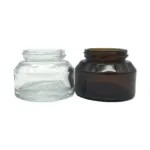
The Challenge: SpiceRoute was selling saffron threads and truffle salt in standard, thin-walled 2oz glass jars with plastic screw caps.
- Consumer Perception: Customers complained the jars felt “cheap” and “light” for a product that cost $45.
- Moisture Ingress: The salt was clumping because the standard PE foam liner was not sufficient to block humidity in humid climates.
The Strategic Shift: The company moved their supply chain to a specialized manufacturer focusing on cosmetic-grade glass rather than food-grade glass.
The New Specs:
- Container: They selected a 2oz Heavy Wall “Cube” Glass Jar. The square shape allowed for tighter packing (less air in the shipping box) and the thick glass wall added 40g of weight to the unit.
- Visuals: They utilized “Super Flint” glass to ensure the vibrant red of the saffron was not dulled by the green tint of standard soda-lime glass.
- Closure: They switched to a metal cap with a Pressure Sensitive (PS) liner. When the cap is torqued down, the PS liner adheres to the glass rim, creating a freshness seal that the customer has to peel off—adding a layer of tamper evidence and moisture protection.
The Result:
- Sales Velocity: The “Cube” shape stood out on shelves dominated by round jars. The visual clarity of the Super Flint glass made the product look fresher.
- Damage Reduction: The heavy corners of the cube jar proved more durable during shipping than the thin round jars, reducing breakage returns by 15%.
- Price Elasticity: The premium packaging allowed SpiceRoute to raise the retail price by 12% without a drop in sales volume.
6. Logistics Deep Dive: Palletization Patterns
When you order wholesale glass jars, you are paying for “air” if you don’t optimize the pallet.
Ti-Hi Ratios
This refers to the number of cartons per layer (Ti) and the number of layers high (Hi).
- 2oz Glass Jars: Because they are short, you can stack them higher. However, glass is heavy. You must ensure the bottom box does not crush under the weight of the 10 layers above it. High-quality wholesale cartons use “double-wall” corrugated cardboard (ECT-44 rating) to prevent crushing.
- 8oz Glass Jars: These maximize the footprint. A standard 40×48 pallet should fit specific patterns.
- Inefficiency: If your jar diameter is 70mm, and the box is designed poorly, you might only fit 10 boxes per layer with 4 inches of wasted space on the edge of the pallet.
- Optimization: Professional suppliers design the master carton dimensions specifically to flush the edges of a standard ISO pallet, maximizing container utilization (Cube Utilization).
7. Quality Control Checklist for 2026
Before signing a contract for 100,000 units, request the “Technical Drawing” and check these three critical dimensions:
- Overflow Capacity (OFC): A “2oz jar” is a marketing term. The OFC might be 65ml or 72ml. You need to know exactly how much liquid fits to the brim to calculate your fill level. If the OFC is too high, your product will look underfilled (too much “headspace”).
- H-Dimension: The height from the bottom of the neck finish to the top. If this is out of spec, your cap will bottom out on the shoulder of the jar before the liner compresses against the rim, resulting in a leaker.
- Verticality (Perpendicularity): Put the jar on a flat surface and spin it. Does it wobble? A “leaner” jar will jam automated labeling machines and result in crooked labels.
Conclusion
Sourcing wholesale glass jars is an exercise in balance. For 2oz glass jars, the focus is on weight, clarity, and seal integrity to convey value. For 8oz glass jars, the focus shifts to lightweighting, thermal stability, and freight efficiency.
In 2026, the successful brand does not just buy glass; they engineer a packaging system. By understanding the material science of clarity, the physics of closure seals, and the economics of logistics, you transform a simple expense into a competitive advantage. The jar is the only marketing material that 100% of your customers will touch—ensure it communicates the quality of what is inside.