 GlassBottleSupplies












Sales manager will contact you within 24 hours
What Top Brands Miss About 10ml Roller Bottles: The 2026 Engineering Guide to Leak-Proof Performance
In the precise world of aromatherapy and topical cosmetics, the delivery system is as critical as the formulation itself.
For years, the industry treated roller bottles for oils as a commodity—a simple assembly of glass, plastic, and a sphere. However, as we approach 2026, the market has shifted. Consumers are educated; they distinguish between a “scratchy” cheap plastic ball and the glacial glide of a polished rose quartz roller bottle. For brand owners, the stakes are financial: a single leaking batch of 10ml essential oil roller bottles can destroy vendor relationships and trigger Amazon delistings.
This is not a guide on how to blend oils. This is an analysis of the tribology (the science of friction and lubrication), the manufacturing tolerances, and the supply chain logic required to source the highest performing 10 ml roller bottles for essential oils.
1. The Physics of the “Glide”: Tribology in Packaging
Why do some rollers dispense a perfect, thin film of oil while others dispense nothing or drip excessively? It comes down to the interaction between the liquid’s viscosity and the “annular gap.”
The mechanism of a roller ball is often misunderstood. It does not work by gravity alone. It works through fluid shear. As the user rolls the ball across the skin, the friction rotates the sphere. This rotation pulls a layer of liquid from the bottle, through the housing gap, and onto the skin.
The Critical “Gap” Tolerance
The space between the ball and the plastic housing (the fitment) is the “annular gap.”
- Too Tight (<0.05mm): The ball seizes. The user has to press hard, dragging the ball across the skin (scratching) rather than rolling it. The oil does not flow.
- Too Loose (>0.15mm): The hydraulic seal is broken. The low surface tension of essential oils allows the liquid to bypass the ball entirely, causing the bottle to leak when inverted.
2026 Sourcing Standard: When specifying 10 ml roller bottles for essential oils, you must match the “gap” to your carrier oil.
- Water-thin (e.g., pure essential oils, alcohol blends): Requires a “Tight Fit” housing (0.05mm – 0.08mm gap).
- Medium Viscosity (e.g., Fractionated Coconut Oil, Jojoba): Requires “Standard Fit” (0.09mm – 0.12mm gap).
- High Viscosity (e.g., Castor Oil, Gel Serums): Requires “Loose Fit” or a textured ball to grab the fluid.
2. Material Science: The Ball Revolution
The sphere is the only moving part of the package. Its material dictates the sensory experience and the chemical compatibility.
Stainless Steel (304 vs. 316)
For years, stainless steel was the gold standard. It is perfectly spherical (machined to high tolerance), cool to the touch, and hygienic.
- Grade 304: Standard food grade. Acceptable for most oils.
- Grade 316: Marine grade. Contains Molybdenum for superior corrosion resistance.
- The Risk: In 2026, we see cheaper suppliers substituting chrome-plated iron balls. These will rust when exposed to acidic essential oils (like lemon or grapefruit). Always test roller bottles for oils with a magnet; high-quality 316 steel is non-magnetic or only slightly magnetic, whereas iron is strongly magnetic.
The Rise of the Gemstone: Rose Quartz Roller Bottle
The demand for “holistic” packaging has exploded. A rose quartz roller bottle offers a dual benefit: the metaphysical appeal of the crystal and the massive thermal retention of stone.
- The Manufacturing Challenge: Unlike steel, you cannot cast stone. It must be ground and polished.
- The “Out-of-Round” Risk: Natural stone has varying hardness. Cheap manufacturing results in balls that are not perfectly spherical. An out-of-round ball creates a gap that changes as it rotates—leak, seal, leak, seal.
- The Solution: For 2026, premium brands must specify “Grade A Polished” gemstones. These undergo a secondary tumbling process to ensure sphericity within ±0.02mm. Without this, a rose quartz roller bottle is a leakage liability.
Glass Balls
Often overlooked, glass balls offer the best chemical resistance. They are impervious to the most aggressive essential oils (like Clove or Cinnamon) that might react with metals or degrade plastics. They offer a “silent” roll, distinct from the metallic rattle of steel.
3. The Fitment: The Unsung Hero of Stability
The “Fitment” is the plastic housing that holds the ball and snaps into the glass bottle. This is where 90% of failures occur.
Material Selection: PE vs. PP
- LDPE (Low-Density Polyethylene): Soft and flexible. It snaps easily into the glass neck. However, it is permeable to strong volatiles. High concentrations of citrus oils (Limonene) can cause LDPE to swell. If the housing swells, it squeezes the ball, causing the roller to seize up.
- PP (Polypropylene): Rigid and chemically resistant. It holds its shape better over time. However, because it is hard, it requires a very precise glass neck finish to seal correctly. If the glass bottle neck is slightly oval, a rigid PP fitment won’t conform, causing a leak around the housing.
Industry Best Practice: For pure essential oils, utilize a PP Housing. For diluted blends (carrier oils), PE Housing provides a smoother “push-in” assembly experience and sufficient resistance.
4. The 10ml Standard: Glass Engineering and Aesthetics
The 10ml essential oil roller bottles (approx. 1/3 oz) are the industry standard unit. But not all 10ml bottles are created equal.
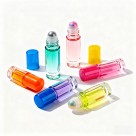
The Heavy Bottom (Luxury Weight)
Standard 10ml vials are made from tubular glass, resulting in thin, uniform walls and a flat, thin bottom. They are functional but feel lightweight. The trend for 2026 is the “Molded Heavy Base” 10ml bottle. Produced using the same technology as perfume bottles, these have a thick “slug” of glass at the base.
- Stability: The lower center of gravity prevents the bottle from tipping over on a vanity.
- Perception: The added weight mimics the feel of high-end cosmetics.
- Dimensions: While holding 10ml, these bottles are often taller or wider, providing more “billboard space” for labeling.
UV Protection: Amber, Cobalt, and Sprayed Finishes
We know Amber glass blocks UV light (200nm-450nm) to protect photosensitive oils. However, 2026 trends favor aesthetics.
- Gradients: Brands are moving toward frosted gradients on 10 ml roller bottles for essential oils.
- The Warning: If you choose a painted or sprayed bottle, ensure the neck finish remains clear (unpainted). Paint on the rim can interfere with the fitment seating. As the fitment is inserted, it can scrape flakes of paint into the oil, contaminating the product.
5. Case Study: “LuminaBotanic’s” Leakage Crisis
To illustrate the importance of these technical specs, let’s review a real-world scenario (anonymized for confidentiality) involving a mid-sized wellness brand, “LuminaBotanic.”
The Product: A “Sleep & Soothe” blend: Lavender, Chamomile, and Valerian Root in a fractionated coconut oil base, packaged in 10ml essential oil roller bottles with a rose quartz roller bottle fitment.
The Failure: Three months after launch, customer complaints spiked. The issue was not leakage during shipping, but “dry rolling.” Customers reported the ball wouldn’t move, or it dragged across the skin without dispensing oil.
The Root Cause Analysis:
- The Stone: The supplier utilized “Grade B” Rose Quartz. Under microscopic analysis, the surface of the stone was pitted.
- The Interaction: The pitting increased friction. More importantly, the housing was made of standard LDPE.
- The Chemistry: The Valerian Root oil contained compounds that caused a slight swelling in the LDPE housing (approx 2%).
- The Result: The swollen plastic clamped down on the rough surface of the rose quartz. The friction became too high for skin contact to overcome. The ball seized.
The Correction: LuminaBotanic switched to a Polished Grade A Rose Quartz (smoother surface = lower friction) and upgraded the housing to High-Density Polyethylene (HDPE), which offers better chemical resistance than LDPE while maintaining enough flexibility to seal against the glass.
- Outcome: The “glide” was restored. Returns dropped to near zero. The brand utilized the “upgraded polished crystal” as a marketing point, actually increasing the price by $2/unit to cover the manufacturing cost.
6. Manufacturing & Assembly: The “Click” Factor
If you are buying roller bottles for oils in bulk, you are likely assembling them yourself or using a contract filler.
The Assembly Force
Inserting the fitment into the glass bottle requires force.
- Manual Assembly: If pressing by hand, you need a fitment with “vertical ribs” on the shank. These ribs crush slightly to accommodate variances in the glass neck inner diameter (ID).
- Automated Assembly: Machines can apply consistent vertical pressure. However, if the fitment is too tight, the machine might crack the glass neck. If too loose, the machine might not detect that the fitment isn’t fully seated (“false click”).
The 16mm Standard
Most 10 ml roller bottles for essential oils use a DIN 16 or GPI 16mm neck finish.
- Warning: Do not mix manufacturers. A 16mm fitment from Supplier A might not fit a 16mm bottle from Supplier B. The internal diameter (ID) of the glass neck is the variable.
- The ID Spec: The standard ID for a roller bottle neck is usually 8.5mm to 9.5mm. A deviation of 0.5mm makes the fitment fall out or impossible to insert. Always request the “Technical Drawing” of both the bottle and the fitment to ensure the ID matches the Plug Diameter.
7. Supply Chain: Sourcing Strategies for 2026
When sourcing these components, especially distinct items like a rose quartz roller bottle, logistics play a key role in quality preservation.
Shipping “Knock-Down” vs. Pre-Assembled
- Knock-Down (KD): Bottles, Fitments, and Caps are packed in separate cartons.
- Pros: Cheaper. Allows you to fill the bottle before inserting the roller.
- Cons: You must manage inventory of three SKUs. Risk of contamination (dust) inside the open bottles.
- Caps-On (Pre-Assembled): Not possible for roller bottles, as you cannot fill them through the roller ball.
- The Hybrid: Bottles in shrink-wrapped trays (sterile). Fitments and caps in sealed bags.
Testing Protocol
Before committing to an order of 50,000 units, perform this 3-step test:
- Vacuum Test: Place filled bottles in a vacuum chamber at -0.5 bar. If they leak, they will fail in air cargo (depressurized planes).
- Oven Test: Store filled bottles inverted at 45°C (113°F) for 72 hours. This simulates a hot delivery truck. If the plastic housing expands and leaks, the design is flawed.
- Glide Test: Roll the bottle on “virgin” paper for 1 meter. The oil track should be consistent, without skips (dry spots) or blobs (flooding).
Conclusion
The humble roller bottle is a masterpiece of tolerance engineering. It balances the viscosity of the oil, the friction of the ball, and the chemical resistance of the housing.
In 2026, success in the aromatherapy market requires looking beyond the “look” of the bottle. Whether you are choosing the clinical precision of stainless steel or the organic allure of a rose quartz roller bottle, the integrity of the fitment housing is what determines the customer experience.
By understanding the tribology of the roll and the chemical interaction of the fitment, brands can confidently scale their production of 10 ml roller bottles for essential oils, ensuring that the only thing the customer notices is the therapeutic benefit of the product, not the mechanics of the package.