 Cam Şişe Malzemeleri












Satış müdürü 24 saat içinde sizinle iletişime geçecektir.
The Physics of Fluid Displacement: Engineering Precision in Professional Nail Lacquer Containers
In the realm of high-performance cosmetic packaging, the vessel is far more than a decorative shell. For professional formulations, boş oje şişeleri serve as a controlled environment where fluid dynamics, atmospheric pressure, and chemical inertness must be perfectly balanced. Achieving consistent application requires an intimate understanding of how glass geometry influences the behavior of non-Newtonian fluids—specifically the thixotropic gels common in modern nail lacquers.
Rheology and the Geometry of the Internal Cavity
The primary function of oje şişeleri is to facilitate the movement of the brush while managing the “load” of the lacquer. From an engineering perspective, this is a study in rheology. When a brush is withdrawn from the bottle, the fluid undergoes shear-thinning. If the internal shoulders of the bottle are too sharp, “dead zones” are created where the lacquer can pool and prematurely dry, leading to flakes that eventually contaminate the rest of the bottle.
İçin 15 ml oje şişeleri, a parabolic internal shoulder design is superior to a flat-shoulder design. This allows for a smooth “return flow” of the lacquer after the brush is wiped against the neck. By minimizing the surface area of the glass in the headspace, we can significantly reduce the rate of solvent evaporation every time the bottle is opened.
[Image suggestion: A thermal or fluid-mapping diagram showing the flow of lacquer during brush withdrawal in a parabolic vs. square-shouldered bottle]
Glass Tension and the “Shoulder-to-Base” Integrity
Üretim 5 ml oje şişeleri presents unique challenges in glass tension. Because the volume is smaller, the ratio of glass mass to product volume is much higher. During the cooling (annealing) phase in the Lehr oven, smaller bottles are prone to higher internal stress near the neck-to-shoulder transition.
If the annealing process is not precisely controlled at approximately 540°C (the typical transformation point for soda-lime glass), the bottle may develop micro-fissures. While invisible to the naked eye, these fissures can fail under the mechanical stress of a high-torque filling line. Professional-grade suppliers utilize polarized light stress viewers to ensure that every batch meets a “Real Temper Number” of 1 to 2, ensuring maximum impact resistance.
Comparative Material Performance for Solvent Barriers
| Teknik Özellik | Standard HDPE (Plastic) | Tip III Soda-Kireç Camı | Borosilikat 3.3 Cam |
| Oksijen Geçirgenliği | High (Potential for oxidation) | Zero (Total Barrier) | Zero (Total Barrier) |
| Solvent Absorption | 2-5% over 12 months | 0% | 0% |
| Yüzey Enerjisi (mN/m) | ~30 (Requires treatment) | ~70 (Excellent wetting) | ~75 (Superior wetting) |
| Heat Distortion Temp | 120°C | 550°C | 820°C |
The Engineering of the Neck Finish: Preventing “Cap-Lock”
One of the most common consumer complaints is the inability to open a bottle after the first few uses—a phenomenon known as “cap-lock.” This is rarely a fault of the cap itself but rather a failure of the neck thread engineering and the land area.
İçinde 15 ml oje şişeleri, the thread must be designed with a “start” that allows for rapid engagement without cross-threading. Furthermore, the “E-dimension” (the diameter of the thread) and the “T-dimension” (the major diameter) must have a tolerance of no more than ±0.25mm. If the neck is too wide, the lacquer will seep into the threads during the wiping process; once the solvent evaporates, the solids act as a high-strength adhesive, locking the cap permanently.
Closure Torque and Sealing Standards
To prevent leakage during air transport (where pressure drops significantly), the sealing system must withstand a vacuum test of at least -0.6 bar. This is achieved through a combination of:
- Stem-Seal Geometry: The brush stem is designed with a flared base that creates a secondary seal against the internal neck wall.
- Liner Compression: Using a closed-cell PE foam liner that compresses exactly 0.3mm when the cap is torqued to 1.4 Nm.
Case Study: High-Viscosity Glitter Suspension for a Global Retailer
Marka Geçmişi ve Gereksinimi
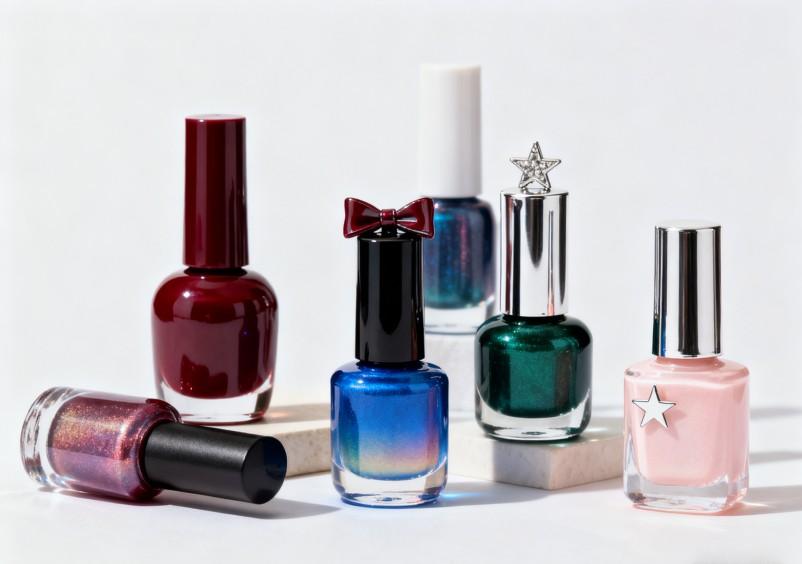
A global fast-fashion retailer required a series of 15 ml oje şişeleri for a new line of “Mega-Glitter” lacquers. These formulas contained large, hexagonal PET glitters (0.040″ diameter) suspended in a high-viscosity clear base. The primary requirement was that the glitter must remain in suspension for 18 months without the need for aggressive shaking.
Teknik Zorluklar
Standard bottles failed during the pilot phase. The heavy glitter particles tended to settle around the edges of the base, and because the standard mixing beads were too light (3mm stainless steel), they couldn’t break the “gel strength” of the thickened base to re-suspend the particles.
Teknik Parametre Ayarları
- Bottle Base: The interior base was engineered with a “Double-V” indentation. This forced the two 4.5mm 316-grade stainless steel mixing beads to travel in a figure-eight pattern, creating maximum turbulence.
- Neck Orifice: Expanded the neck ID (Internal Diameter) to 10.5mm to allow for a wider brush tuft (700+ filaments) capable of “picking up” the large glitters without clumping.
- Glass Clarity: Specified a “Super-Flint” glass with a low iron content (<0.015% Fe2O3) to ensure the glitters’ holographic effect wasn’t distorted by a green tint.
- Ağırlık Dağılımı: Increased the base thickness to 5.5mm to lower the center of gravity, preventing the bottle from tipping during the automated filling of the viscous fluid.
###量产过程与质控解决方案
During production, we implemented a “Hot-End Coating” (tin tetrachloride) to improve the scratch resistance of the glass surfaces as they bumped together on the conveyor. Post-production, a “Centrifuge Accelerated Stability Test” was performed at 3000 RPM for 30 minutes to simulate 12 months of gravitational settling.
Nihai Pazar Performansı
The specialized bottle design resulted in a 98% reduction in “settling” complaints compared to the brand’s previous supplier. The heavy-base design provided a premium hand-feel that justified a 15% price increase at retail, while the “Double-V” base became a technical talking point for their marketing team.
Advanced Surface Treatments: Aesthetic Meets Technical
For the modern boş oje şişeleri market, decoration is no longer just “painting.” Techniques like “Internal Lacquering” allow the outside of the bottle to remain clear while the inside is coated in a metallic or pearlescent finish. This protects the coating from being scratched during consumer use.
Furthermore, “Acid Etching” (Frosting) is now being replaced by “Soft-Touch” spray coatings. Unlike chemical etching, which can weaken the glass surface tension by creating micro-pores, soft-touch coatings are polymer-based and actually provide a layer of impact protection for a 5 ml oje şişesi, which is often dropped in transit.
Sıkça Sorulan Sorular
Q1: How do you prevent the brush from “curling” inside a 5 ml nail polish bottle? A: This is a “shunting” issue. The distance from the top of the neck to the internal base must be measured against the brush’s “out-of-cap” length. We typically allow for a 0.5mm to 1.0mm clearance. If the brush touches the bottom, the filaments will take a permanent set (curling), ruining the application precision.
Q2: What is the difference between “Flint” glass and “Super Flint” glass for nail polish? A: It comes down to the purity of the sand and the level of iron oxide. Super Flint uses high-purity silica, resulting in a refractive index that mimics crystal. This is crucial for high-end lacquers where the color in the bottle must perfectly match the color on the nail.
Q3: Can these bottles be autoclaved for medical-grade or antifungal treatments? A: While Type III glass can withstand the heat of an autoclave, the thermal shock (rapid cooling) might be an issue. For medicated polishes, we recommend using a specialized annealing process to increase the thermal shock resistance to at least 60°C-80°C.
Q4: Why do some bottles have a “beaded” finish on the bottom? A: Those small dots (knurling) are actually functional. They prevent the glass from “suctioning” to the conveyor belts during the manufacturing process and provide a friction surface for the automated labeling machines.