 유리병 용품












영업 매니저가 24시간 이내에 연락드리겠습니다.
Beyond the Laboratory: The Industrial Evolution of the Precision Reagent Bottle
The Molecular Imperative of the Glass Reagent Bottle
In the hierarchy of laboratory and industrial vessels, the 시약병 occupies a position of uncompromising utility. Unlike standard decorative glassware, a 화학 시약 병 is a specialized pressure vessel designed to manage the kinetic energy of volatile solutes while maintaining absolute purity. The engineering of these bottles starts not at the mold, but at the molecular level—balancing the concentration of Boron Trioxide ($B_2O_3$) to ensure the glass can withstand aggressive ion exchange without shedding silica flakes.
한 유리 시약병, the primary failure mode is often ignored by laypeople: “Leaching.” When a high-pH solution resides in a low-quality glass container, it gradually pulls alkali ions from the surface, a process known as “glass corrosion.” This changes the concentration of the reagent, leading to failed titration or contaminated batches in high-precision industries like semiconductor manufacturing or clinical skincare.
Structural Calculus: 100 ml Reagent Bottle and the Physics of Wall Thickness
그 100 ml reagent bottle is perhaps the most ubiquitous size in both academic and industrial settings, yet it poses the most significant manufacturing challenge. At this volume, the surface-area-to-liquid ratio is relatively high, meaning any surface defect is magnified.
Engineering a high-quality stock reagent bottle requires a “Vertical Glass Distribution” analysis. Using a process known as Narrow Neck Press and Blow (NNPB), we can ensure that the wall thickness remains constant within a ±0.15mm tolerance. This is not merely for aesthetics; a uniform wall thickness ensures that when the bottle is placed on a hot plate or subjected to cryogenic storage, the thermal expansion is uniform across the entire X-Y-Z axes.
Table 1: Material Performance Metrics for Reagent Glass Bottles
| Technical Property | USP Type I (Borosilicate) | USP Type III (Soda-Lime) | HDPE (Comparison) |
| 팽창 계수 | 3.3 x 10⁻⁶/K | 9.0 x 10⁻⁶/K | ~120 x 10⁻⁶/K |
| Max Working Temp | 500°C | 200°C | 120°C |
| 수분 분해 저항성 | 0.02 mL (0.02N Acid) | 0.30 mL (0.02N Acid) | N/A |
| Gas Permeability | Zero | Zero | Significant |
| Typical Use Case | Analytical Chemistry | Non-reactive Stock | Bulk Storage |
The Hermeticity of the Stopper: Beyond the Ground Joint
The sealing mechanism of reagent glass bottles has evolved from simple corks to the “Standard Taper” (ST) ground glass joint. However, in the modern 24/40 or 29/42 joint systems, the “Roughness Average” (Ra) of the grind determines the success of the seal. If the grind is too coarse, capillaries form, allowing volatile reagents like Ether or Chloroform to escape via “wicking.”
다음과 같은 경우 화학 시약 병, we now often utilize a PTFE (Polytetrafluoroethylene) sleeve or a liner-less PBT (Polybutylene terephthalate) screw cap. The PBT cap is preferred for its high chemical resistance and thermal stability up to 180°C. The “Lip-Seal” design integrated into the cap uses the rigidity of the glass rim to deform the plastic slightly, creating a 360-degree hermetic barrier without the need for secondary greases that could contaminate the sample.
Case Study: Safeguarding a Volatile “Active Peptoid” for Global Distribution
브랜드 배경 및 요구 사항
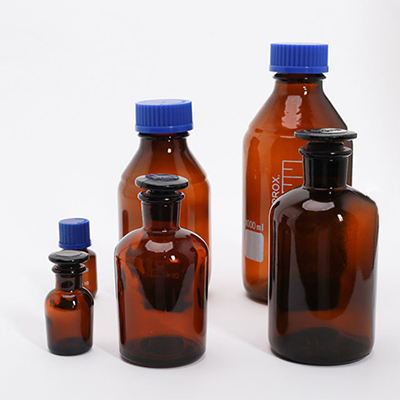
A Swiss-based biotechnology firm specialized in “Active Peptoid” chains—highly unstable, moisture-sensitive molecules used in next-generation dermatological repair. These molecules were delivered in a 100 ml reagent bottle format to high-end compounding labs. The reagent was suspended in an anhydrous solvent that would degrade instantly if it encountered even 5 parts per million (ppm) of atmospheric moisture.
기술적 과제
The client faced a 15% loss of potency during air-freight across different pressure zones. Standard reagent glass bottles were breathing; as the plane ascended, the internal pressure increased, forcing some vapor out. During descent, moist cabin air was sucked back in. Additionally, the amber coloring of previous bottles was inconsistent, allowing UV spikes at 380nm to cleave the molecular chains.
기술 파라미터 설정
- 유리 기판: ASTM E438 Type I Class A Borosilicate 3.3.
- 자외선 차단: Targeted “Deep Amber” melt with a 0% transmission cutoff at 400nm (verified via Spectrophotometry).
- 폐쇄 시스템: 45mm GL45 thread with an integrated pouring ring.
- Seal Material: High-purity Virgin PTFE faced Silicone (130 Shore A hardness).
- 토크 표준: 2.5 Newton-meters (Nm) application torque using a calibrated digital torque wrench.
대량 생산 및 품질 관리
We moved away from traditional batch melting and utilized a “Continuous Tank Furnace” to ensure the amber pigment was distributed with zero “striations.” To solve the “breathing” issue, we implemented a vacuum-induction sealing process within a dry-nitrogen chamber. Every stock reagent bottle was subjected to a “Leakage Test” using a methylene blue dye-bath under 2 bars of external pressure to ensure zero ingress.
최종 시장 성과
The peptoid potency remained at 99.8% over an 18-month stability study. The firm was able to transition from expensive refrigerated shipping to standard climate-controlled logistics, reducing their carbon footprint by 22%. The “Pouring Ring” design on the 화학 시약 병 eliminated “Drip-Back,” which had previously caused the labels to peel and presented a safety hazard to lab technicians.
Photochemical Stability: The Physics of the Amber Melt
어떤 시약병 is described as “Amber,” it is not a mere dye. It is a chemical modification of the glass structure. Iron ($Fe$) and Sulfur ($S$) are added to the melt under strictly controlled reducing conditions to create “iron-sulfur chromophores.”
한 유리 시약병, the thickness of the glass directly correlates to its light-blocking efficiency. A 100ml bottle with a 3mm wall thickness will block significantly more actinic light than a 500ml bottle with a 1.5mm wall. This is a critical consideration for engineers when scaling up a formulation. If the wall thickness changes, the UV exposure profile of the reagent changes, potentially necessitating a re-formulation of the preservative system.
The Sustainable Supply Chain: Borosilicate’s Infinite Lifecycle
In the context of reagent glass bottles, sustainability is defined by “In-Use Longevity.” While plastic 시약병 are often “single-use” due to chemical absorption and surface degradation, a borosilicate 3.3 expansion glass vessel can be autoclaved, chemically cleaned, and reused thousands of times.
The supply chain for these bottles is shifting toward “Closed-Loop Glass Reclamation.” Because high-purity borosilicate is a valuable industrial commodity, shattered or retired reagent glass bottles are being harvested to serve as “cullet” (recycled glass) for new melts. This reduces the furnace energy consumption by 25%, as cullet melts at a significantly lower temperature than raw silica sand.
Ergonomics and the “Tactile Certainty” of Lab-Ware
The final stage of reagent bottle engineering is the human interface. The “Hand-Feel” of a stock reagent bottle involves the center of gravity and the “Grip Pattern.” Many modern reagent glass bottles now feature a “Shoulder Slope” of exactly 35 degrees, which is the optimum angle for the human wrist during a controlled pour.
Furthermore, the graduation marks on a 100 ml reagent bottle are no longer just painted; they are “Fired-on Ceramic Enamel.” This ensures that even after exposure to strong acids or repeated cycles in an industrial dishwasher, the volume markings remain legible. This prevents dosing errors—the silent killer of laboratory accuracy.
전문가 FAQ
Q1: Why is Borosilicate 3.3 preferred over 5.1 or 7.0 for chemistry reagent bottles?
A: Borosilicate 3.3 has the lowest coefficient of thermal expansion, making it the most resistant to thermal shock. While 5.1 or 7.0 (often used in pharmaceutical vials) are excellent for chemical neutrality, they cannot withstand the rapid heating/cooling cycles that a chemistry reagent bottle often undergoes during sterilization or reactive synthesis.
Q2: Can I store hydrofluoric acid (HF) in a glass reagent bottle?
A: Absolutely not. HF is one of the few chemicals that reacts directly with the silica matrix of the glass, effectively “eating” the bottle from the inside out. For HF, specialized fluoropolymer (PFA or PTFE) bottles must be used. Always consult a chemical compatibility chart before selecting a reagent glass bottle.
Q3: What is the “Hydrolytic Class” of a reagent bottle, and why does it matter?
A: The hydrolytic class (per ISO 719) measures the amount of alkali released by the glass into water. A Class 1 (Type I) glass reagent bottle releases the least, ensuring that the pH of your stored reagent remains stable. This is critical for buffer solutions or sensitive pH-indicators.
Q4: How do I prevent “Seizing” of ground glass stoppers in stock reagent bottles?
A: “Seizing” happens when a reagent (like Sodium Hydroxide) reacts with the CO2 in the air to form carbonates in the grind, acting as a cement. To prevent this, use a PTFE sleeve or a light coating of specialty vacuum grease. Alternatively, switch to a PBT screw-cap reagent bottle which does not utilize ground joints.