 GlassBottleSupplies












Sales manager will contact you within 24 hours
Is Your Perfume Bottle Iconic or Invisible? The Design Guide
In the fragrance industry, the liquid inside is the soul, but the glass outside is the salesman. A customer cannot smell a scent through a screen or from across a department store aisle. They buy the fantasy that the bottle represents.
For brand owners and procurement managers, the choice of vessel is the single most defining decision of a product launch. Are you chasing the viral, sculptural trend of a perfume in shoe bottle? Are you aiming for the heritage status of antique glass perfume bottles? Or are you simply trying to manage the supply chain economics of perfume tester bottles?
Before we ask why a specific design succeeds, we must ask: Is the glass technically capable of delivering your brand’s promise without breaking the bank—or the bottle?
This guide explores the engineering reality behind these distinct categories.
1. The Engineering Challenge: The “Shoe” Phenomenon
The success of Carolina Herrera’s “Good Girl” sparked a revolution in figurative glass. Suddenly, every brand wanted a complex shape: lightning bolts, trophies, and the iconic stiletto. But manufacturing a perfume in shoe bottle is a nightmare for the uninitiated.
Is the Mold Feasible? A standard bottle is a cylinder or a square. It pops out of a “two-part mold” easily. A shoe, however, has an “undercut” (the space between the heel and the sole).
- The Physics of Release: You cannot pull a glass shoe out of a standard mold because the heel would snap off.
- The Solution (Split Molds): To manufacture a perfume in shoe bottle, we use complex multi-part molds that open sideways and downwards simultaneously. This increases mold costs by 300% compared to a standard bottle.
The “Glass Distribution” Risk: The heel of a glass shoe is solid glass; the body is hollow.
- Cooling Rates: Thick glass (the heel) cools slowly. Thin glass (the container) cools fast.
- Thermal Shock: If not annealed (cooled) precisely in a specialized Lehr oven, the tension between the hot heel and the cool body will cause the bottle to spontaneously explode weeks after filling.
Why Choose It? Despite the cost and technical risk, brands choose this route because it is “Instagrammable.” It turns the product into a statue. If you are sourcing this, you must demand a Polariscope Stress Test to ensure the complex shape isn’t hiding internal fractures.
2. The Practicality of Utility: Perfume Tester Bottles
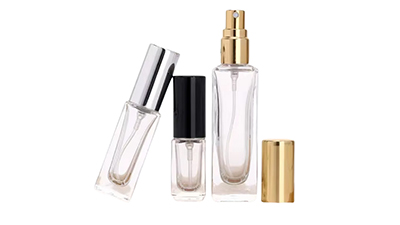
While the retail bottle is the star, the perfume tester bottles are the workhorses of the industry. They are the unsung heroes that sit on the counter, handled by hundreds of people daily.
Is it Durable Enough for Retail Abuse? A retail bottle sits on a vanity. A tester is dropped, banged, and wiped with alcohol constantly.
- Wall Thickness: Standard perfume tester bottles often use a slightly thicker glass distribution than their retail counterparts to withstand impact.
- The “No-Cap” Economy: Testers rarely come with the decorative heavy cap. They often ship in plain white corrugated boxes (“Tester Cartons”) to save cost.
The Supply Chain Strategy: Smart brands do not mold a separate bottle for testers. They use the same glass run.
- The Difference: It is in the decoration. The retail bottle might have hot-stamping and a metallic spray coating. The tester bottle usually has the branding simply silk-screened to save money, with the word “TESTER” legally printed to prevent resale.
- Sourcing Tip: When ordering your 20,000 retail units, always add 5-10% extra volume as “decoration-free” units to serve as your perfume tester bottles. This lowers your overall average unit cost.
3. The Heritage Trend: Reproducing Antique Aesthetics
There is a massive resurgence in the demand for antique perfume bottle designs—heavy crystal, elaborate cuts, and ground glass stoppers. This is driven by the “Niche Perfumery” market, which wants to signal history and luxury.
Is it Real Crystal or “Super Flint”? True antique glass perfume bottles from the 19th century were often made of Lead Crystal.
- The Problem: Lead is toxic and illegal in modern cosmetic packaging in many jurisdictions.
- The Solution: We use Super Flint (Extra White) glass. By using high-purity sand and removing all iron content, we achieve the refractive index (sparkle) of crystal without the lead.
The Stopper Mechanics: An authentic antique perfume bottle used a “Ground Glass Joint.” The glass stopper was ground with sand to fit perfectly into the glass neck, creating an airtight seal without plastic.
- Modern Reality: This is too expensive and prone to leakage for shipping.
- The Hybrid: We manufacture bottles that look like antiques with heavy cut-glass patterns, but the neck is a standard FEA 15 crimp neck. We then create a heavy cap that mimics a glass stopper but hides a modern pump underneath. This gives the aesthetic of antique glass perfume bottles with the functionality of a modern spray.
4. Sourcing Tactics: “Old” vs. “New” Manufacturing
When you search for antique perfume bottle suppliers, you will find two types of products.
- True Vintage: These are for collectors, sold individually. Not scalable for a brand.
- Vintage-Style Production: This is what we supply.
The “Fire Polishing” Secret: To make a new bottle look like a high-value antique, we use a technique called Fire Polishing.
- Process: After the bottle leaves the mold, it passes through a flame. This melts the outer microscopic layer of the glass.
- Result: It smooths out the “mold seam” (the line where the mold halves meet). An antique perfume bottle rarely had visible seams. Fire polishing removes the seam and gives the glass a “liquid,” glossy finish that feels hand-blown.
5. Real-World Case Study: The “Art Deco” Resurrection
The Client: L’Heure Dorée (A revivalist fragrance house based in Paris). The Concept: They wanted to launch a line inspired by the 1920s. They specifically requested a design based on a rare antique glass perfume bottle found at an auction—a geometric, fan-shaped bottle with a “tiara” stopper.
The Challenge: The client initially tried to produce this shape with a budget manufacturer using standard Flint glass.
- Failure 1 (The Color): Standard glass has a green tint. The “Art Deco” clear lines looked muddy.
- Failure 2 (The Cap): They used a standard plastic cap that looked too light. It ruined the “antique” illusion.
- Failure 3 (The Leak): The fan shape had sharp corners. The glass was thinning at the corners, leading to breakage during shipping.
The Solution: We engineered a solution for their commercial run.
- Material Upgrade: We switched to High-White Super Flint glass. This provided the “diamond-like” clarity essential for the vintage look.
- Corner Radius: We subtly rounded the sharp interior corners of the mold (invisible to the eye) to improve glass flow and thickness, reinforcing the structural integrity.
- Surlyn Cap Technology: Instead of cheap plastic or heavy glass (which breaks), we used Surlyn (a resin) for the “Tiara” cap. Surlyn mimics the transparency and weight of glass but is unbreakable. It allowed us to mold the complex “antique” stopper shape perfectly.
The Result: The product launched as a “Modern Classic.” Customers praised the weight and feel, believing it to be glass-on-glass. The brand successfully charged a 40% premium over competitors because the packaging communicated “Heirloom Quality.” They now order this custom antique perfume bottle design in batches of 50,000.
6. Manufacturing Checklist: Before You Order
Whether you are ordering a novelty perfume in shoe bottle or a standard cylinder, your Purchase Order must contain specific technical data.
1. The Neck Standard:
- Are you using FEA 15 or FEA 20? (The standard crimp sizes).
- Warning: Some antique glass perfume bottles reproductions use “screw necks.” Ensure your pump supplier has a matching screw-on pump, or you will have unsealable bottles.
2. The Decor Limit:
- If you are doing a perfume in shoe bottle, the surface is curved. You cannot use standard silk-screen printing. You must use “Pad Printing” or “Water Transfer Decals” to get the logo onto the curved heel.
3. The Vacuum Test:
- Always demand a vacuum leakage test report. A beautiful bottle is useless if the micro-roughness of the sealing surface (“the land”) prevents the pump gasket from sealing.
Conclusion: Glass is the First Note
In perfumery, we talk about top notes, heart notes, and base notes. The bottle is the “Pre-Note.” It is the signal that tells the brain what to expect.
A perfume in shoe bottle screams fun, night-out, and rebellion. Antique glass perfume bottles whisper elegance, tradition, and sophistication. Perfume tester bottles speak of utility and confidence in the scent itself.
Your choice of glass defines your market position. Don’t let manufacturing defects mute your message.