 GlassBottleSupplies











Sales manager will contact you within 24 hours
Custom Essential Oil Bottles: The Science of Surface Finish
In the essential oil market, the “unboxing experience” is the first step in therapeutic healing. Before a customer smells the Lavender or Peppermint, they feel the bottle. The texture of the glass, the permanence of the print, and the depth of the color convey the value of the product inside.
However, for a brand manager, achieving a premium look is fraught with technical pitfalls. Essential oils are powerful solvents. They dissolve glues, strip cheap paints, and cloud inferior plastics. A beautifully designed essential oil bottle can turn into a sticky, peeling mess in the hands of a customer if the surface treatment is not engineered for chemical resistance.
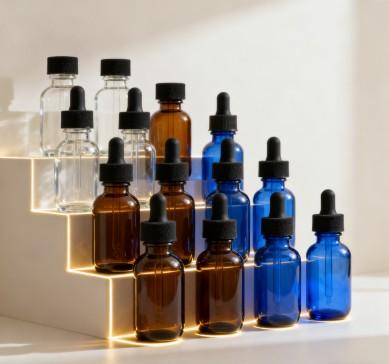
This guide explores the “Is It vs. Why” of glass decoration, helping you navigate the complex world of frosting, spraying, and printing for essential oil bottles.
The “Is It?” Question: Frosting vs. Coating
One of the most popular trends in luxury aromatherapy is the matte, frosted look. It diffuses light, hides fingerprints, and feels “soft” to the touch. But not all “frosted” glass is created equal.
1. Spray Frosted (The Imitation)
Is it real frosting? No. This is a clear glass bottle sprayed with a semi-transparent matte lacquer.
- The Problem: While cheap and capable of being colored (e.g., pink frost, blue frost), this is a surface layer.
- The Risk: If undiluted essential oil drips down the neck—a common occurrence—it can act as a solvent. The “frost” may bubble or peel off, leaving the clear glass underneath exposed. This looks disastrous on a premium product.
2. Acid Etched (The Standard)
Is it real frosting? Yes. This is a subtractive process. We dip the essential oil bottles into a bath of Hydrofluoric Acid.
- The Why: The acid chemically eats away the smooth top layer of the glass, creating a microscopic rough surface.
- The Benefit: Since there is no coating to peel, the frosting is permanent. It is part of the glass itself. It is impervious to even the most aggressive citrus oils or carrier oils.
Printing Logic: Silk Screen vs. Labels
When branding your essential oil roller bottles, you have two choices: apply a sticky label or print directly on the glass.
Why Direct Printing Wins for Oils
Paper or plastic labels rely on adhesives. Over time, oil vapors (“terpenes”) can migrate through the label material or seep under the edge, dissolving the glue. This causes “flagging” (where the label corner lifts up).
High-Temperature Silk Screen Printing is the solution for essential oil bottles.
- The Process: Ceramic ink is pushed through a mesh screen onto the bottle.
- The Firing: The bottle is then passed through a lehr (oven) at roughly $600^\circ C$.
- The Result: The ink fuses with the glass. It becomes scratch-resistant and completely immune to oil damage. You can scrub it with alcohol, and the logo will not fade.
The Design Challenge of Essential Oil Roller Bottles
Essential oil roller bottles (typically 10ml) present a unique challenge due to their small surface area and high friction usage (being carried in pockets and purses).
Hot Stamping: The “Luxury” Trap
Many brands want a shiny gold or silver logo (Hot Stamping).
- The “Is It” Issue: Hot stamping uses a thin foil pressed onto the glass with heat and a bonding agent.
- The Durability Check: Unlike ceramic silk screening, foil sits on top of the glass. On a roller bottle that rubs against keys and phones in a bag, this foil can scratch off.
- Our Solution: For essential oil roller bottles, we recommend “Decal Printing” or double-pass screening for metallic looks, or ensuring a UV-cured protective clear coat is applied over the foil to seal it against abrasion.
Gradient Color Spraying
A popular trend is the “Ombre” look (e.g., fading from opaque blue to clear).
- The Technique: This is achieved via electrostatic spraying.
- The Warning: As mentioned with frosting, sprayed paint is vulnerable. For roller bottles, we insist on using Epoxy-based paints rather than standard acrylics. Epoxy offers superior chemical resistance against the “drip-back” that occurs when the roller ball is used.
Electroplating: When Metal Meets Glass
For the ultra-luxury segment, brands sometimes request fully metallic-looking bottles (Gold, Rose Gold, Chrome). This is done via Vacuum Metallization (UV Electroplating).
- The Mechanics: The glass is placed in a vacuum chamber, and aluminum vapor is condensed onto the surface.
- The Critical Flaw: Metal blocks light completely (good for UV protection), but if the plating is internal, it can react with the oil.
- The Rule: Electroplating must always be on the external surface of essential oil bottles. Furthermore, the neck area (where the cap threads screw on) should ideally remain clear/unplated. If you plate the threads, the friction of screwing the cap on and off will grind the plating into dust, which falls into the oil.
Case Study: The “Matte Black” Peeling Disaster
Client: A men’s grooming brand launching a beard oil line (which uses similar carrier oils to aromatherapy blends).
The Product: A “Midnight Edition” Sandalwood blend in a 30ml Matte Black bottle.
The Problem:
The client originally sourced “Matte Black” bottles from a low-cost supplier. After 2 months of inventory storage, they noticed white spots appearing on the black bottles. Worse, when customers used the product, the black “paint” would stick to their hands if a drop of oil ran down the side.
- The Diagnosis: The bottles were clear glass sprayed with a cheap, non-cured rubberized paint. The Sandalwood oil (a solvent) was eating through the paint.
The Solution:
We transitioned the client to Black Solid Glass (or UV-Blocking Violet Glass) for the ultimate solution, but due to budget constraints, they needed a coated option.
- Process Change: We used a clear glass base but applied a High-Temperature Water-Based Spray.
- Curing: The bottles were baked at $180^\circ C$ to cross-link the paint polymers.
- The Test: We performed a “24-hour Soak Test.” We submerged the painted bottle in the beard oil for 24 hours. No peeling, no softening.
The Result:
The brand relaunched the “Midnight Edition.” The tactile feel was harder and more ceramic-like, which customers associated with higher quality. Returns due to “defective packaging” ceased immediately.
How to Test Surface Quality (A Buyer’s Guide)
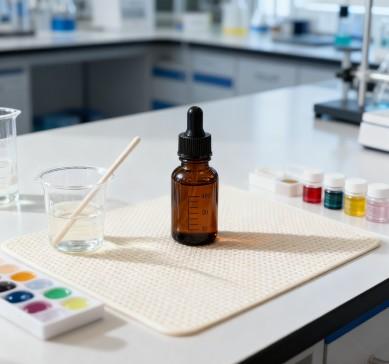
When you receive samples of customized essential oil bottles, do not just look at them. You must torture them. Here is the standard protocol we recommend to our B2B clients:
1. The Tape Test (Adhesion)
- Take a piece of industrial-grade adhesive tape (like 3M Scotch tape).
- Press it firmly over the printed logo or the sprayed color.
- Rip it off quickly at a 90-degree angle.
- Pass: Nothing comes off.
- Fail: Flecks of gold foil or paint are stuck to the tape.
2. The Solvent Rub Test (Chemical Resistance)
- Soak a cotton pad in pure Alcohol (Ethanol) or Acetone (if testing for extreme durability). Alternatively, use the essential oil you plan to sell (e.g., Lemon Oil).
- Rub the surface of the essential oil roller bottles vigorously 50 times.
- Pass: The color does not transfer to the cotton; the gloss level remains the same.
- Fail: The cotton turns the color of the bottle; the logo blurs.
3. The Scratch Test (Hardness)
- Use a coin or a key.
- Scratch the surface of the bottle with moderate pressure.
- Note: Acid-etched frosting will show a metallic mark (from the coin) that wipes off. Sprayed frosting will physically scratch, removing the coating. This is the easiest way to tell the difference between “fake” and “real” frosting.
Technical Specifications for Customization
When ordering customized essential oil bottles, include these terms in your Purchase Order (PO) to ensure professional results:
| Feature | Specification Key | Why it matters |
| Decoration Area | “360-degree” vs. “Single Face” | Determines if the print wraps around the whole bottle. |
| Print Type | “High-Temp Ceramic Silk Screen” | Ensures the logo is permanent and dishwasher safe. |
| Frosting Type | “Acid Etching” | Prevents peeling and offers a premium tactile feel. |
| Color Matching | “Pantone C (Coated)” | Ensures the bottle color matches your brand book exactly. |
| Neck Finish | “Masked Neck” | Ensures no paint gets on the threads (prevents contamination). |
Conclusion
In the competitive world of essential oils, your bottle is your silent salesman. A heavy, acid-etched bottle with crisp, fired-on printing tells the consumer, “This oil is pure, stable, and valuable.” A peeling, sprayed bottle suggests, “This product is cheap.”
Don’t let the packaging betray the quality of your formulation. Whether you need sleek essential oil roller bottles with durable ombre finishes or classic amber bottles with ceramic printing, the technology of the surface is just as important as the shape of the glass.